The eighteen outfits below range from a $40 puffer vest to a four-figure leather coat, and the one that belongs to you depends on whether your winter is a dry forty-five degrees or a slushy twenty with wind. Most of these fail somewhere specific: the ballet flat dies at the first salted sidewalk, the slip skirt quits below forty, the statement coat only works if your boots can handle the miles you will actually walk in them. The Lands’ End Down Puffer Coat and Quince’s slim-cut vest both made the cut because they solve the shape problem most winter outerwear ignores, not because they are the warmest options on the rack.
1. Corduroys, Sweater, and Ballet Flats
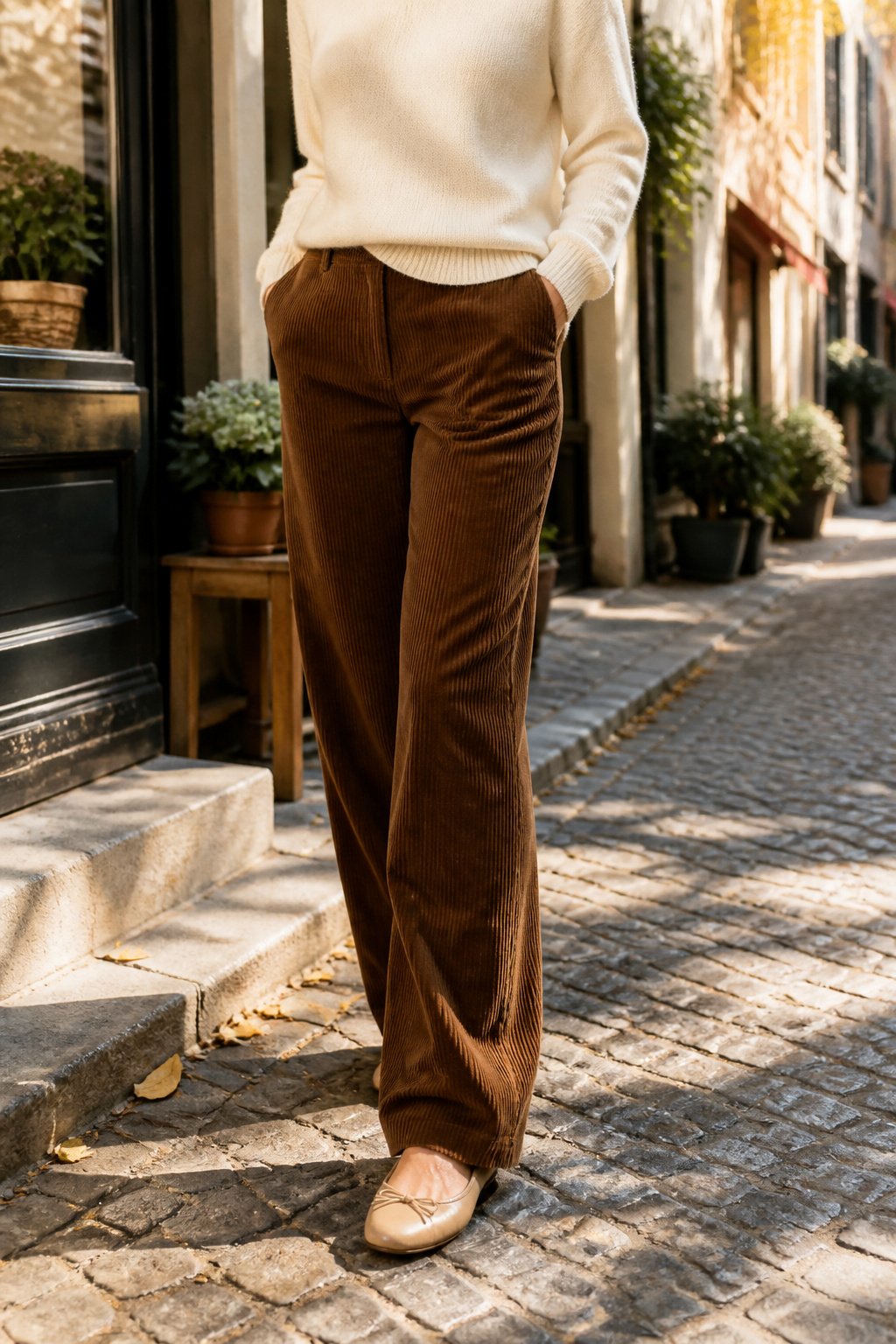
FRAME cords carry more texture than denim without the bulk of wool trousers, which makes them an easy swap when you want something that reads as intentional but still feels like weekend wear. The wale catches light differently than flat cotton, so a simple sweater, something in a neutral stripe or solid cream, does enough of the work without competing. Ballet flats from Margaux or Larroudé finish it, though this is strictly a dry-day choice; once sidewalks turn slick or slushy, the thin sole and open throat leave you cold and unstable. For that reason, this outfit lives in the gap between seasons or on clear January afternoons, not through a full Northeast winter. Keep a pair of commuter boots in the car and you get the look without the risk.
2. Jeans, Booties, Turtleneck, and Puffer
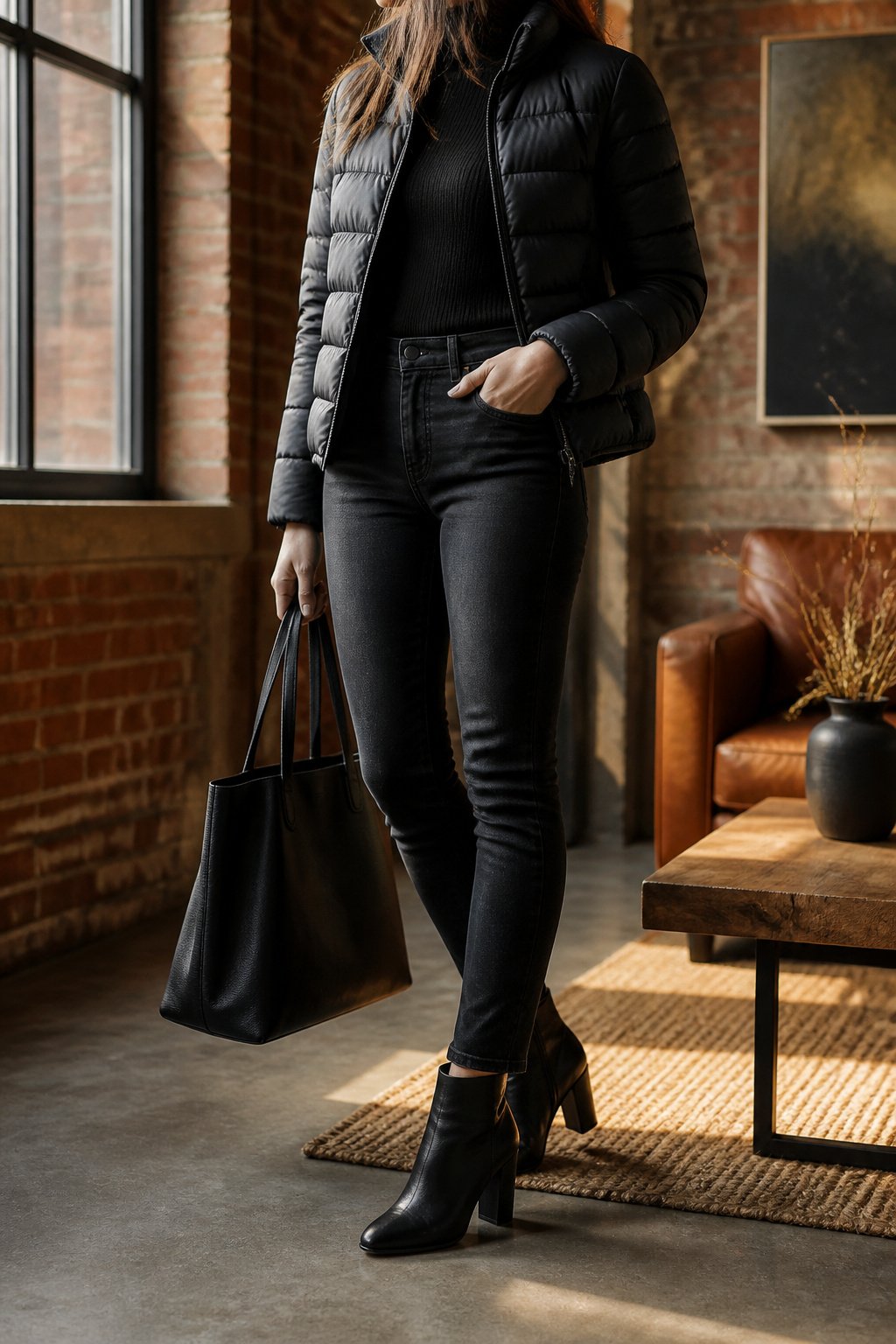
Dark jeans and ankle booties are the backbone of this particular uniform, and the piece that makes it winter-ready is a down puffer that actually fits. The Lands’ End Down Puffer Coat has the clean, straight cut that keeps bulk from swallowing the frame, but the real move is what sits underneath. A fitted turtleneck, tucked or half-tucked, draws a slim line from shoulder to hip so the puffer reads as intentional volume rather than accident.
The booties matter for proportion. A heel height close to the shaft of the jean, somewhere in that 40-pair range most of us accumulate, keeps the ankle from looking chopped. I pair mine with a mid-rise ankle jean that hits right at the bootie top, no gap, no bunch.
The mistake is sizing the puffer to fit over thick layers. Buy for the turtleneck, not for the sweater-over-turtleneck you might wear once. The coat should close cleanly with just that base layer; add a cardigan only on days cold enough to leave it open. That balance, slim inside and structured out, is what makes this look pulled together instead of padded.
3. Jeans, Sneakers, Button-Down, and Light Layer
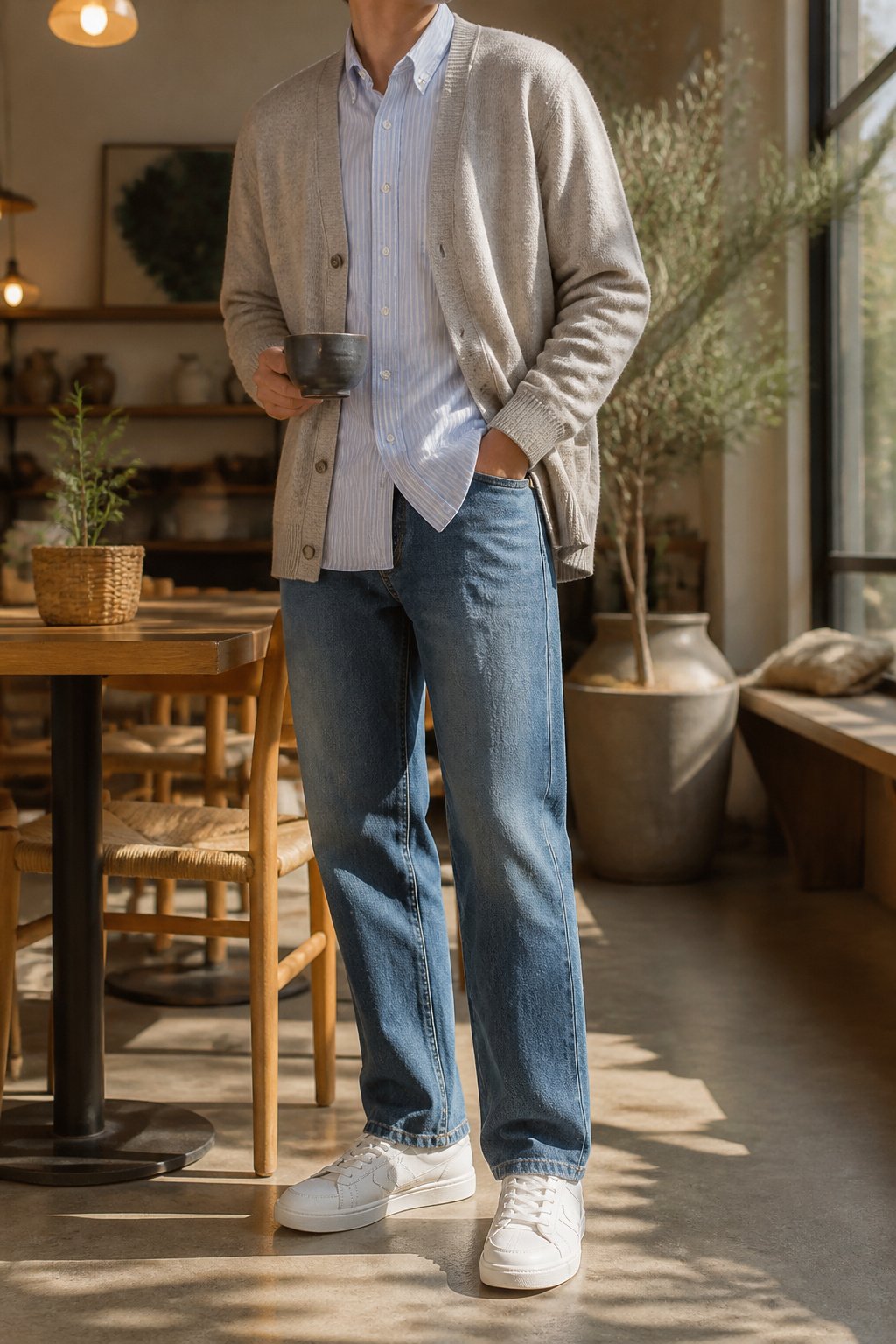
A pair of Cariuma white sneakers hits that sweet spot between clean and casual without looking like you just left the gym. The trick is keeping the rest of the outfit structured enough that the sneakers read as intentional, not leftover.
Straight-leg jeans give the right proportion underneath, and a button-down shirt layered under a cardigan or light jacket solves the temperature problem most winter days actually present: overheated offices, sunny sidewalks, then a shaded bus stop. The button-down sits flat and breathable against your skin, and the cardigan peels off without disturbing the whole look. A barn coat works for the outer layer if you need more warmth; the sneakers still ground it.
Two ways to play the shoe angle. Cariuma’s canvas stays crisp-looking longer than you’d expect, and the leather Veja Campo holds up similarly if you want a slightly dressier option. Birkenstock clogs swap in cleanly if you want zero heel but more coverage than a sneaker, and loafers with sheer socks tilt the same outfit toward something you could wear straight through dinner.
The real win here is adaptability. You are dressed for 45 degrees and sunny, 65 degrees inside, or whatever combination the day throws at you, without the bulk of a full winter kit you will end up carrying.
4. Striped Sweater, Wide Leg Denim, and Kitten Heeled Boots
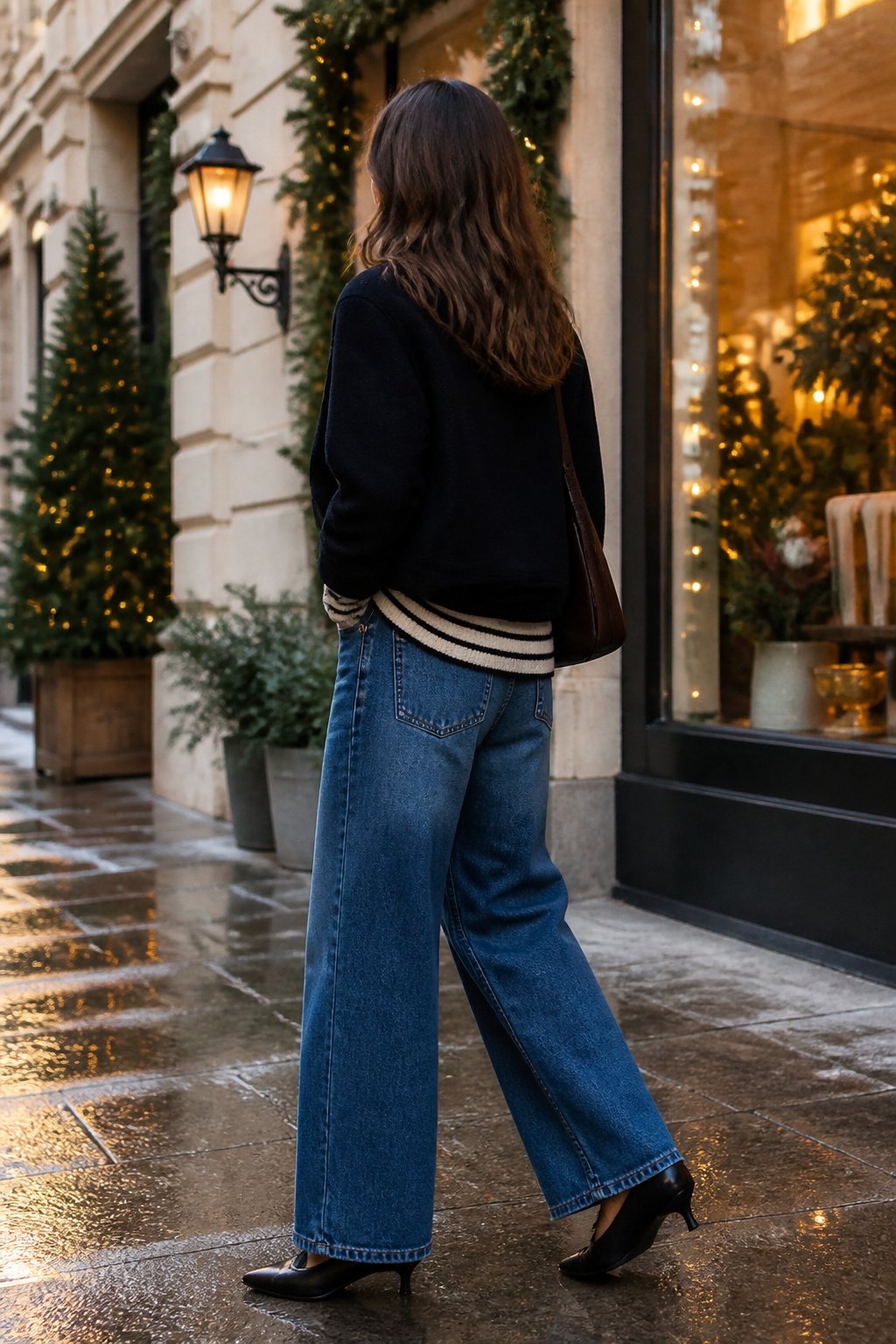
A striped sweater with wide leg denim and kitten heeled boots borrows enough polish from office-adjacent styling to feel intentional without looking like you tried. The width of the denim is what makes the combination work for casual hours, but that same width creates a practical problem: the hem will drag on wet pavement or fray at the back if the heel is too low.
A kitten heel, roughly one and a half to two inches, lifts the denim just enough to clear the ground without shifting the whole look toward dressiness. Higher heels would read as evening or interview; flats would leave you hemming or hiking the waistband to compensate. The kitten heel sits in the middle ground where practicality meets proportion.
In this context, the heel’s modest height signals that you chose function first and let the polish follow. The stripe pattern on the sweater does similar work, borrowing from classic tailoring but rendered in wool or cotton rather than silk or crisp poplin. Wear it to a casual Friday that runs into dinner, or to weekend errands where you still want to look pulled together.
5. Faux Leather Maxi Skirt and Trench
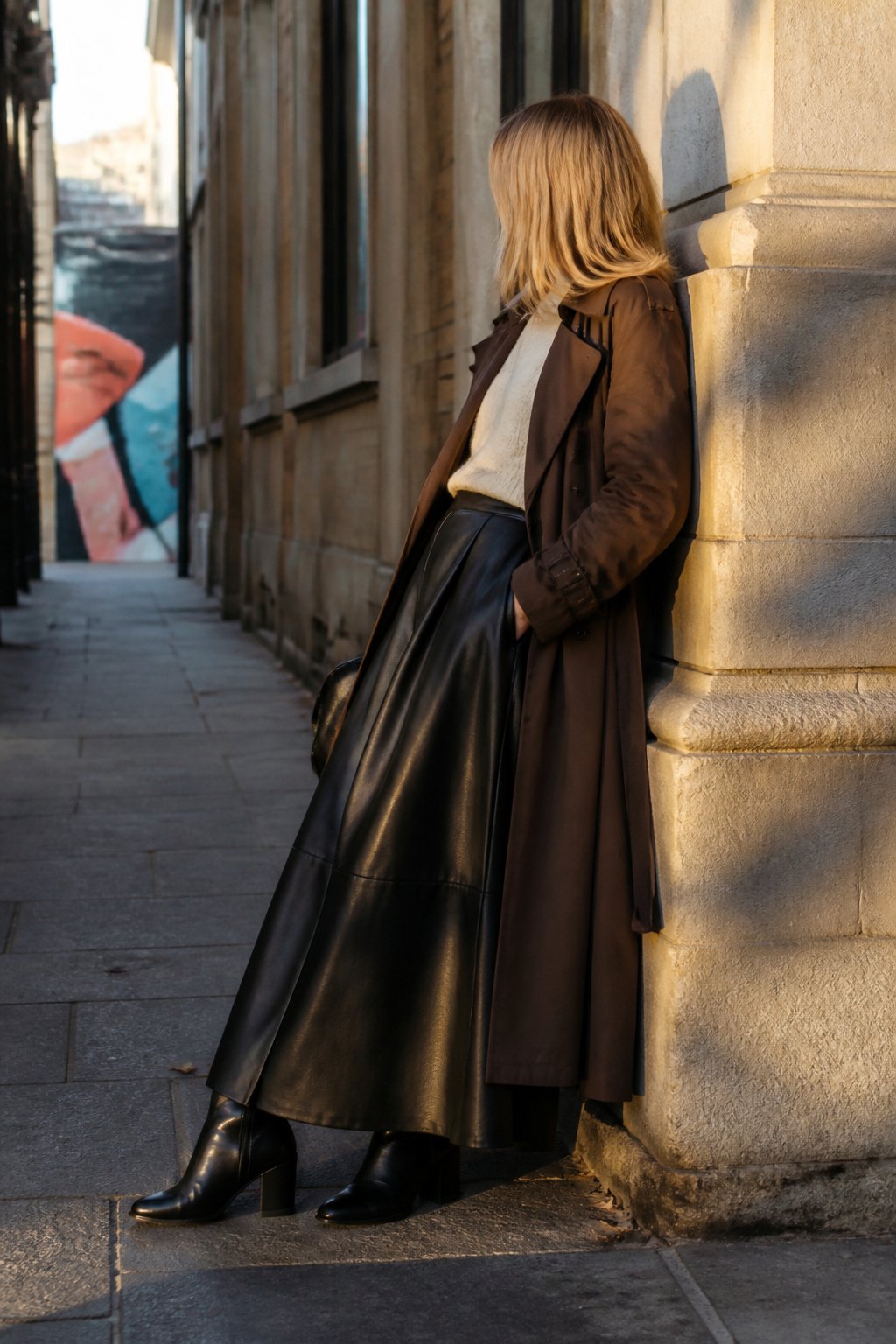
A faux leather maxi skirt does more for winter comfort than most people expect. The material itself blocks wind in a way woven fabrics simply do not, so the cold does not cut straight through on gusty days. Length matters just as much as composition here. A skirt that hits at the ankle leaves almost no gap for air to enter below a coat, which turns out to be the weak point in most skirt-based winter outfits.
The trench coat you layer over it needs to clear the hem by a few inches, not match it exactly. In real walking conditions, a coat that barely covers the skirt rides up with every stride, exposing the break to wind and rain. I look for a trench that falls to mid-calf or lower on my frame, which still shows enough of the skirt’s texture to keep the outfit from looking like a uniform. A gap of two to three inches between coat hem and skirt bottom stays covered through normal movement without swallowing the whole look.
For color, I keep the skirt in black or deep chocolate and let the trench do the talking. Camel reads classic; olive or burgundy gives the same structure with less predictability. Underneath, a thin wool turtleneck or fitted crewneck sweater provides warmth without the bulk that would fight the skirt’s line. Knee-high boots finish it, tucked under the hem so the silhouette stays continuous from shoulder to floor.
6. Cashmere Sweater and Satin Trousers
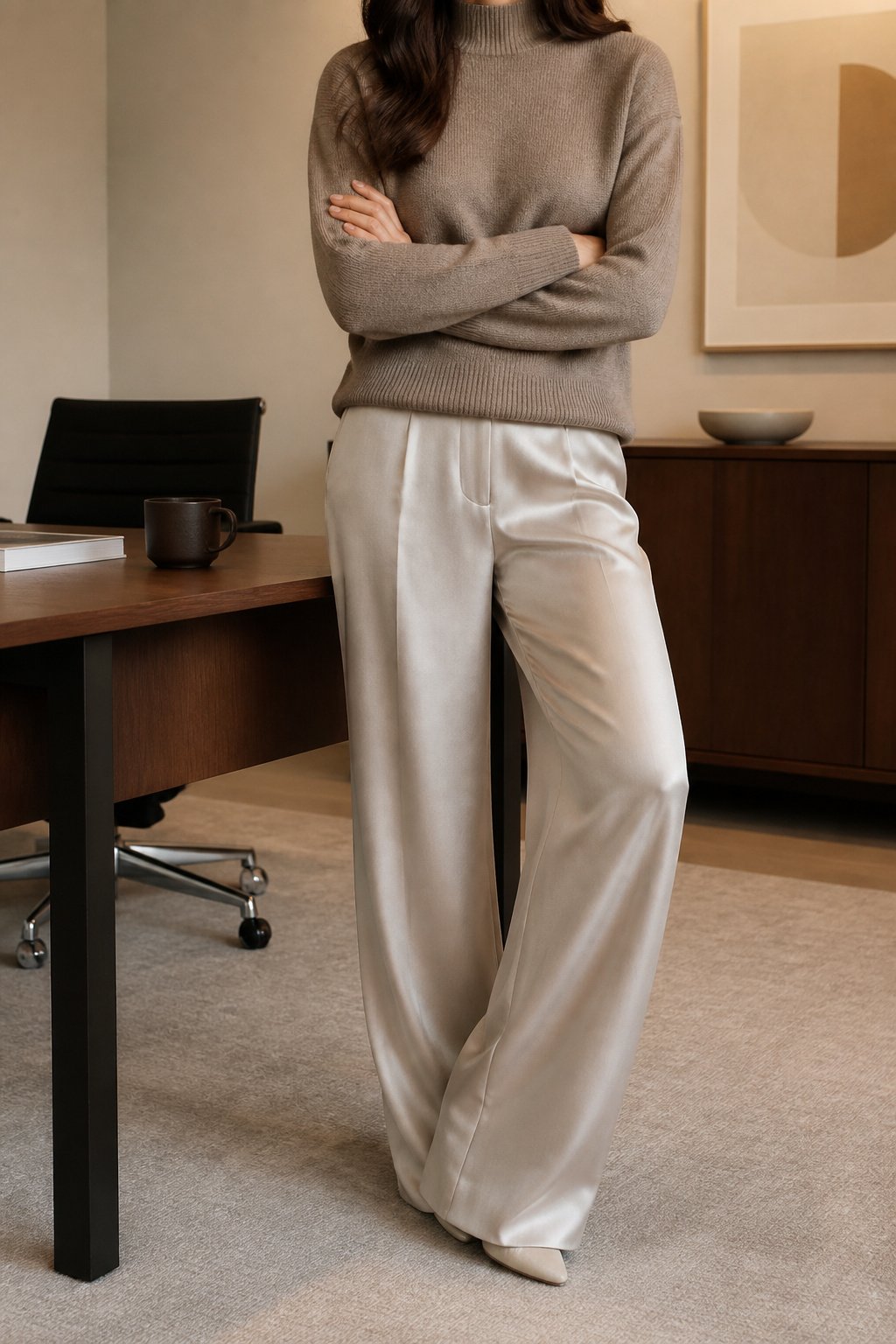
A 12-ply cashmere sweater is the weight that actually blocks winter wind without needing a coat indoors, and the hand changes noticeably from the featherweight versions sold for spring. The density sits right for office thermostats set to sixty-eight, and it keeps its shape through a day of reaching for coffee cups and laptop bags.
Satin trousers read dressed-up because of the light catch, but a relaxed drawstring waist or elastic back panel keeps them out of formal territory. The fabric does the work; you do not need a crease or a belt to signal intention. I pair mine in a tone slightly cooler than the sweater so the contrast reads as material, not mismatch.
This combination fills the Thursday spot in my weekly rotation: too polished for grocery runs, not stiff for a dinner that might end at a bar with sticky tables. The satin picks up cat hair and requires a lint roller in my bag, which is the trade I accept for an outfit that transitions without a change of shoes.
7. Sweater Dress and Tall Boots
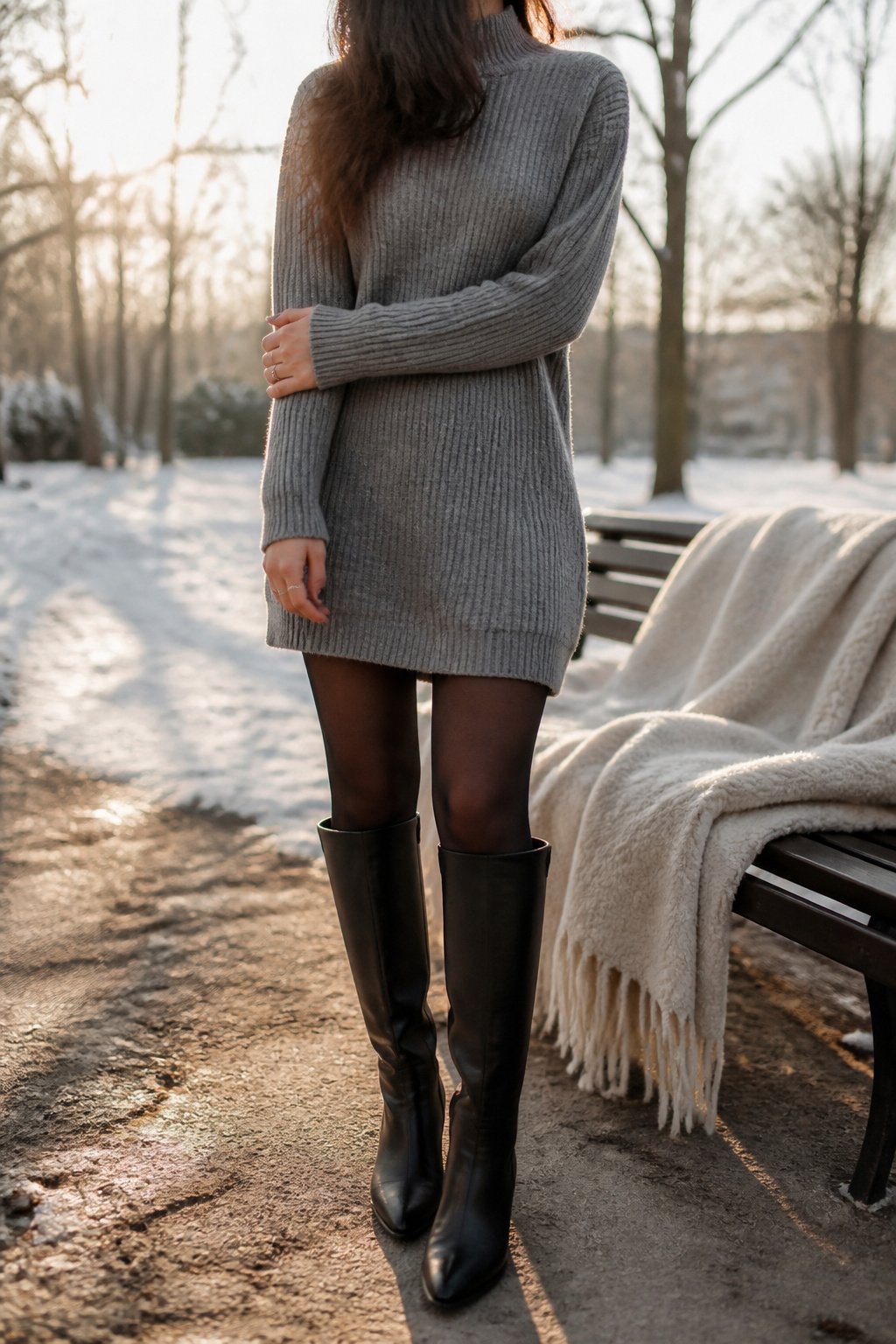
A sweater dress solves the morning decision fatigue of matching separates, but the boot question trips people up more than it should. The dress hem and boot shaft need to work like a sliding scale, not a fixed rule. A shorter dress, around mid-thigh, pairs cleaner with a knee-high or over-the-knee boot so the gap of exposed leg stays narrow. A longer sweater dress that hits above the knee can handle a mid-calf boot without looking chopped up, though the proportion reads more casual and a little school-days if the boot is too heavy.
Tights underneath are non-negotiable for warmth, and the weight matters more than the color. A 60–80 denier tight gives actual insulation without turning the dress into a sausage casing; anything sheer reads summer-in-winter and leaves you cold. Wool-blend tights cost more but do not sag at the knees by noon, which is worth the trade if the dress is fitted.
The "too short" worry is usually about context, not inches. A sweater dress in a thick rib knit worn with tall boots and dark tights reads covered-up despite the length, because the eye tracks the boot as part of the outfit rather than bare skin interrupting it. The boot shaft should cover at least half the distance between knee and hem for that continuous line to hold. Wear it to a Saturday market or a casual office with a long cardigan over top; the same dress with ankle boots and no tights is a different garment entirely.
8. Quilted Jacket as Centerpiece
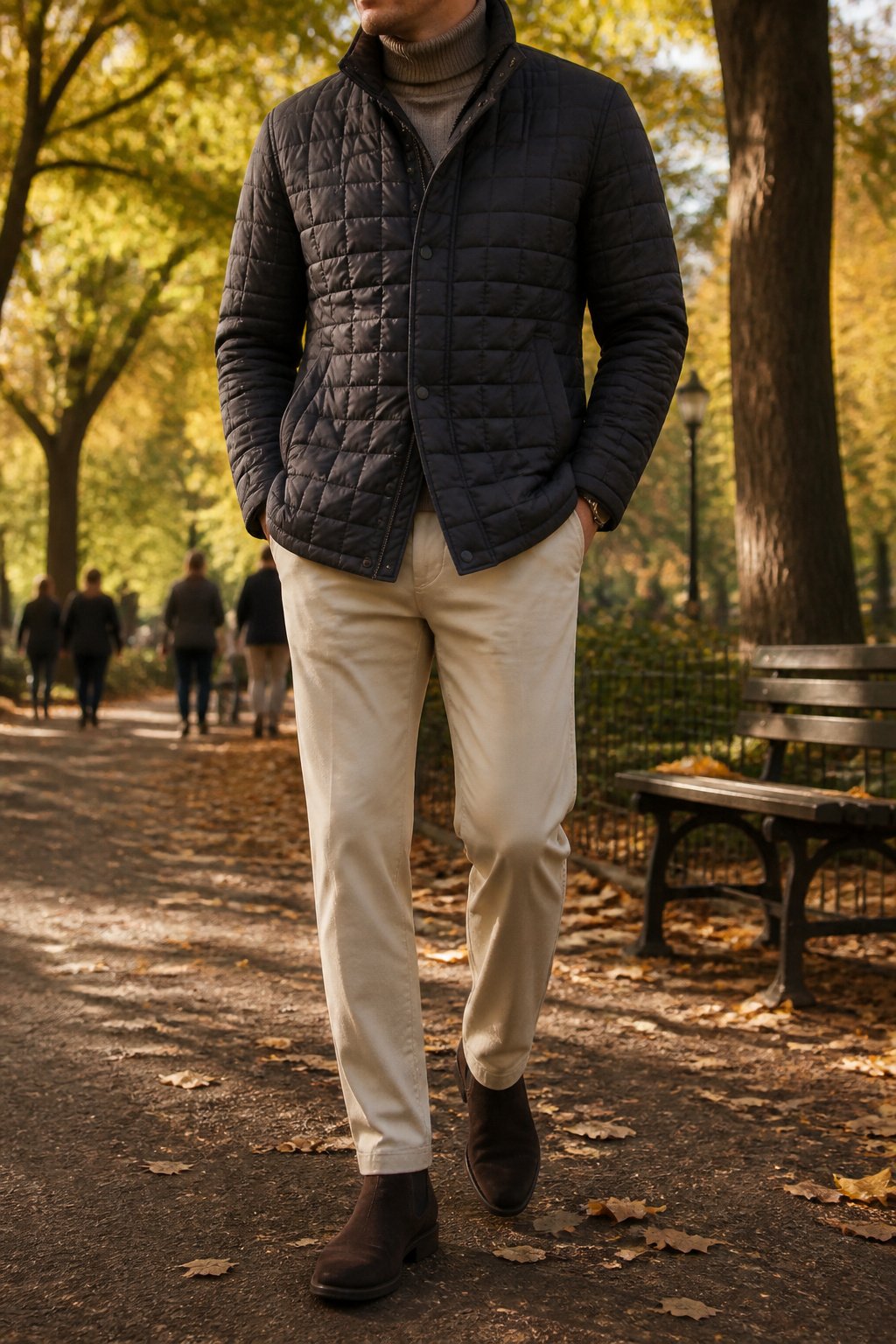
A quilted jacket carries enough structure to build an outfit around instead of throwing it on at the door. The channel stitching gives it a grid that reads deliberate, almost like outerwear with a tailor’s logic, where a generic puffer balloons outward and erases whatever you spent time choosing underneath.
The sweet spot for quilting alone sits somewhere between forty-five and fifty-five degrees. Below that, the thin batting compresses and the wind cuts through; above it, you end up carrying the thing by noon. What works underneath is the question that saves the silhouette. A fine-gauge turtleneck or a slim crewneck sweater slides in without fighting the seams; anything bulky at the shoulders or hips turns the jacket into a tent. I learned that the hard way with a cable-knit that looked fine alone and ridiculous once zipped.
The collar matters more than people notice. A stand collar in quilting frames the neck the way a blazer lapel frames a shirt; a hooded puffer swallows that line entirely. Choose the jacket first, then fit the layers underneath like puzzle pieces, and the whole thing looks considered rather than bundled.
9. Matching Knit Set
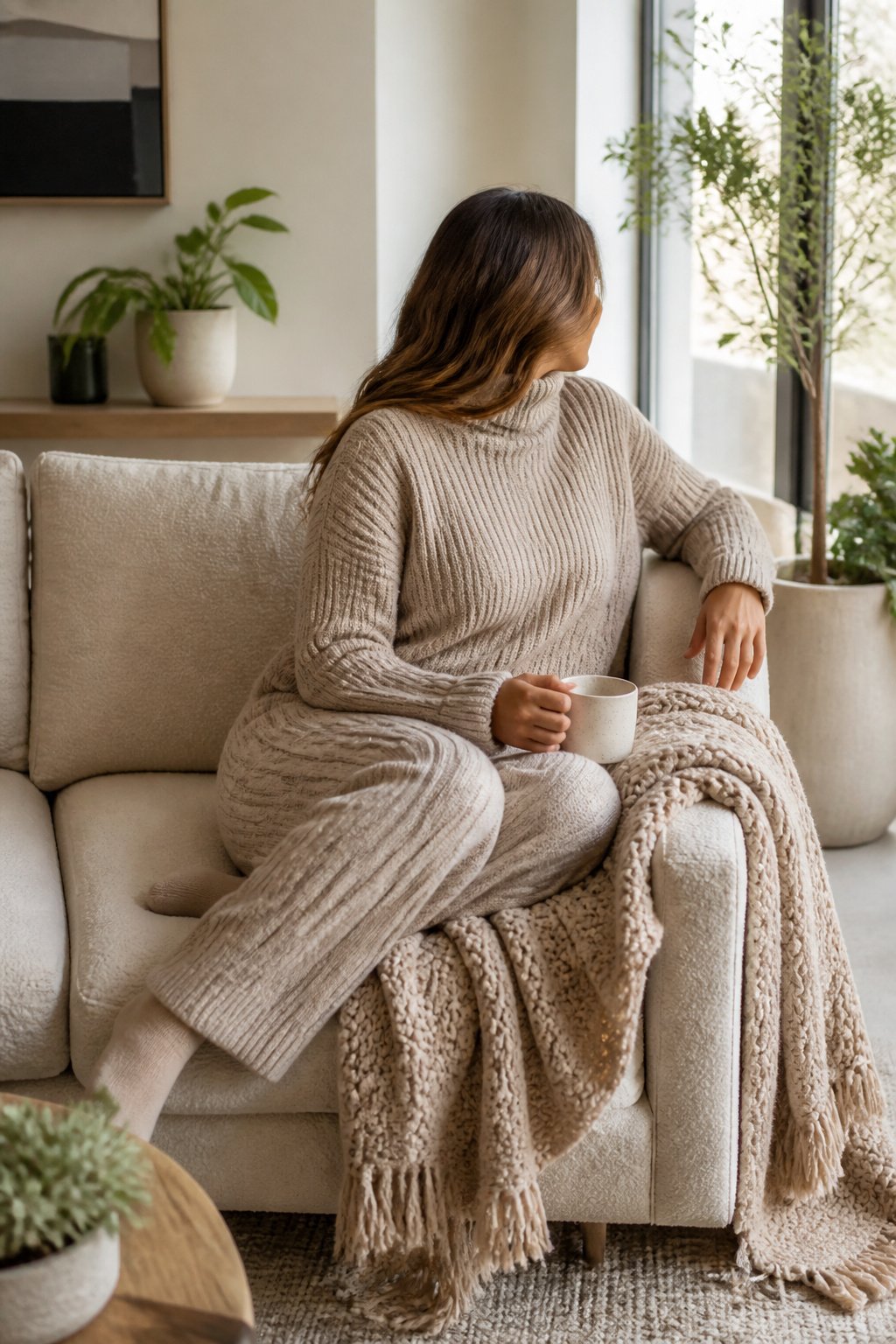
A matching knit set only looks coordinated when the top and bottom come from the same dye lot and fiber weight; two cream knits from different mills read as "close enough" under morning bathroom light and clash by noon. The pieces that hold up through a day of desk-to-errands sitting and standing have enough structure in the rib or gauge that the waistband doesn’t sag into a ripple and the sleeves keep their length when you’re reaching for a top shelf.
Sets from lines like Kilte or SPANX’s AirEssentials handle this better than the budget packs that look folded but pill after two washes. The real test is whether the set splits. A cropped cardigan from a matching knit set tucks into high-rise jeans easily; the wide-leg pant pairs with a tucked silk shirt for dinner. If the top is too cropped or the pant too lounge-specific, you’re stuck with one look. I look for a hem that hits near the hip bone and a pant leg that skims the shoe rather than pooling, so each piece has somewhere else to go.
10. Vest, Leggings, and Sneakers
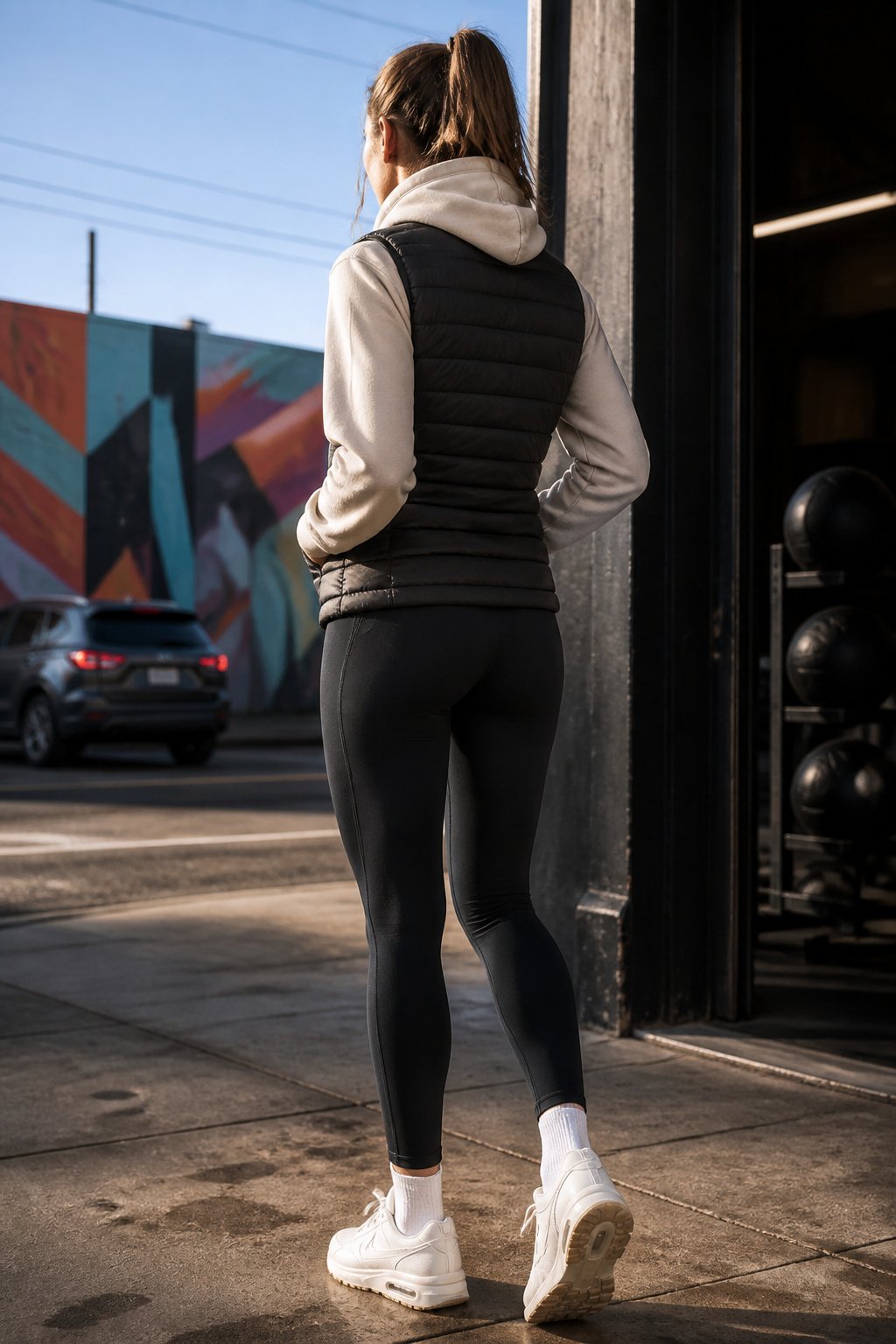
A vest instead of a full jacket changes how the whole outfit reads. Arms stay free, layers stay slim, and you do not overheat the minute you walk into a heated store or the gym lobby. Quince makes a puffer vest that fills this gap neatly: enough fill to signal winter, cut close enough that it does not look like outerwear you forgot to finish.
The legging question is where this pairing lives or dies. A standard 220-gram weight works for three-season athleisure, but in January it looks like you are refusing to admit it is cold. Something closer to a brushed fleece-back or a heavier synthetic knit, the kind that holds shape without going sheer at the knee, reads intentional for the season.
Sneakers finish it. Sportier pairs like the New Balance 327 hit the right note: not your running shoes, not trying to be dressy, just a clean sole that handles sidewalk salt. If you are coming straight from a workout, the Lululemon Down for It All vest layers more technically over sports bras without the bulk of a full coat. Either way, the vest keeps the silhouette vertical. A cropped puffer jacket would cut you in half; the vest lets the eye travel straight up.
11. Wool Coat, Skirt, and Sweater
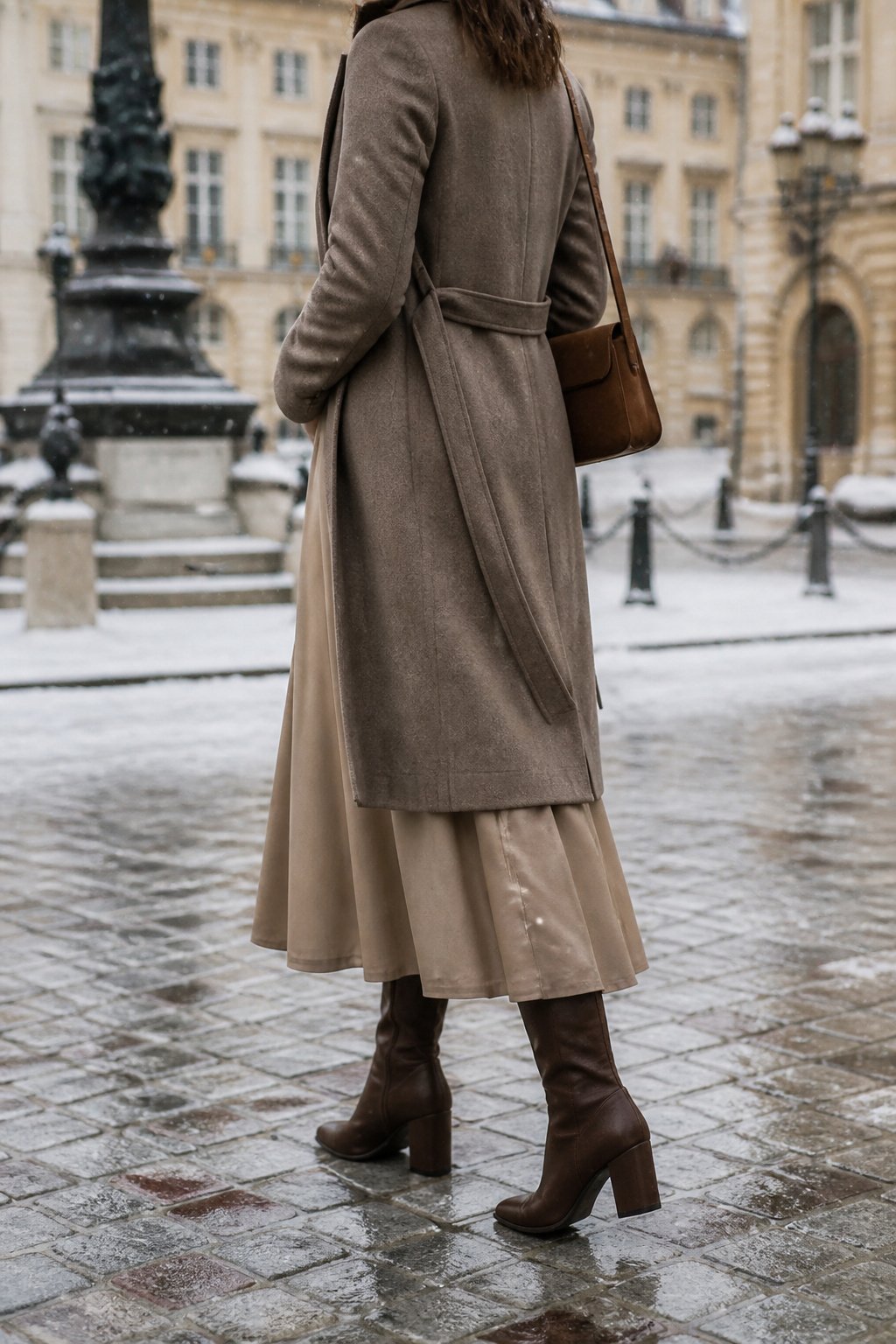
A skirt outfit in winter only works if the coat does the actual work. Minimum 24-ounce wool is what carries this combination through January, not the lighter stuff that looks right in the store and quits by the crosswalk. The Bernardo belted coat or Macy’s Walker Coat both land in that weight class, which is the difference between a wool coat that performs and one that poses.
Below it, a suede skirt or heavier knit midi hits tea length or just past the knee. That length matters for the coat-off moments, the walk from parking garage to office or the lunch where the coat comes off and stays off. Long enough to keep boots and tights doing their share, short enough that you’re not managing fabric every time you sit.
This is not the faux leather maxi skirt and trench combination. That look depends on the skirt itself blocking wind and the trench adding attitude more than insulation. Here the skirt is lighter, the coat is the entire thermal strategy, and the silhouette reads leaner because of it. The maxi-trench pairing works for milder days or shorter exposures; this one commits the warmth to the outer layer and keeps the lines underneath simpler.
12. Blazer, Jeans, and Booties
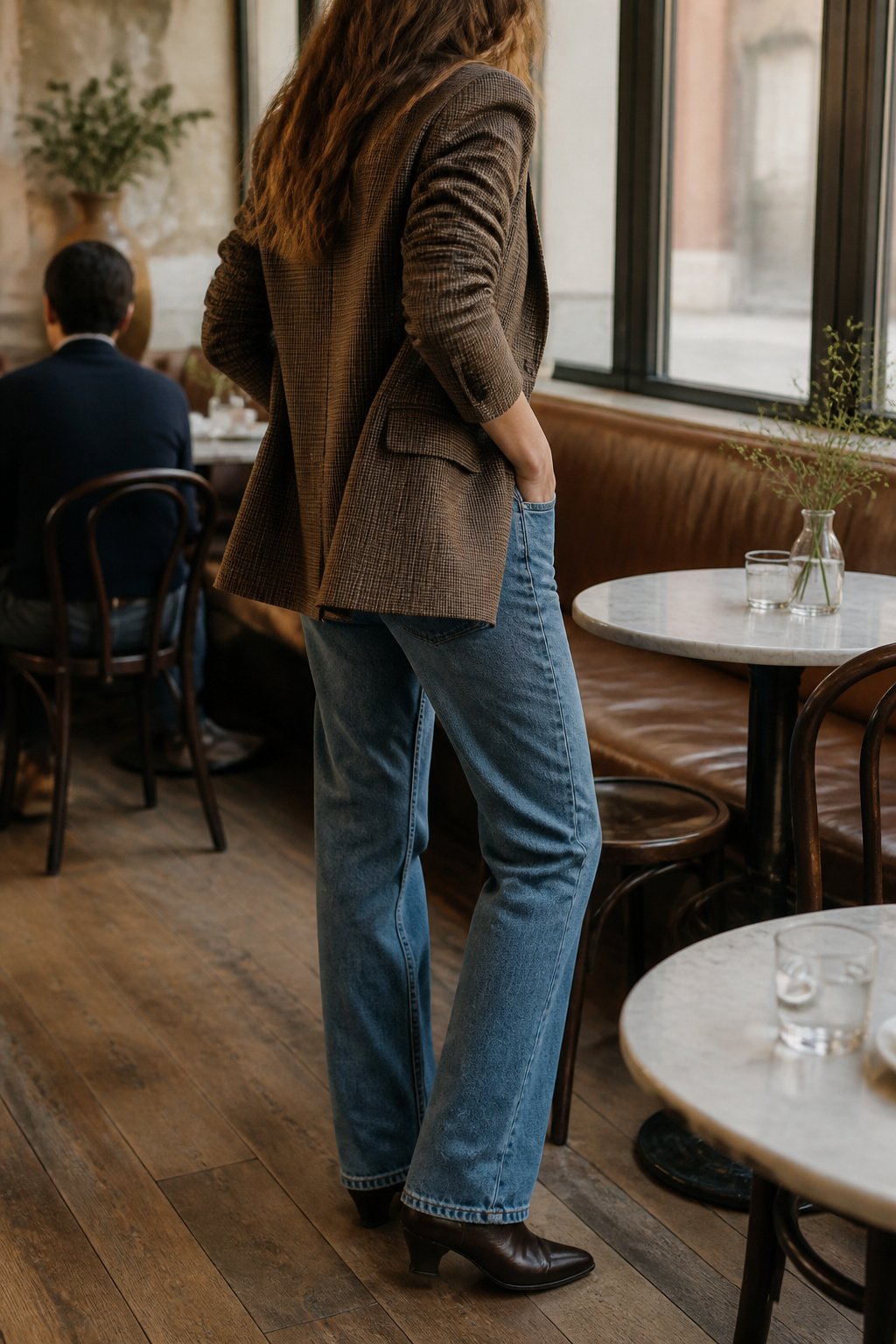
A blazer lifts denim from weekend to somewhere deliberate without asking you to swap the jeans themselves. The structure does the work: shoulders and a closed front read as intention, not effort. What matters is the bootie height against where the jacket hem lands. A cropped blazer, hitting near the high hip, pairs cleanly with a heel that rises 2–2.5 inches; anything taller starts to chop the leg line. Longer blazers that cover the seat need a lower shaft, maybe flat to one inch, or the proportions pool and the whole thing goes office-costume.
This combination fails in two places that matter for casual winter outfits. Wet weather is the first: most blazers worth wearing are wool or a wool blend, and water spots darken the sleeve and lapel in ways that do not brush out. The second is distance. That moderate heel height walks fine for errands, but a full day on your feet or a trek across parking lots will have you feeling the pitch by hour three. For those days, the blazer stays home and the puffer comes out.
13. Trench Coat, Button-Down, and Trousers
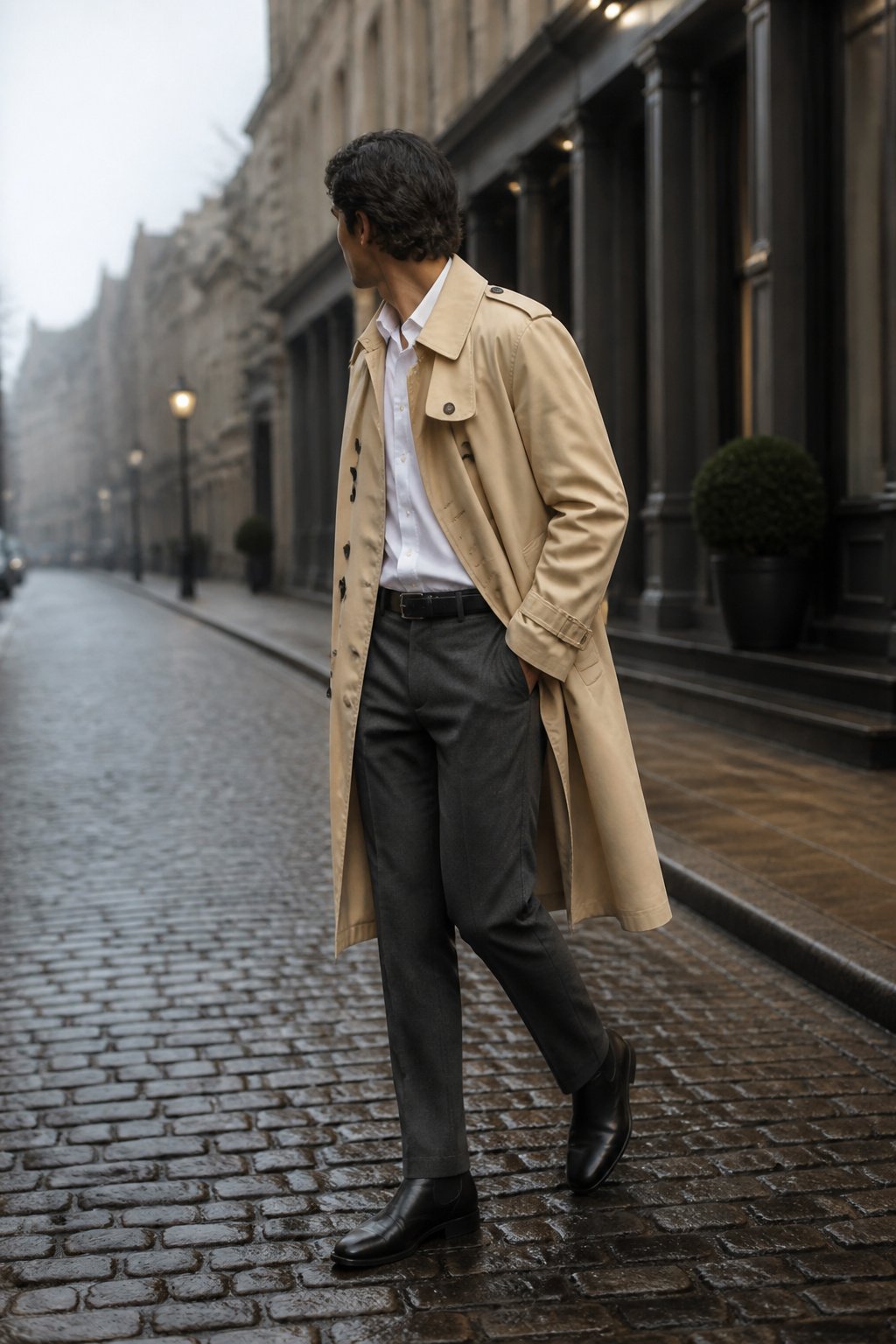
The trench does actual work in this outfit, not just posture. A real winter trench has a storm flap that channels rain off the shoulders, a throat latch you can button up to the neck, and enough weight in the fabric that it does not balloon in wind. Those details matter because the coat is the only barrier between you and a soaked shirt.
Trousers cut straight through the hip and thigh sit cleanly under the belt without the bunching that wider legs create. The On The Loose Ruti work pants manage this while staying comfortable enough to travel in, though they run expensive. The straight-leg silhouette keeps the belt line flat so the trench closes properly.
A button-down beats a tee here for the collar. The collar gives the trench neckline something to frame, and the placket adds a vertical line that reads as intentional rather than thrown-on. Cotton or a cotton blend with body, not drape, holds that line under the coat’s weight. A tee would collapse into a rumpled neckband the moment you add a scarf.
14. Statement Coat, Jeans, and Booties
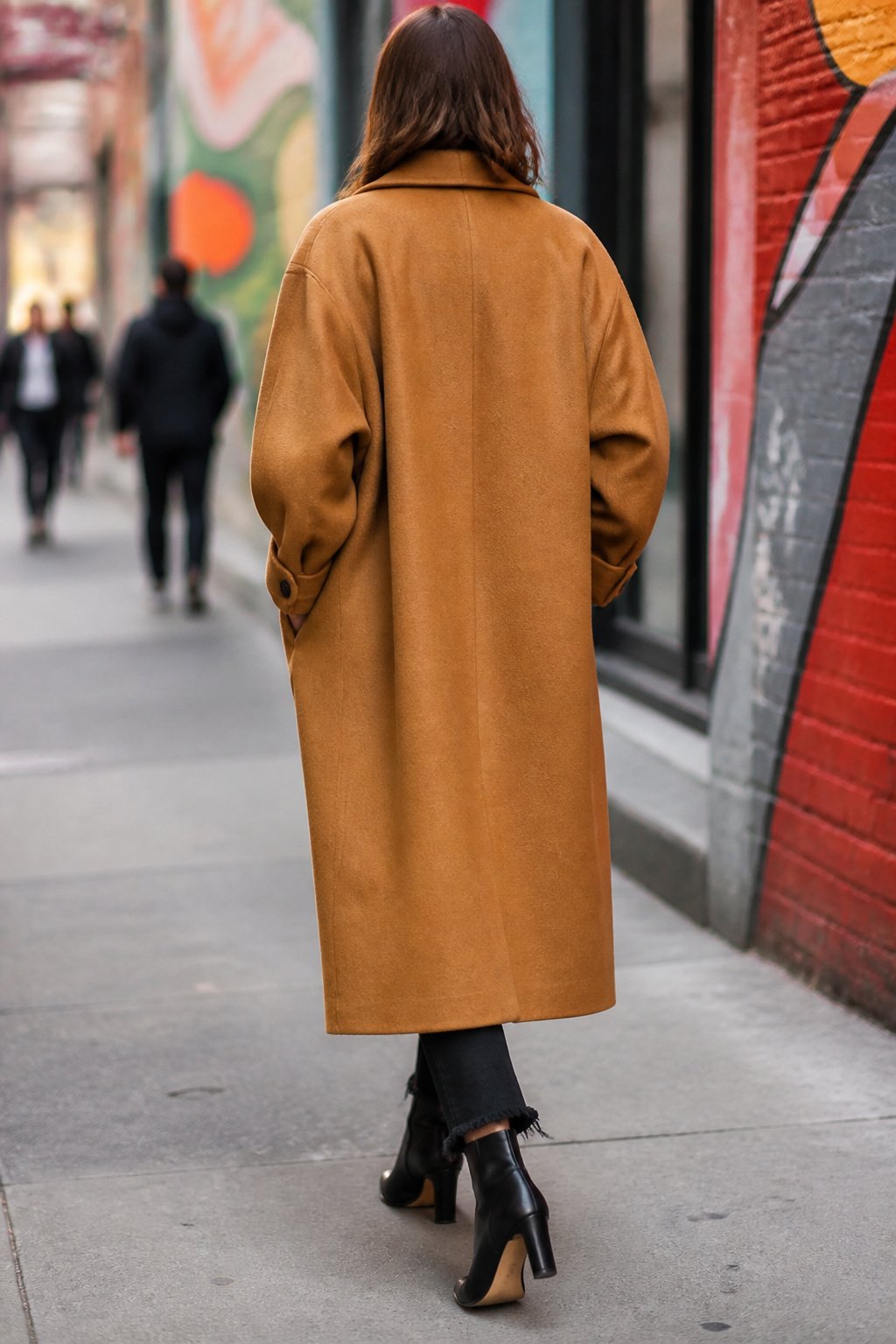
A camel or black coat in a long or mid-length cut does the heavy lifting here. The trick is knowing what "statement" actually means at your price point. At the upper end, Nour Hammour is making the strongest options right now. For more range, Revolve’s selection covers the middle ground. J.Crew and Abercrombie also hold up if you want pattern, like plaid, instead of another neutral.
The base underneath needs to stay quiet. Black jeans and a simple top are enough; anything louder competes with the coat instead of supporting it. This is where the outfit lives or dies.
For boots, the Margaux booties are the specific choice that holds up to repeated wear. They go with everything, which matters more than it sounds when you are reaching for the same pair three mornings a week. The coat gets the attention, but the boots do the miles.
15. Skirt, Sweater, and Booties
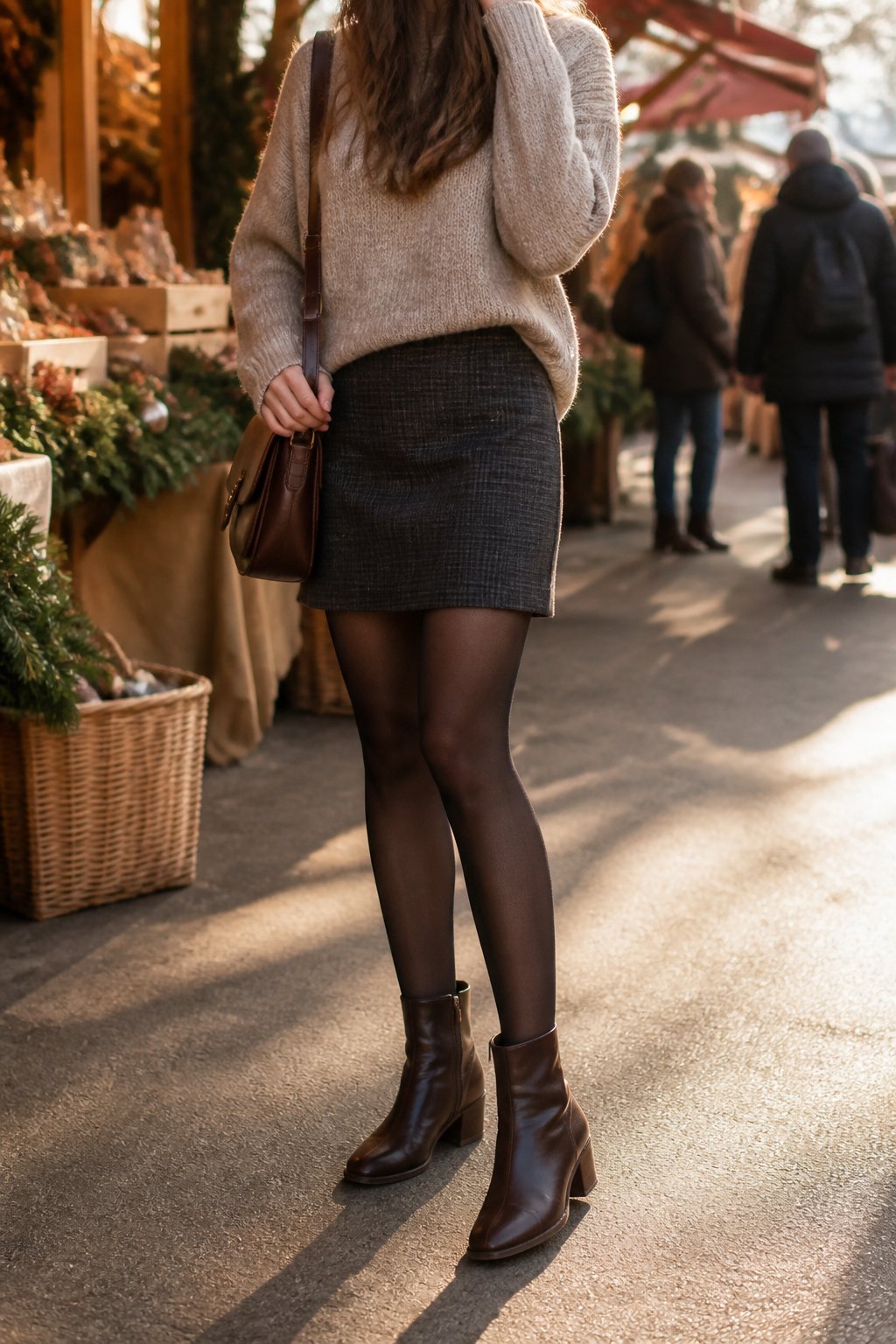
Ankle booties need a skirt that hits at least an inch above the boot shaft, or the whole leg turns into a solid block of fabric. Knee-high boots, on the other hand, pair cleanly with anything from mini to midi; the boot itself carries the visual weight. I learned this the hard way with a tweed skirt that grazed the top of my booties and made me look about four inches shorter.
Tucking changes everything. A full tuck with a cropped sweater gives you a defined waist and keeps the silhouette from going sack-like, but a half-tuck works better with bulkier knits; you get structure without the awkward bunching at the beltline. The trick is leaving just the front panel loose, not the sides.
Wool or cable-knit tights in 60–80 denier make this genuinely winter-appropriate, not the sheer 20-denier pairs that read as leftover from fall. Opaque black is the safe choice, but a charcoal or burgundy can pull the palette together if your sweater is neutral. Skip the patterned ones unless the skirt and sweater are both solid; two textures plus a pattern is where this combination falls apart.
16. Leather Pants and Sneakers
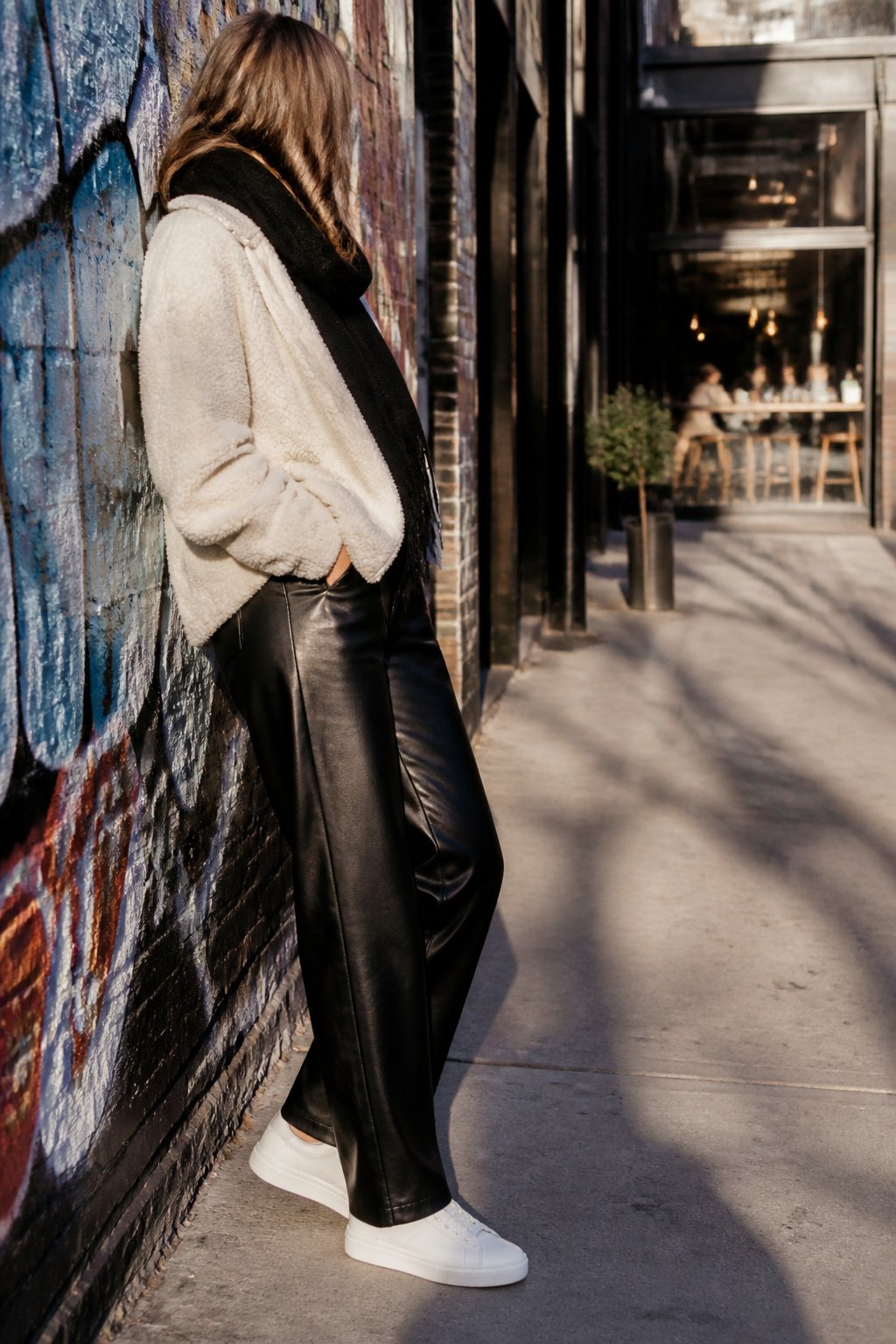
The texture pairing that makes leather pants and sneakers read as intentional, not lazy, comes down to weight and finish. A heavier faux leather with the drape of real trousers, not the stiff crackle of costume vinyl, lets the pants move like actual clothing. That fluidity is what lets a clean, streamlined sneaker sit right at the ankle without the whole silhouette collapsing into "ran out the door."
Clean sneakers work here because they borrow the minimal line of a dress bootie without the formality. Athletic-looking trainers shift the outfit toward gym-adjacent territory; a pared-down white leather pair, something closer to a Veja Campo or Cariuma, keeps the register in "weekday casual."
For a full day of sitting, the heavier-weight faux leather holds its shape better than thinner versions that pool and crease at the knee by noon. The sneaker’s flat sole also means no heel digging in during a long drive or back-to-back meetings. The trick is proportion: the pant needs enough structure that it does not collapse over the shoe, and the shoe needs enough visual quiet that it does not fight the pant’s surface shine.
17. Slip Skirt and Blazer
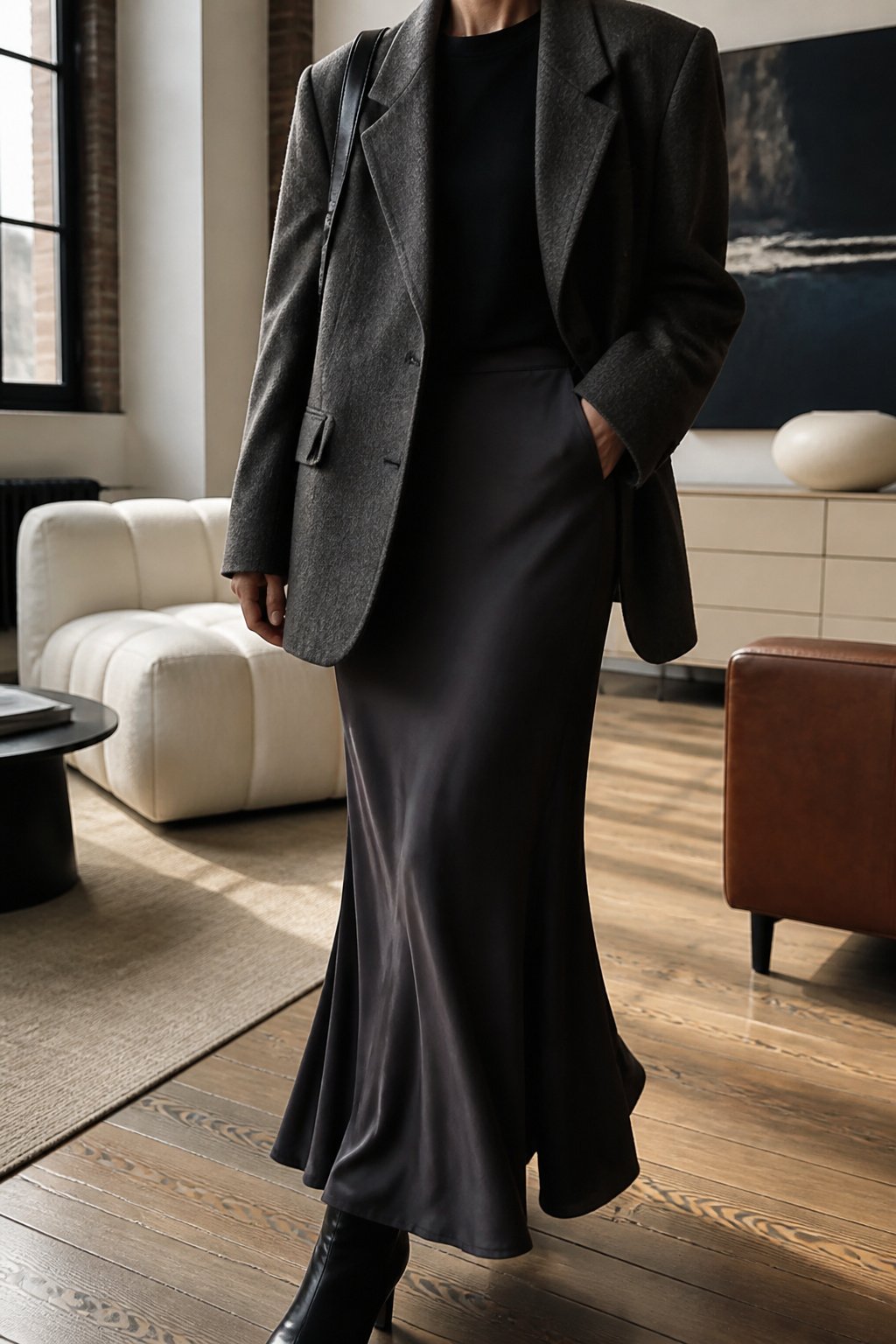
A satin or silk slip skirt in winter only works when you know the temperature floor. Below about 40°F, the thin fabric and exposed legs stop being a style choice and start being a problem. I have pushed this outfit to roughly that limit by adding a substantial blazer, usually wool or a heavy tweed, which gives the skirt the structure it completely lacks on its own. The contrast is the point: the slippery, lightweight skirt against something weighty and tailored keeps the look intentional rather than seasonally confused.
Footwear is where most people get this wrong. Delicate strappy heels or open sandals read as summer holdovers and leave you cold. A closed-toe ankle boot with a low, block heel bridges the gap. It carries enough visual weight to match the winter blazer while keeping the line from ankle to hem clean. A sock in a tone close to the boot, not the skirt, prevents the ankle from looking like an interruption.
18. Faux Leather Pants and Cropped Jacket
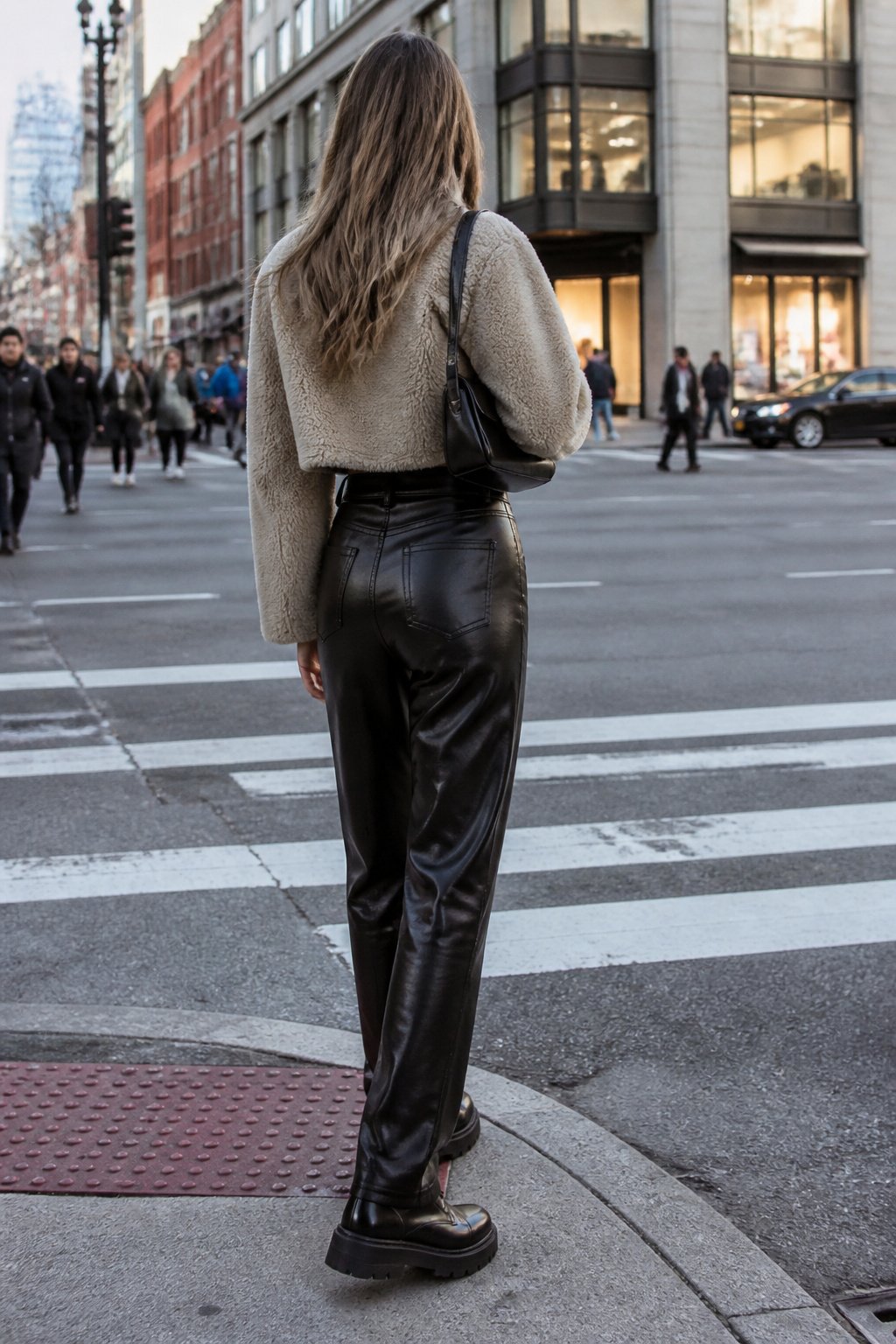
Faux leather pants with a cropped jacket sounds like a recipe for a draft across your stomach, but the pairing works when the math on the waistband is right. High-waisted pants that sit at the natural waist, roughly an inch above the navel, close the gap that a lower rise leaves open to January air. The jacket hem needs to hit that same line, not hover two inches above it. Anything shorter and you are managing exposed skin; anything longer and the proportions read off.
A cropped jacket that meets the waistband of high-rise pants reads intentional, not like you outgrew your layers. The faux leather gives structure without the stiffness of the real thing, and the cropped layer keeps the silhouette from feeling heavy. It is current because the shapes are clean, not because the combination is new. Trendy would be adding a belt bag or a neon turtleneck underneath. Skip both.
Layering That Actually Keeps You Warm
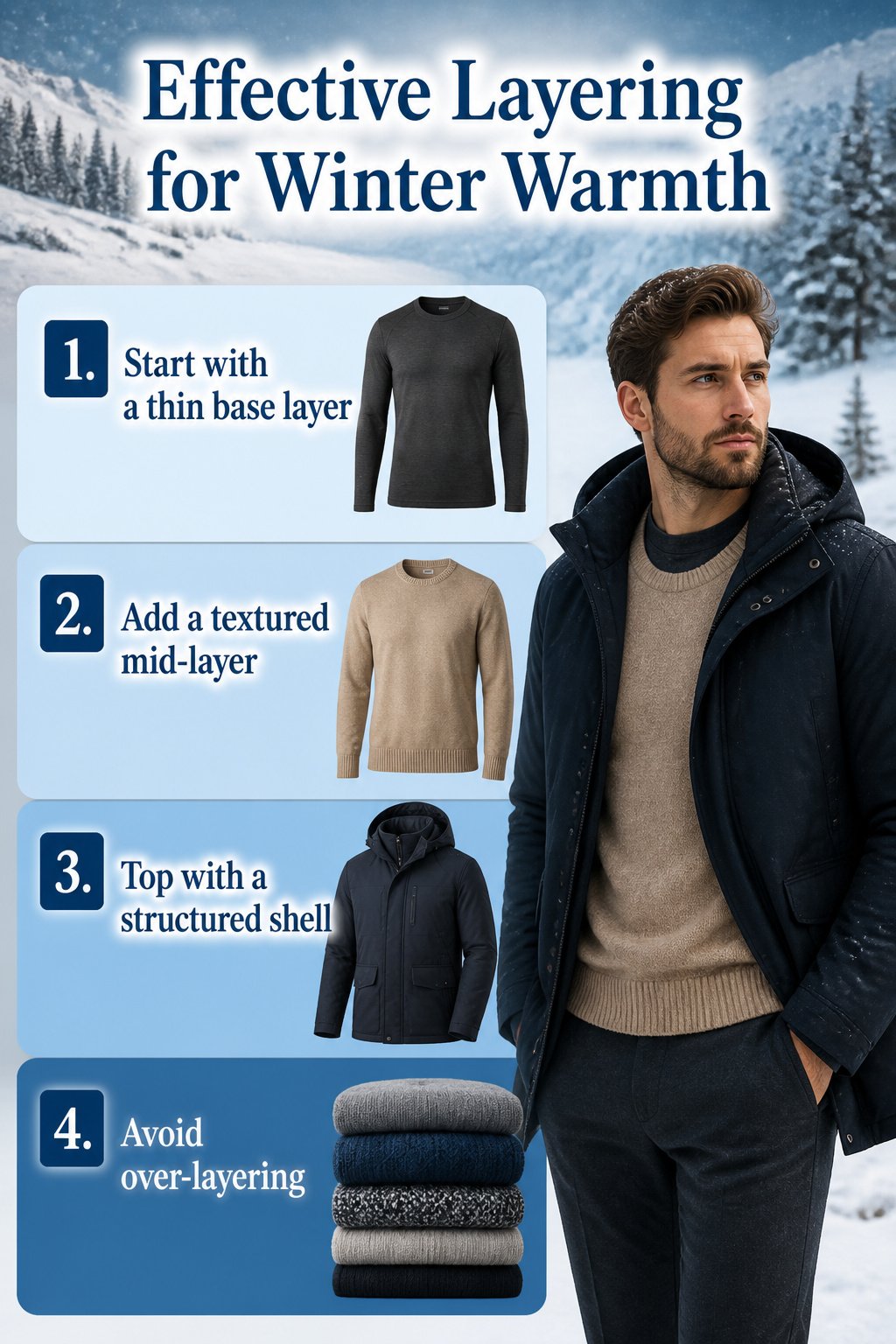
The layer order that actually traps heat starts with something thin and smooth against your skin, like a silk or fine merino base, so sweat moves outward instead of pooling. Mid-layers need loft and texture: a cashmere crewneck, a brushed fleece, anything with air pockets that your body heat can fill. The shell blocks wind and adds structure, but it does not do the warming.
Materials matter more than thickness. A chunky cotton sweater breathes too well and stays damp; a thin wool jersey underneath a quilted vest outperforms it every time. I learned this the hard way after years of piling on whatever was heaviest and spending subway rides shivering in my own sweat.
The common mistake is over-layering for the walk and not the wait. Three warm pieces feel right at the door, but ten minutes indoors and you are stripping, then freezing again outside. Two real layers plus a coat you can open or remove beats four half-layers you are stuck wearing all at once. Fit matters too: anything tight enough to compress the mid-layer kills the air pockets that were doing the actual work.
Footwear for Dry, Wet, and Icy Days
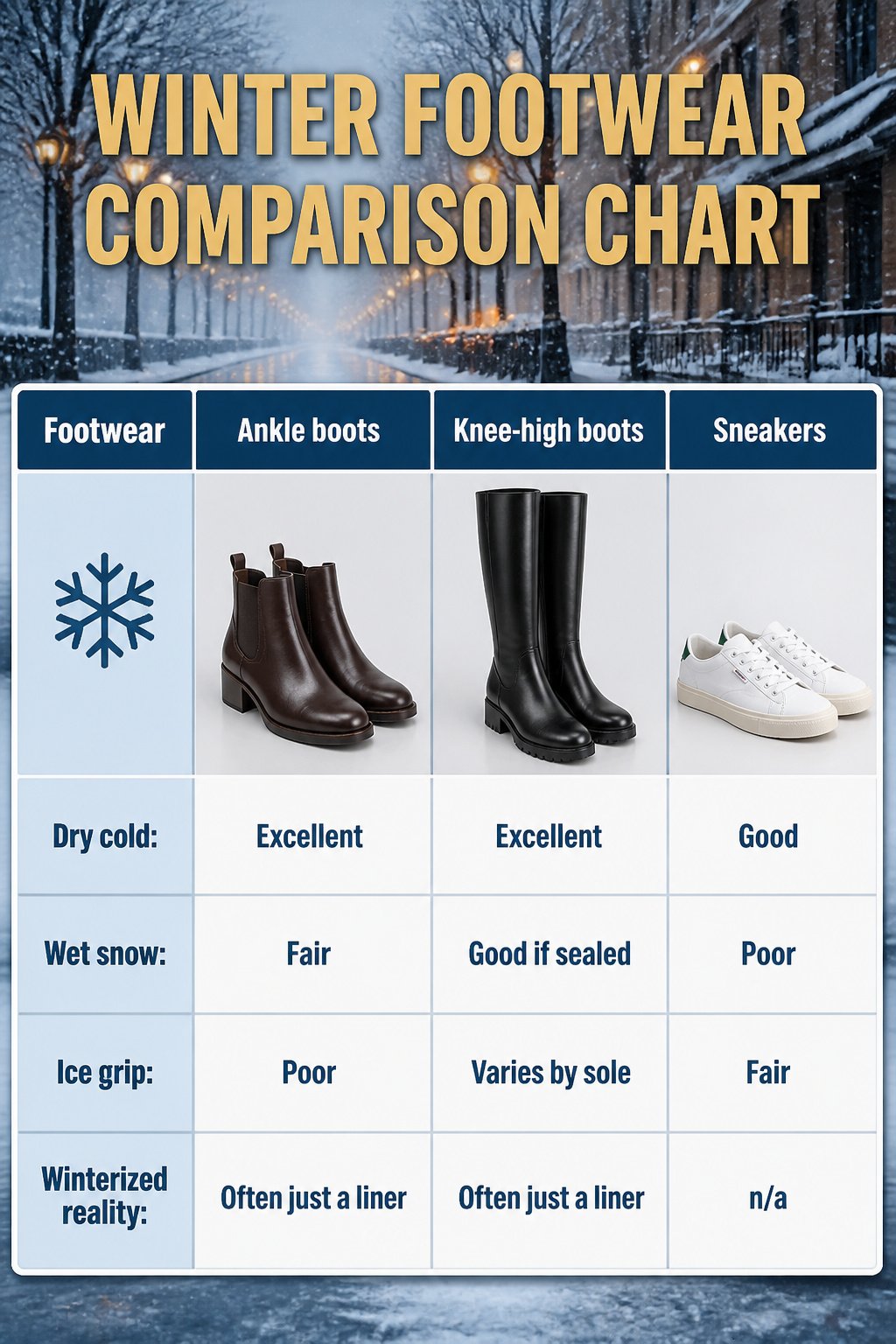
Winter marketing loves the word "winterized," but that label usually just means a water-repellent spray and a fleece insole. Real winter performance sits in the sole and the upper. Ankle boots like the Downtown booties from Margaux handle dry cold beautifully; the leather is substantial and the block heel keeps you above sidewalk slush. What they do not handle is ice. The sole is smooth leather-bottomed, which I learned the hard way on a glazed-over parking lot last February.
Knee-high boots solve a different problem. They block wind on the leg and pair with skirts and tights without the gap that lets cold air in at the ankle. For wet days, you need rubber or treated leather with a sealed seam; anything less and snowmelt wicks through within a block or two.
Sneakers are the wildcard. The Cariuma white sneakers I reach for most days are canvas with a rubber sole, which means water resistance is basically n/a. They work for dry winter days above freezing, or for the office commute where you are never outside more than ten minutes. For actual rain or slush, they soak through at the toe seam.
| Ankle boots (Margaux Downtown) | Knee-high boots | Sneakers (Cariuma) | |
|---|---|---|---|
| Dry cold | Excellent | Excellent | Good |
| Wet snow | Fair (water can enter at ankle) | Good if sealed | Poor |
| Ice grip | Poor (smooth sole) | Varies by sole | Fair (rubber grips better than leather) |
| "Winterized" reality | Often just a liner | Often just a liner | n/a |
If you own one pair, make it a knee-high with a lug rubber sole. It is the only shape that covers dry, wet, and icy with a single purchase.
Outerwear Weight and Temperature Range
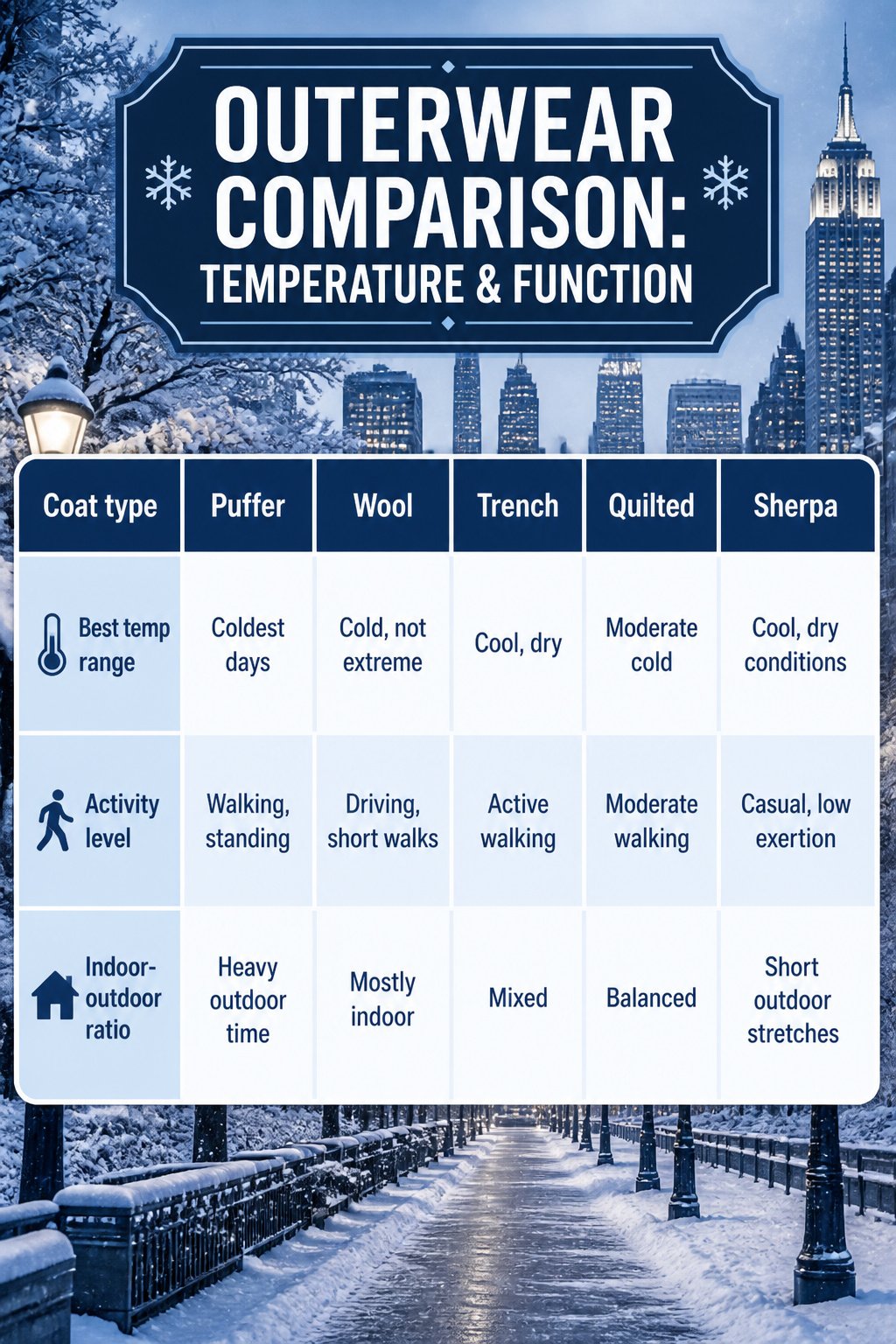
Puffer coats handle the single-digit days when you are outside for more than a few minutes at a stretch, while wool coats work fine for the twenties and thirties if your commute is mostly car-to-parking-garage. Trench coats belong to the forties and fifties, or to layered systems where you are generating heat by walking fast. Quilted jackets split the difference between wool and puffer, good for the thirties with a sweater underneath, and Sherpa coats trade some wind protection for warmth in dry cold that stays above freezing.
| Coat type | Best temp range | Activity level | Indoor-outdoor ratio |
|---|---|---|---|
| Puffer | Coldest days | Walking, standing | Heavy outdoor time |
| Wool | Cold, not extreme | Driving, short walks | Mostly indoor |
| Trench | Cool, dry | Active walking | Mixed |
| Quilted | Moderate cold | Moderate walking | Balanced |
| Sherpa | Cool, dry conditions | Casual, low exertion | Short outdoor stretches |
The real question is how long you spend in transitional space. Someone with a ten-minute walk from train to office and a drafty lobby needs a puffer over her wool coat, or a quilted jacket she can leave on indoors. A driver who parks underground might own one good wool coat and call it done. I keep three because my January involves a cold platform wait, a overheated subway car, and a walk that is either two blocks or twenty depending on which meeting I am headed to. The coat that works for all three barely exists, and the attempt to find it usually ends in sweating through a lining or shivering through a sleeve.
Accessories That Earn Their Drawer Space
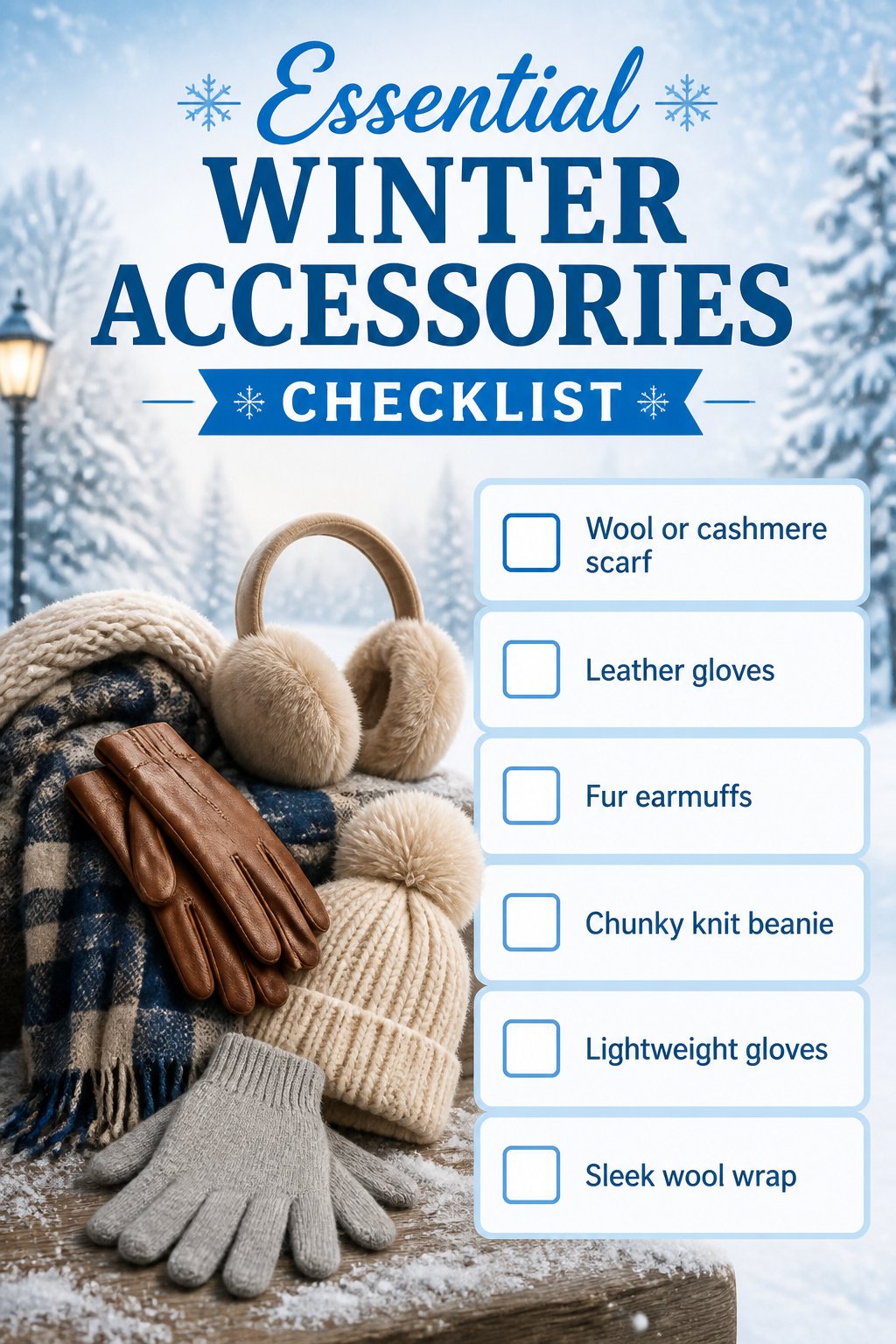
Wool and cashmere scarves earn their keep by staying warm after they absorb a little snow or sleet, while acrylic knits look plush and turn clammy fast. That difference matters more than color when you are choosing between a chunky knit and a sleek wool wrap for daily wear. Leather gloves in a neutral tone handle wet commutes better than suede, and they only improve as the surface ages. Fingerless fur gloves trade some function for style; they work for a short walk or an outdoor coffee, not for an hour of scraping ice.
A hat, scarf, and glove set is a complete kit. Add earmuffs and a second scarf and the look tips toward costume, especially if textures clash. One bold accessory, like a fur or knit earmuff, reads intentional. Two competing for attention reads like you are trying on a character. Two accessories max, unless they share the same material family, is the rule that keeps casual winter outfits from looking like you are performing winter rather than dressing for it.
Frequently Asked Questions
What are some casual winter outfit ideas?
Corduroys paired with a sweater and ballet flats, jeans with booties and a turtleneck under a fitted puffer, and a sweater dress with tall boots and wool-blend tights all work well. A quilted jacket over a slim turtleneck or a matching knit set split into separates also handles the season without looking bundled. Most of these depend on one warm layer doing the work rather than stacking bulk.
How do you style a sweater dress in winter?
Pair it with tall boots so the shaft covers at least half the distance between your knee and the hem, creating a continuous line. Wear 60–80 denier tights, or wool-blend if the dress is fitted, since they resist sagging at the knees. The boot height matters more than the dress length; a shorter dress needs a knee-high or over-the-knee boot, while a longer dress can handle a mid-calf boot without looking chopped up.
What are essential winter wardrobe pieces?
A down puffer that fits over a single layer, not multiple bulky sweaters, keeps proportions clean. A wool coat in at least 24-ounce weight actually blocks January wind. Tall boots with the right shaft height for your hemline, sturdy sneakers that handle sidewalk salt, and one quilted jacket with a stand collar give you range without a closet full of outerwear. The common thread is fit: each piece should work with slim layers underneath rather than requiring you to size up.