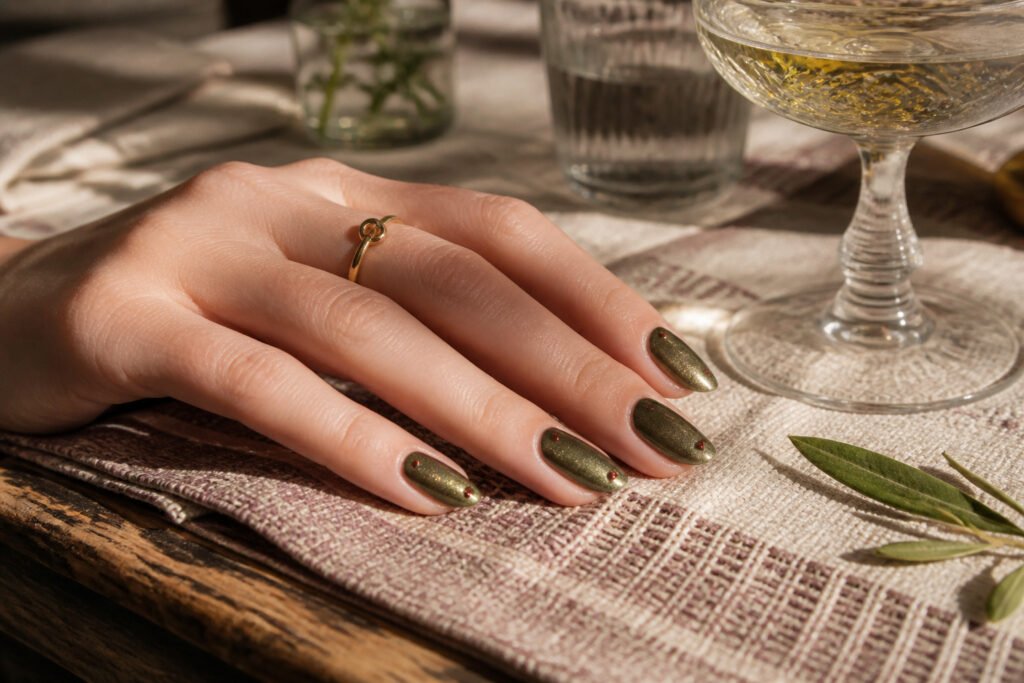
Olive nails are manicures built around olive green polish, often accented with tiny red details that read as cocktail garnish rather than holiday kitsch. The look only works when the red stays smaller than a pimento and sits off-center; let it creep past a sixteenth of an inch and the whole hand registers as Christmas. A cat-eye shimmer over the green turns the nail into actual glass, with magnetic pigment steering the flash so it hits at an angle, not straight on.
1. Glassy Finishes
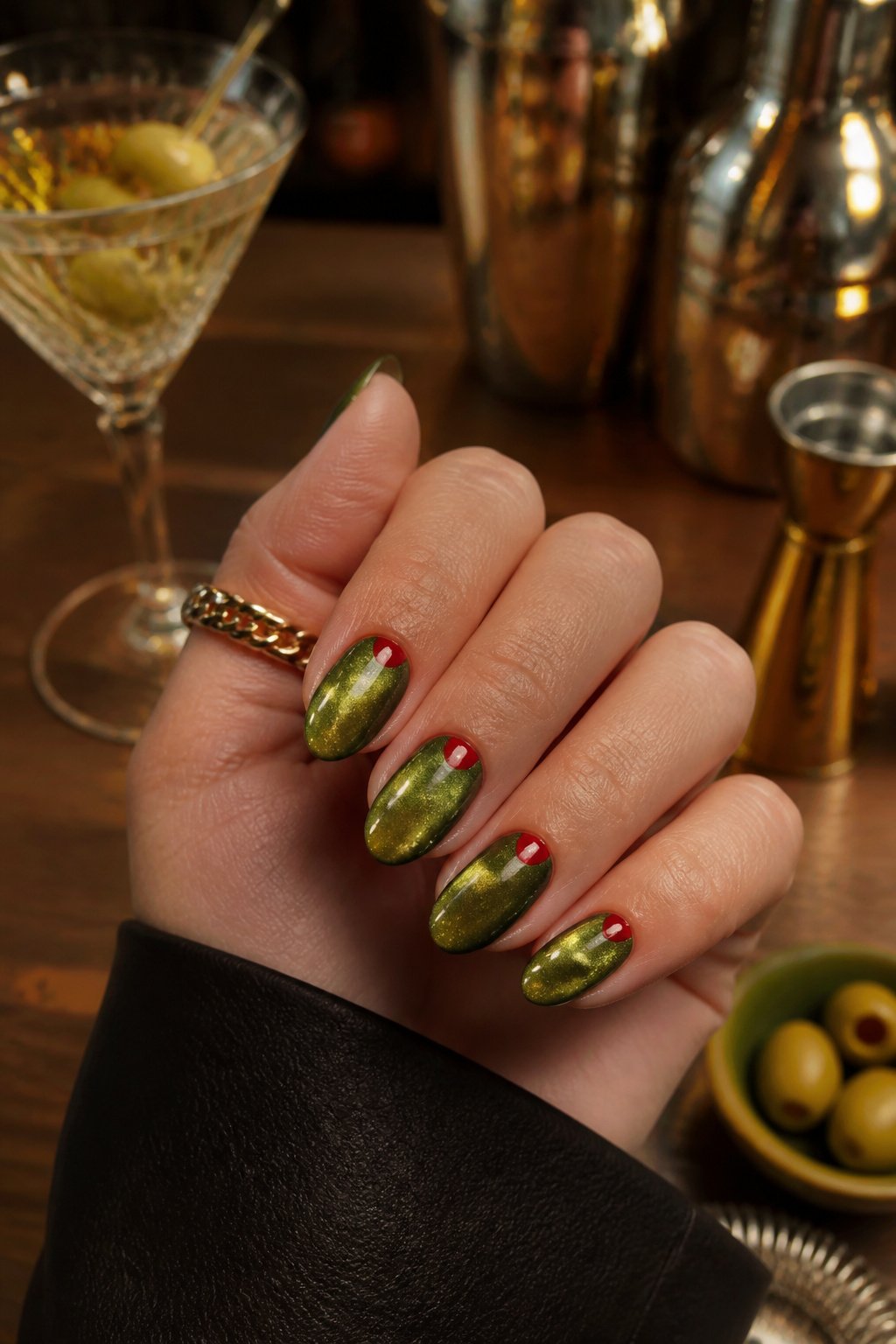
A cat-eye shimmer over olive green turns the nail into actual glass: light slides across the surface the way it would through a martini stem, and the magnetic pigment lets you steer that flash so it hits at an angle, not straight on. The red sits at the cuticle or the free edge, no wider than a pimento, and because it is a single dab rather than a stripe or a pattern, it reads as garnish rather than Christmas. I have seen this go wrong when the red creeps past a sixteenth of an inch; then the eye registers holiday, not happy hour. Keep the accent smaller than the olive itself, place it asymmetrically, and the finish stays cocktail-hour specific from January straight through to March.
Olive nails are the whimsical, surprisingly wearable look of the season.
— Bustle
That wearability is what makes the glassy version worth trying: the shimmer does the work so the nail art does not have to.
2. Straight Up
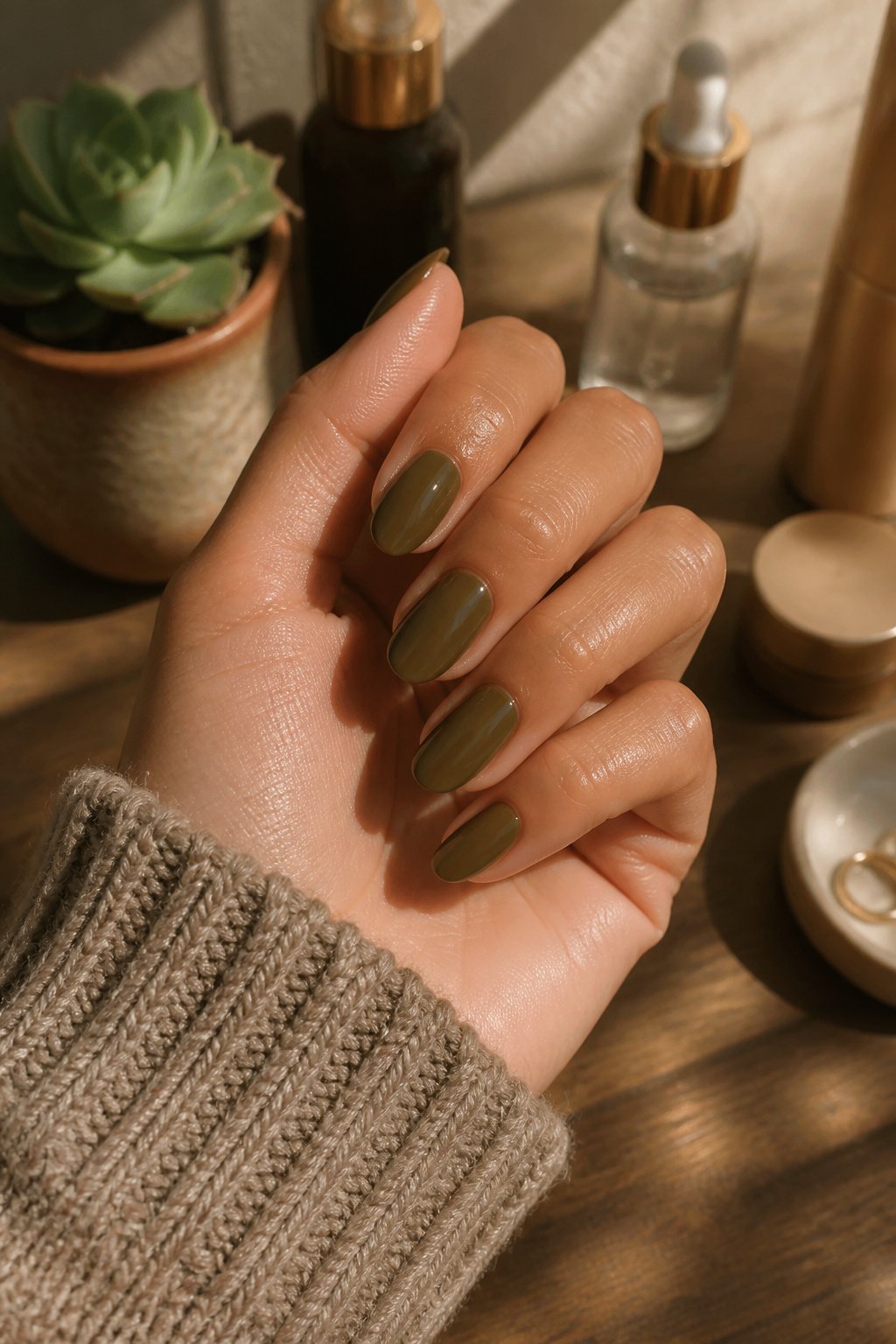
A single coat of olive polish with a glossy top coat reads as deliberate, not like you grabbed the wrong bottle from the pharmacy shelf. The shade that works is the one with enough brown in the base to keep it from tipping into lime or forest territory; think Castelvetrano brine rather than fresh grass. I have seen this on short, squared nails and on almond shapes, and the simplicity holds because the color itself carries the weight.
This is the entry point if the rest of the trend feels too literal. No tiny pimentos, no martini glass art, just the hue doing the work. A glossy finish keeps it from looking like hardware-store green, which is where olive polish goes flat or chalky and suddenly reads as accidental. The top coat matters more than usual here because olive can skew muddy under matte or satin finishes.
Two coats of a quality polish plus a dedicated top coat will get you through a week without chips, in my experience comparing wear times across finishes. The maintenance is the same as any dark neutral, which is why this works for someone who wants to test the trend without rebuilding their entire manicure routine.
3. 3D Accents
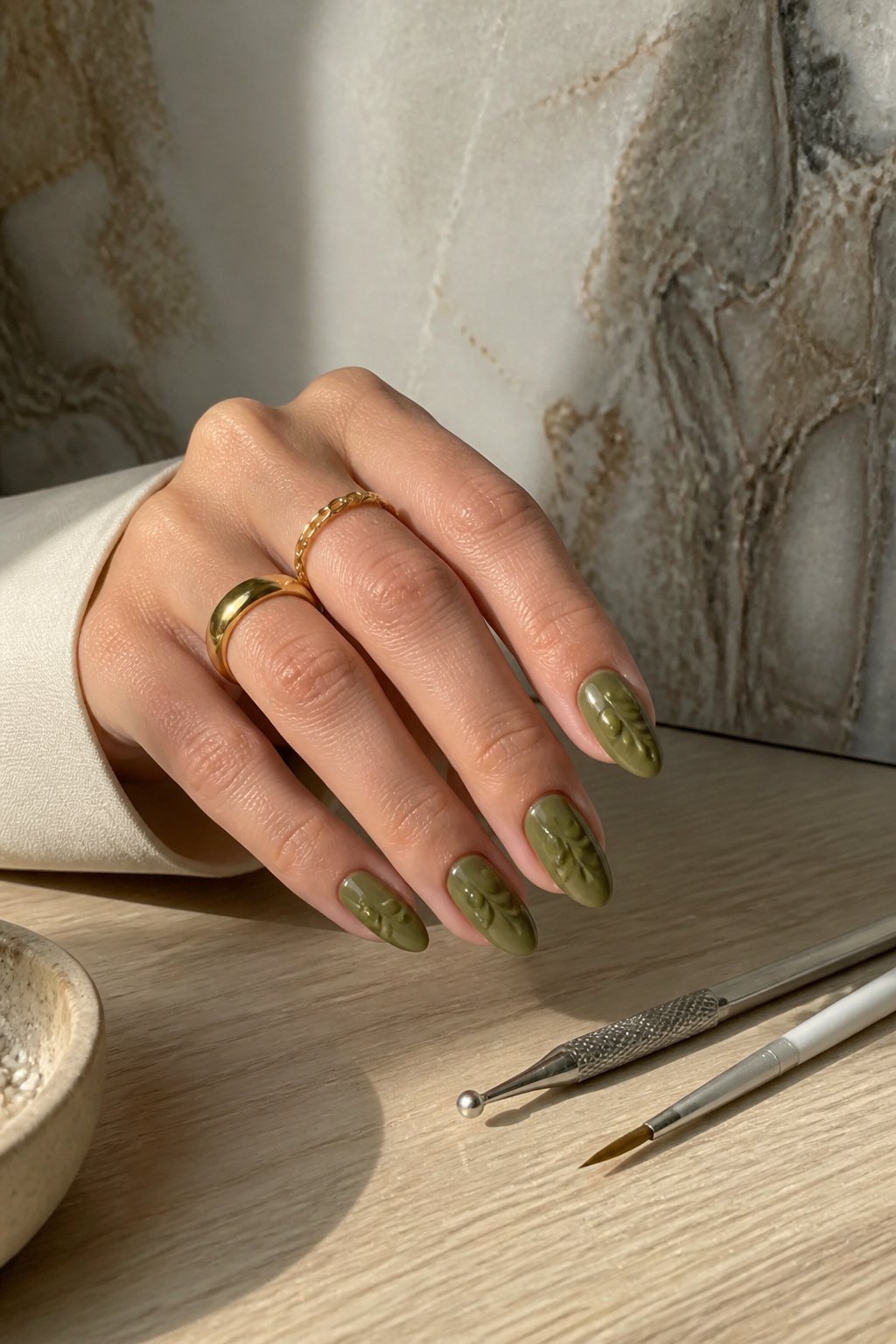
Building 3D olives onto a nail takes either a gel builder or a small acrylic bead shaped while it is still workable. The trick is letting the base layer cure to a tacky finish, then adding the next shape so it grips without sliding. I have watched tutorials where the olive sits almost a quarter inch above the nail plate, and that height looks striking for a photo. For daily wear, anything past two stacked gel layers catches on hair, pockets, and keyboard edges. Keep the rise under a millimeter, maybe two at the center of the olive, and taper the edges flat to the nail. That low dome still reads as dimensional under light, but you will not be peeling it off by Wednesday. If you want the full sculptural effect for one night, a press-on accent olive makes more sense than growing your own liability.
4. Jelly Olives
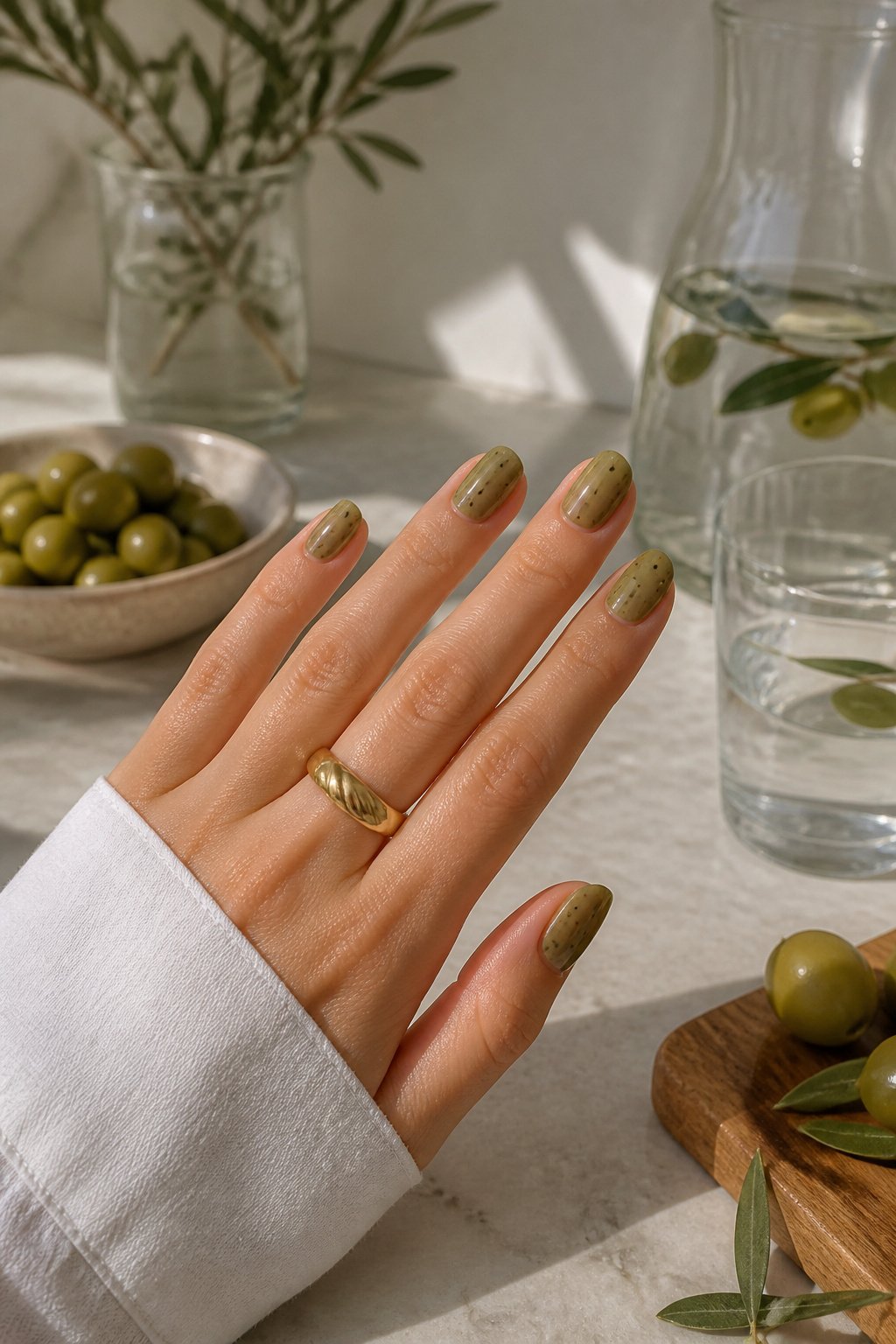
A sheer jelly base in muted olive lets the natural nail show through just enough to keep the color from turning muddy, which is the usual risk with earth tones on shorter nails. I built this in three thin coats of a translucent olive polish, each one barely pigmented enough to tint the layer below.
The micro-dots sit in a deep maroon, not the bright cherry red that reads summer picnic. Maroon carries enough blue in its mix to pull against the olive’s yellow undertone, and that tension is what makes the combination feel like late December rather than early July. I placed the dots with a dotting tool at irregular intervals, maybe six or seven per nail, keeping them small enough that they read as texture from arm’s length rather than a pattern you study up close.
Jelly polish demands patience. Each coat stays tacky longer than a creme, and rushing the next layer traps bubbles that the translucency will expose for days. I wait a full four minutes between coats, which feels excessive until I remember the alternative: starting over.
5. Frosted Cocktails
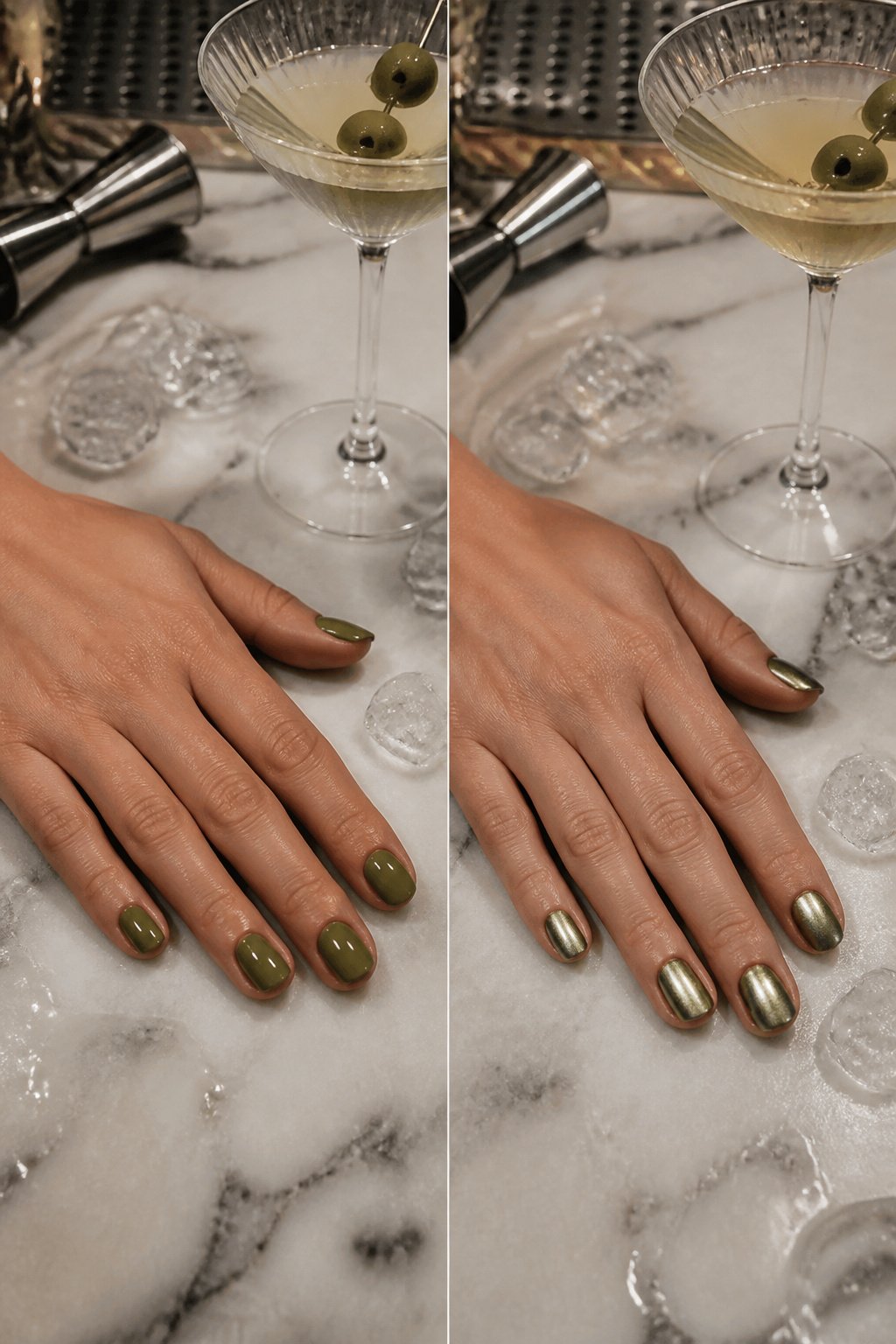
Silver chrome powder shifts olive green from earthy to almost glacial, which is the whole point of the frosted-cocktail look. The trick is keeping it from reading as straight-up metal. A muted, brown-based olive underneath preserves enough warmth so the chrome reads as chill rather than robotic. On one hand you get the olive nail art, on the other a silver chrome that catches light like condensation on a cold glass. The contrast does the work: the chrome feels refrigerated because the olive next to it stays organic. Skip yellow-leaning olives here; they fight the silver and land closer to neon than martini.
6. Dirty and Flirty
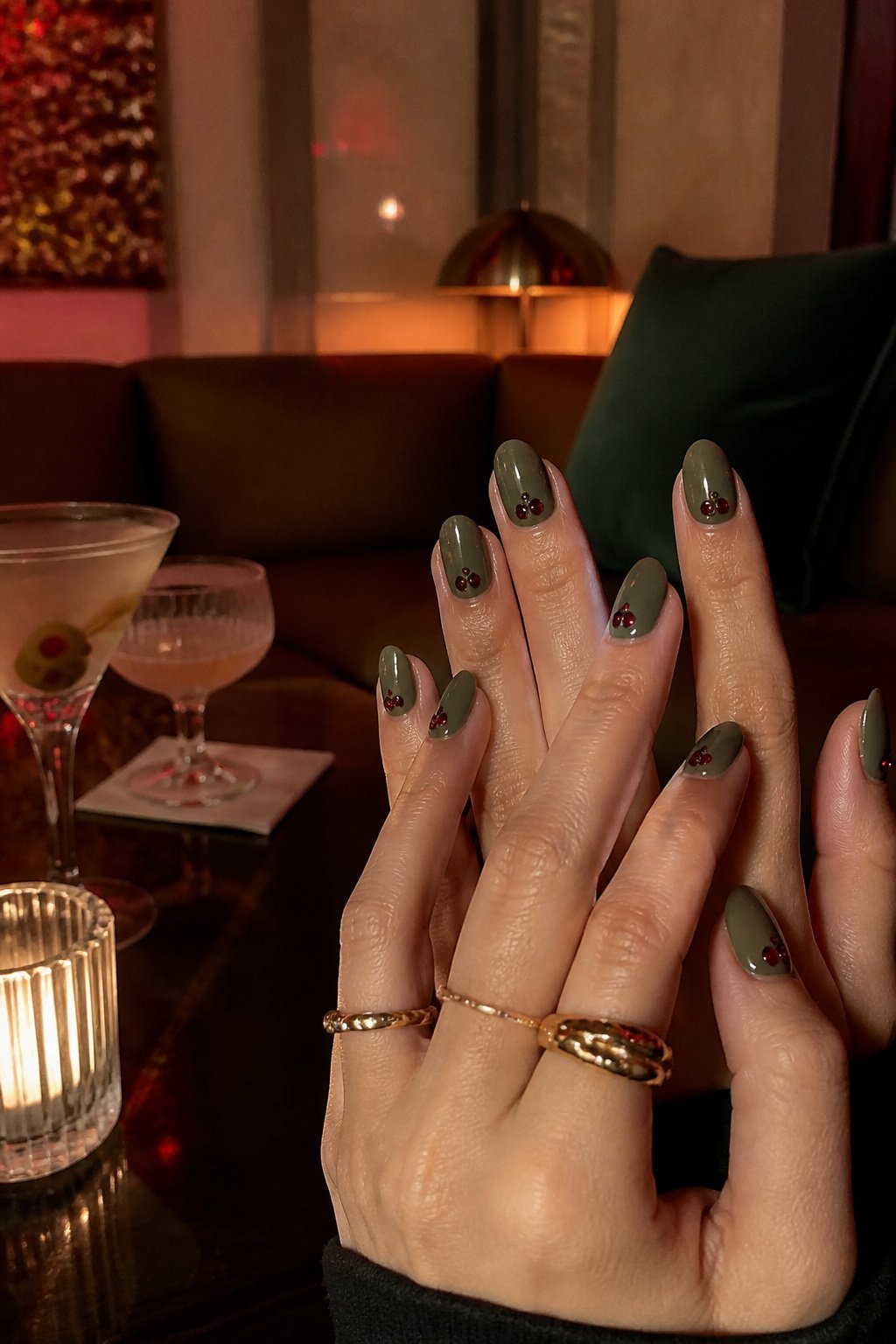
The placement of the rhinestones matters more than the stones themselves. Set each red rhinestone slightly off-center inside the olive shape, toward where a real pimento would sit, not dead middle. Without that offset, the eye reads random red dots. Cluster them too symmetrically and the nail looks like a ladybug theme gone wrong.
For the kiss prints, a stamper works cleaner than freehand if you own one. Press the design onto the nail while the olive base is still tacky, or seal it with a thin layer of top coat first so the lip shape lifts cleanly. I have seen the print smudge when stamped over fully cured polish, and once it ghosts, there is no fixing it without starting the nail over.
The combination reads playful rather than crude because the scale stays small. Keep the rhinestones under 2 mm and the kiss prints limited to one or two nails per hand. Anything larger shifts the mood from flirty to bachelorette-party loud, which is fine if that is the goal, but it is not this design’s goal.
7. With a Twist
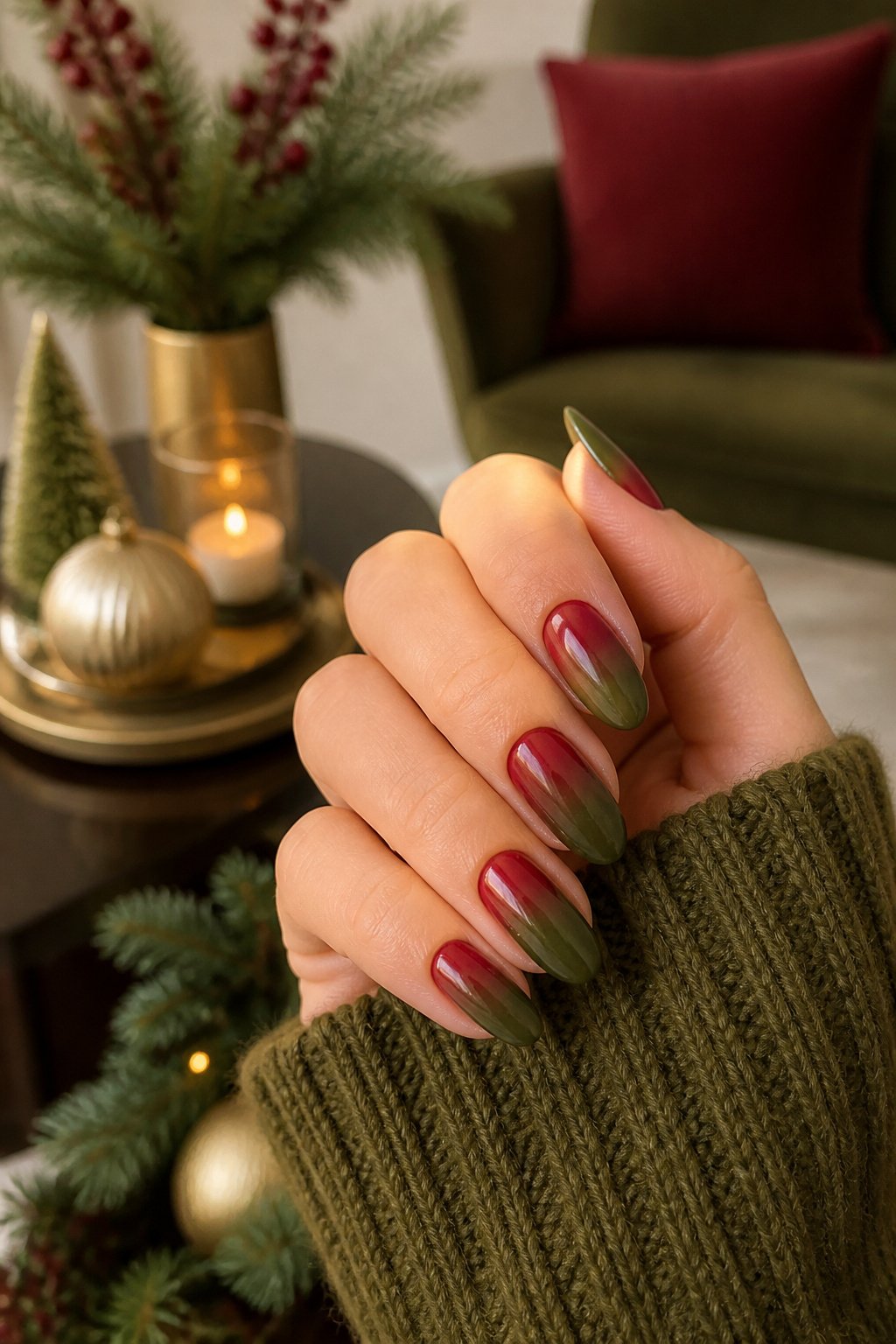
A red-to-green gradient on olive nails walks a thin line between cocktail hour and December 25th. The shift works when you keep the red portion to roughly one-third of the nail, starting from the cuticle, and let the olive green own the remaining two-thirds toward the free edge. That ratio reads like a martini garnish rather than a candy cane because the eye lands on the green first.
The red itself needs to be the right shade. Anything too bright or blue-based will flash "holiday" immediately. A deeper, brownish red, something closer to a rust or a dried cherry, sits back and lets the olive feel savory instead of seasonal.
Placement matters too. A vertical gradient, running side to side rather than base to tip, breaks the Christmas association almost entirely. The eye doesn’t read vertical color bands as festive in the same way; they register more as abstract sunset tones or cocktail layers. If you do run the gradient horizontally, keep the transition zone wide and slightly muddied where the two colors meet. A hard, clean line between red and green is what sells the holiday look; letting them blur into each other for a quarter-inch or so keeps things grown-up.
Finish choice is the final pivot. A high-gloss top coat pushes the design toward party territory, while a matte finish grounds it and makes the combination feel more editorial than celebratory. I tend toward matte for daytime wear and add the gloss only if the occasion actually involves a bar cart.
8. The Whole Martini
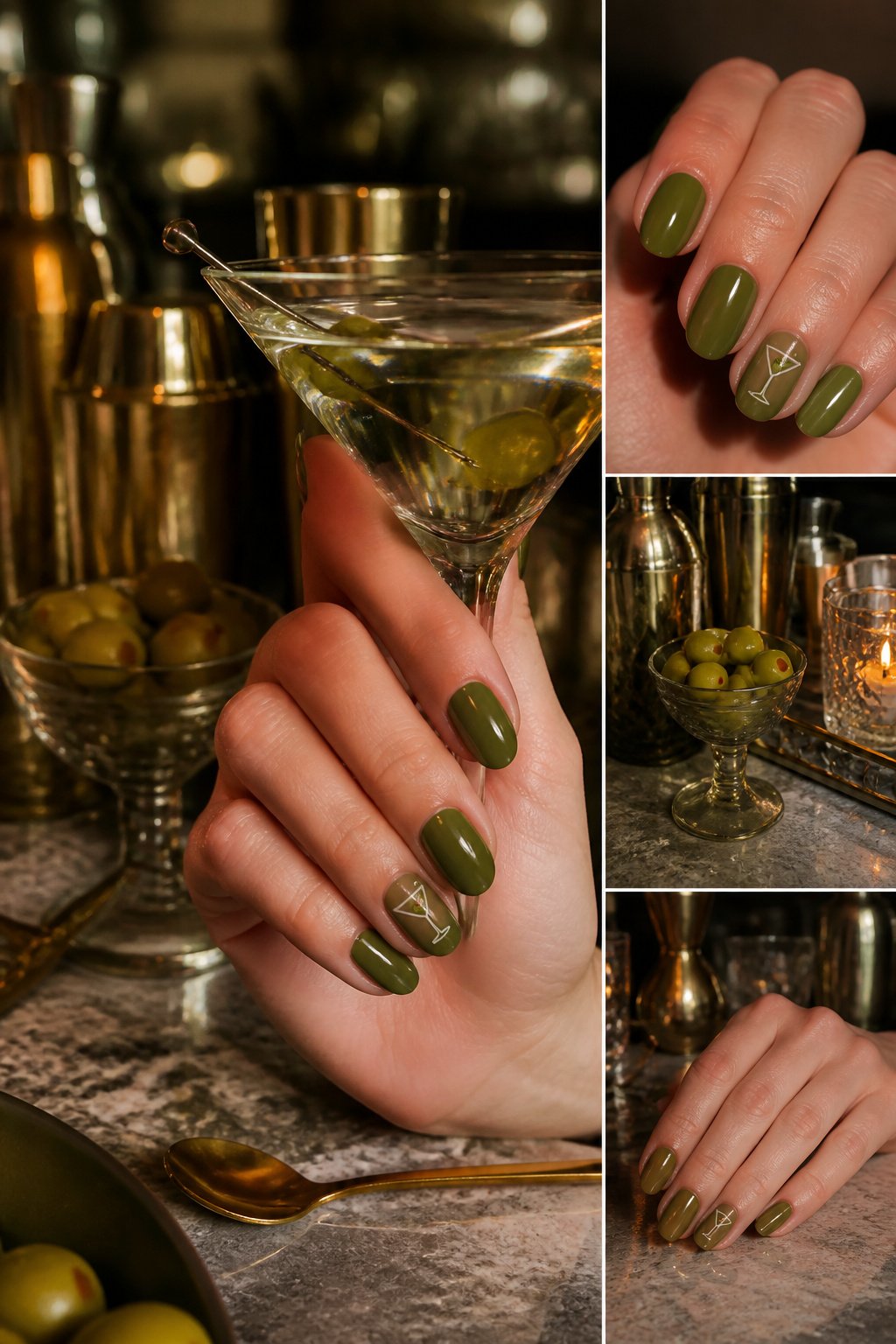
A tiny martini glass with a toothpick and olive reads as a party joke, which is why it works best on one or two accent nails, not the full set. The detail that holds up at normal distance is simpler than the Instagram close-ups suggest: the glass shape, the olive dot, and a thin line for the toothpick. Add a cat-eye shimmer or a dab of red on the remaining nails and the whole hand reads as cocktail hour without looking like a novelty shop. Two accent nails keep the eye moving; ten turns the joke exhausting.
9. Studded Pits
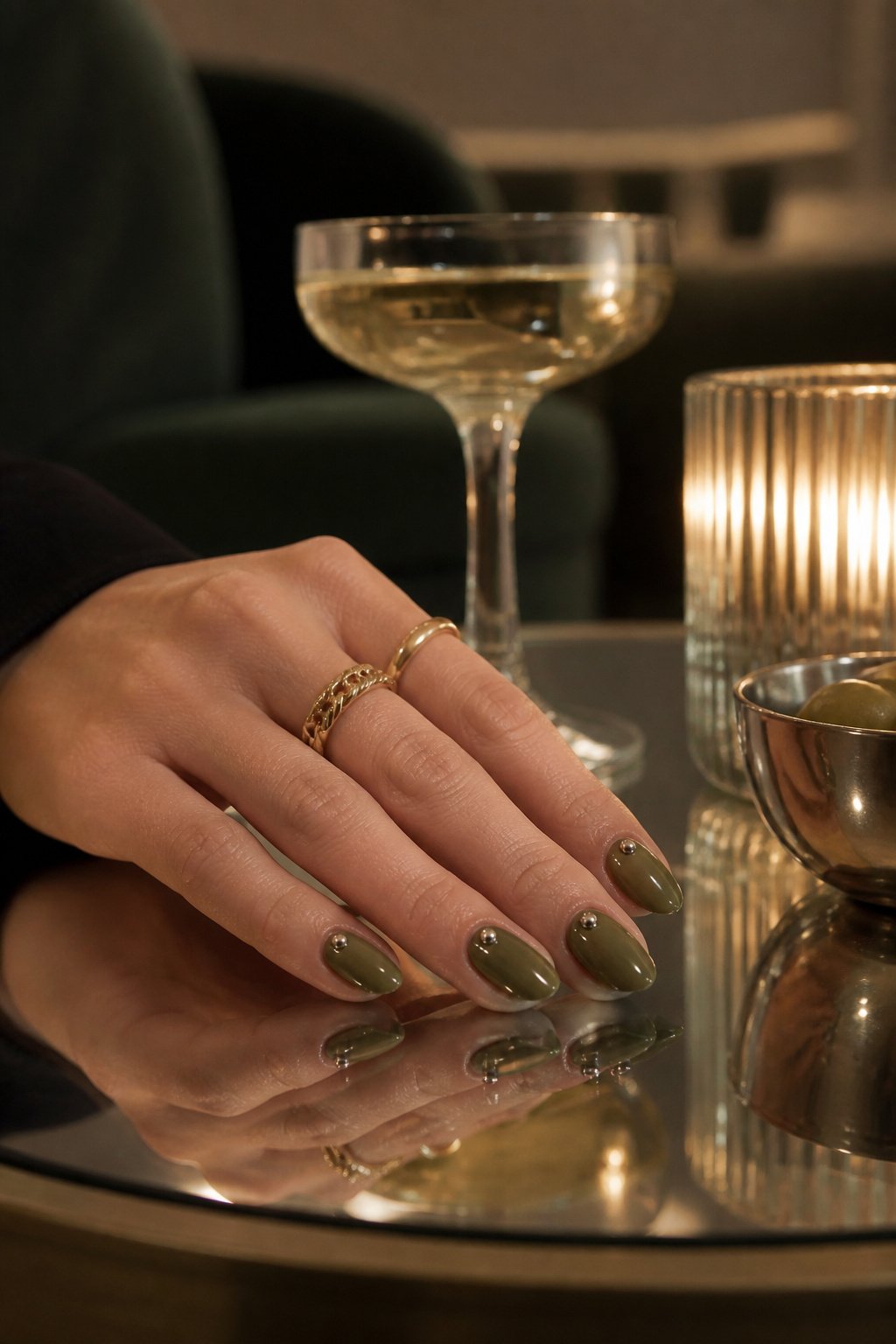
Chrome studs on olive nails shift the whole reference from literal fruit to something more suggestive, like the glint off a bar cart rather than the olive itself. The red dots you sometimes see in this trend read cute; swapping them for chrome makes the set feel grown-up, almost architectural.
The finish matters more than the shape. A mirrored chrome that catches light without glare keeps the accents looking deliberate, like jewelry, not like hardware you bolted on. Anything too brushed or too matte starts to read industrial fast.
I have seen this done as a single stud at the base of each nail, or scattered like freckles across two accent fingers. The second option, paired with silver chrome on the opposite hand, gives the whole manicure a chilled, after-hours feeling that still looks intentional enough for a Tuesday meeting.
10. Glazed Olives
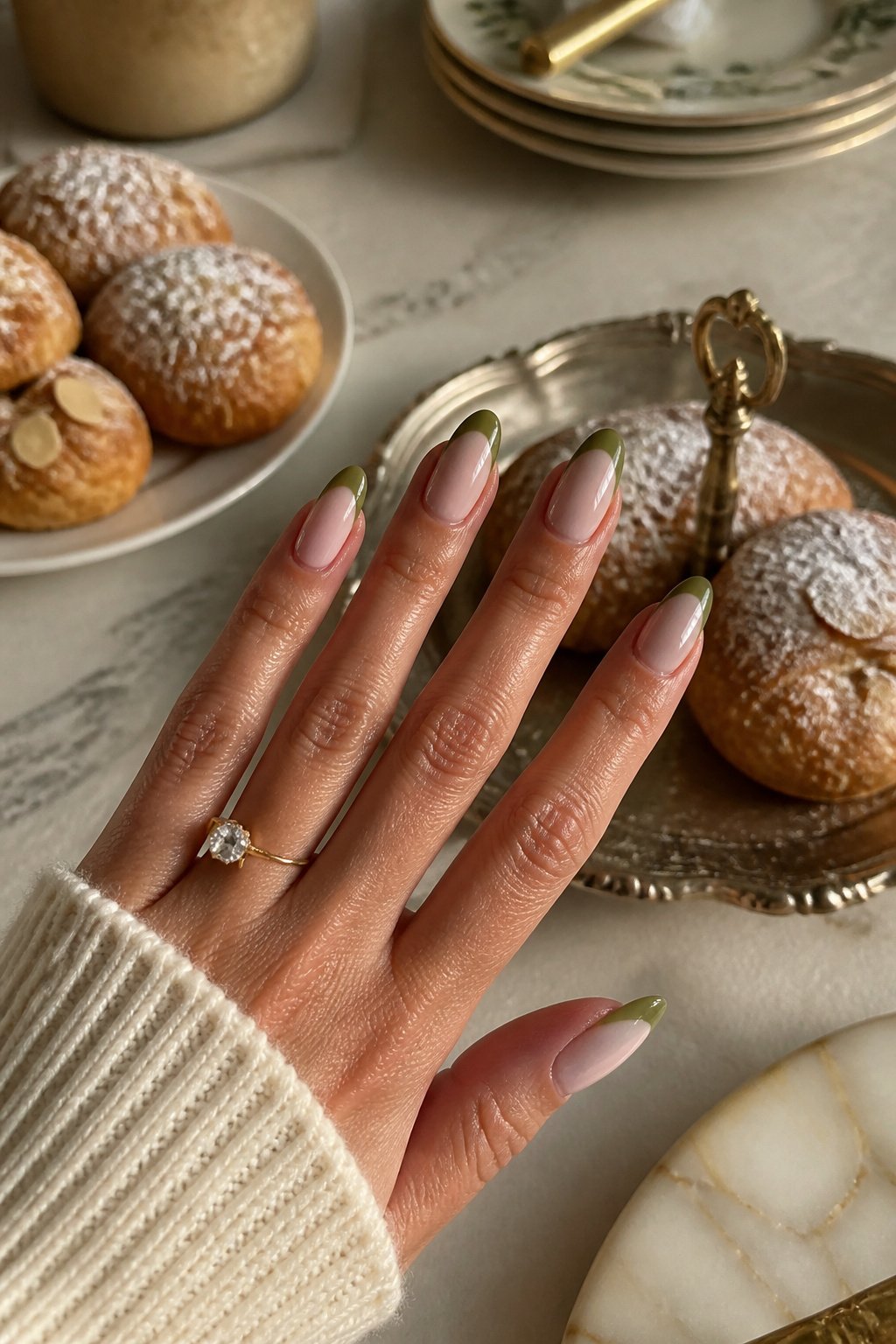
The glazed donut technique, built on a milky nude base with chrome powder sheen, shifts entirely when the tips go olive instead of pink. Olive tips need a cooler white, one with a hint of blue rather than the warm ivory that flatters pink or peach bases. Green reflects yellow undertones aggressively; pair it with a creamy white and the whole nail turns muddy.
I learned this the hard way trying a warm pearl over an olive base last spring. The chrome powder, which should read as wet-looking glass, pooled into something closer to tarnished brass. Switching to a stark blue-white gel, almost paper-toned, pulled the olive back to its savory, dirty-martini register. The chrome layer sits on top exactly the same: buff the powder over a no-wipe top coat, cure, seal. The difference is only in that first white layer’s temperature, but it makes the difference between a manicure that looks intentional and one that looks like a color-correction mistake.
11. XL Dots
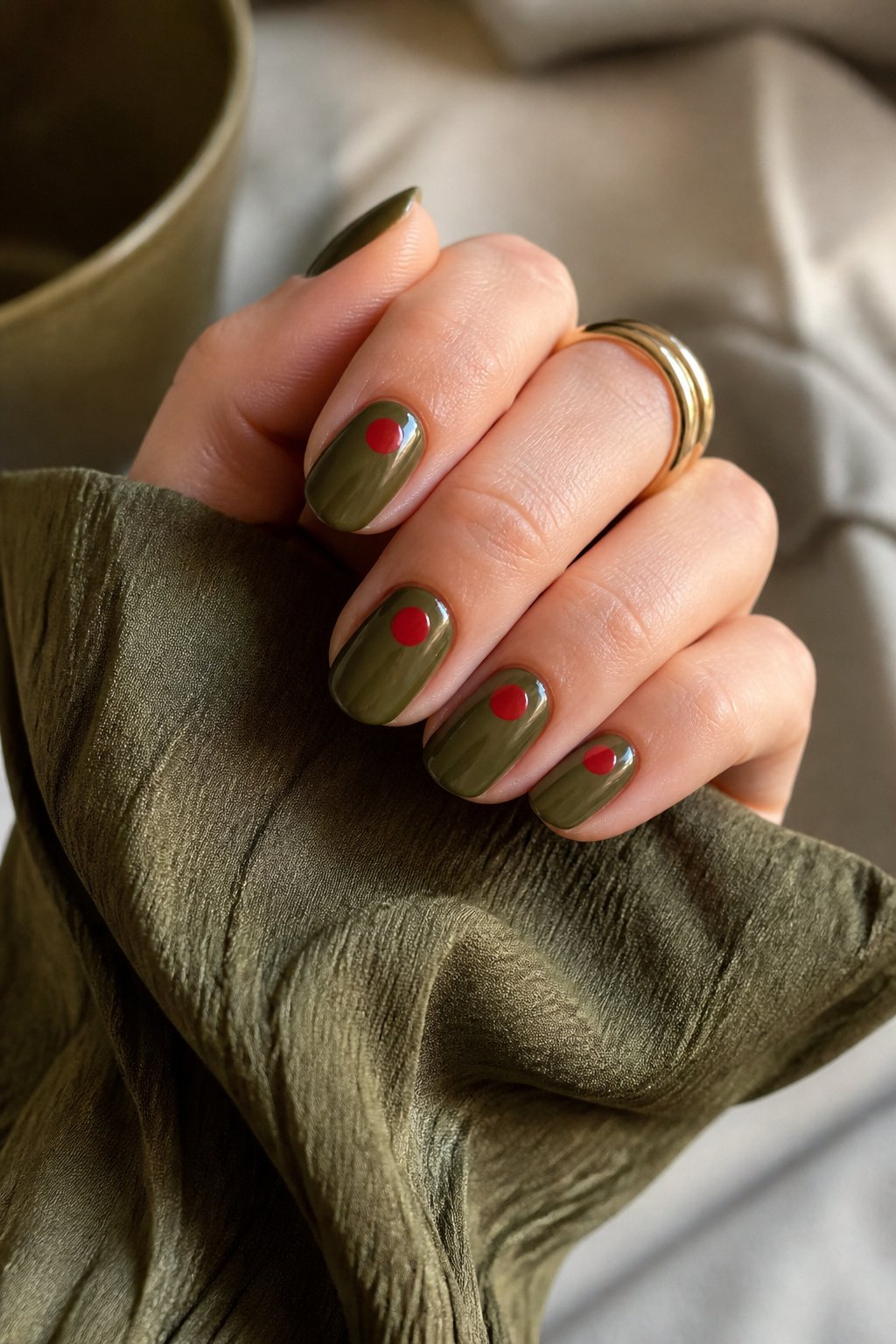
Oval nails carry oversized pimento dots better than square shapes because the curved sidewalls echo the round olive form instead of fighting it. A square tip leaves the dot floating in blank space; the oval lets the design breathe along the nail’s natural arc.
The dot can run about two-thirds the width of the nail bed before it stops reading as an olive and starts looking like a random red circle. Any smaller and the pimento detail gets lost; any larger and the maroon base disappears entirely, which defeats the point of the contrast. The bright red center against that darker base is what sells the illusion, so you need enough surrounding color to register the "olive" at a glance.
I have seen this done with a single accent nail and with every finger covered, and the full set only works when the dots stay disciplined to that same scale across all ten. One oversized outlier breaks the visual rhythm completely.
12. Textural Brines
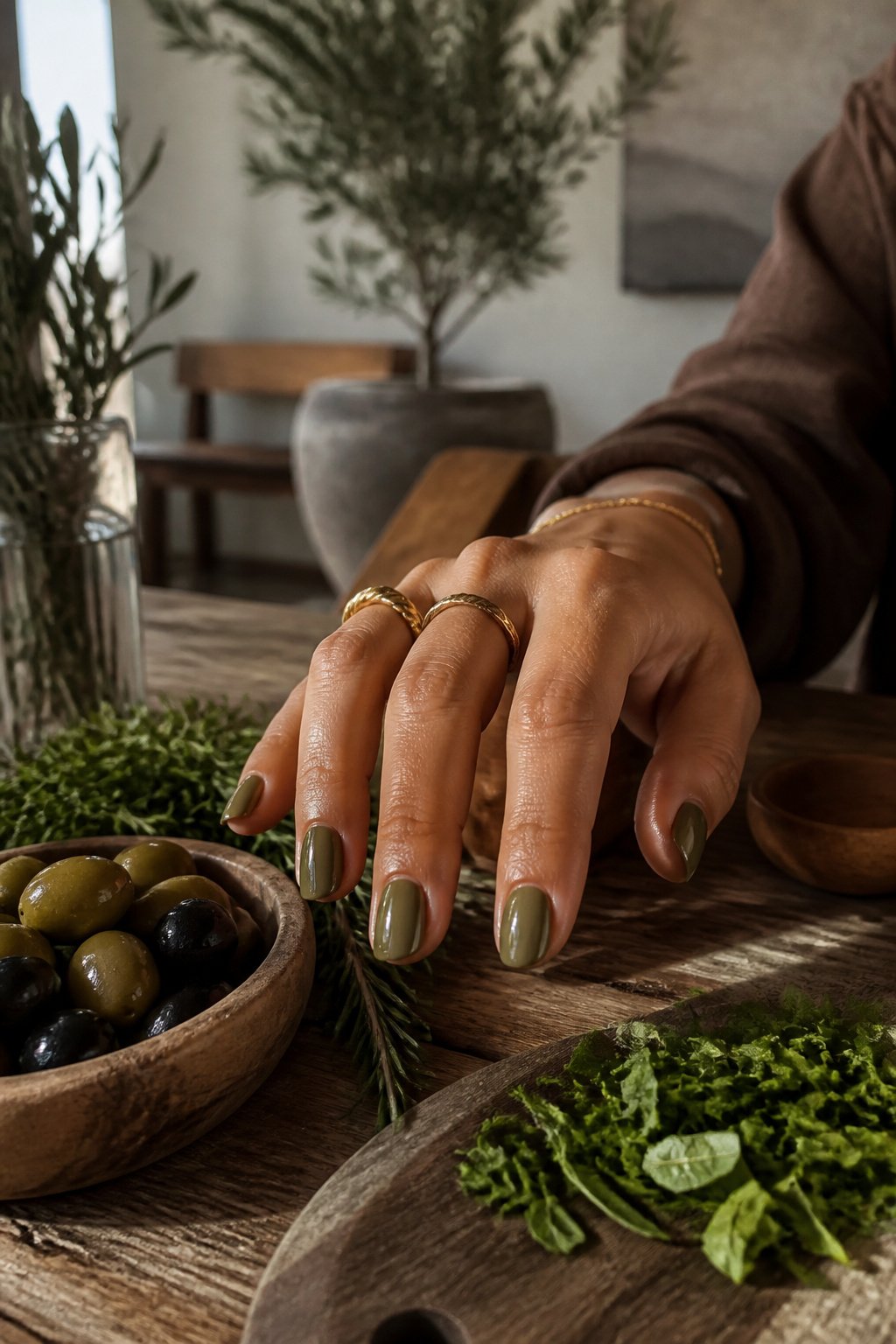
Clear 3D gel over olive polish gives the nail a raised, almost wet look without changing the color underneath. The technique is straightforward: the tech builds the gel into small domes or irregular ridges, cures each layer, and leaves the surface glossy so light catches the curves. The result reads like olive brine sitting on the skin of the fruit, translucent and slightly swollen.
Texture changes how long the manicure lasts. Raised gel catches on hair, pockets, and keyboard edges, so the wear time runs shorter than a flat olive-green coat. A thinner build helps, though it sacrifices some of that juicy dimension. Two ways to play this: keep the 3D minimal and concentrated near the cuticle for protection, or go full dome and plan on a touch-up within the week.
13. French Tips
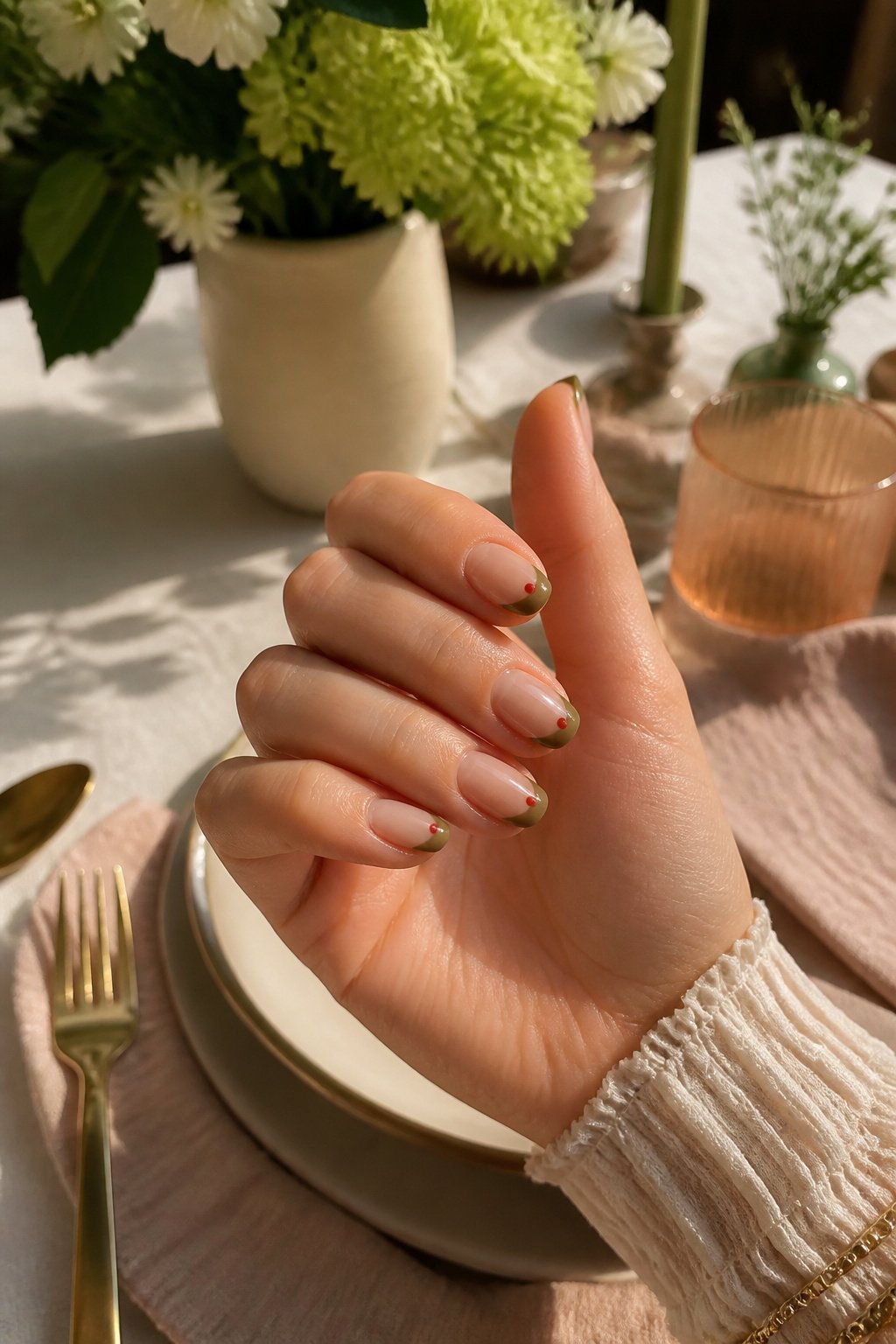
The modern French tip gives olive nails a cleaner stage than a full coat ever could. A band of green across the free edge reads as color-blocked and intentional, not like you grabbed the wrong bottle. The red dot belongs at the center of the smile line, not off to the side, and it needs to stay small enough that it registers as a punctuation mark rather than a separate design element. Too large, and you have a cherry; too far left or right, and the olive reference dissolves into abstract blobs that require explanation. I have seen the same layout saved on two different boards, one labeled "martini nails" and the other "minimalist Christmas," which tells you how much placement controls the reading. The green itself can shift from a deep Castelvetrano tone to something more muted and brown-based; the dot stays the same warm red either way. Almond tips carry this best, since the narrow point gives the green band a natural frame and the dot a clear center. Square shapes work, but the geometry fights the organic reference slightly, and the dot can look stranded in all that flat width.
14. Deconstructed Olives
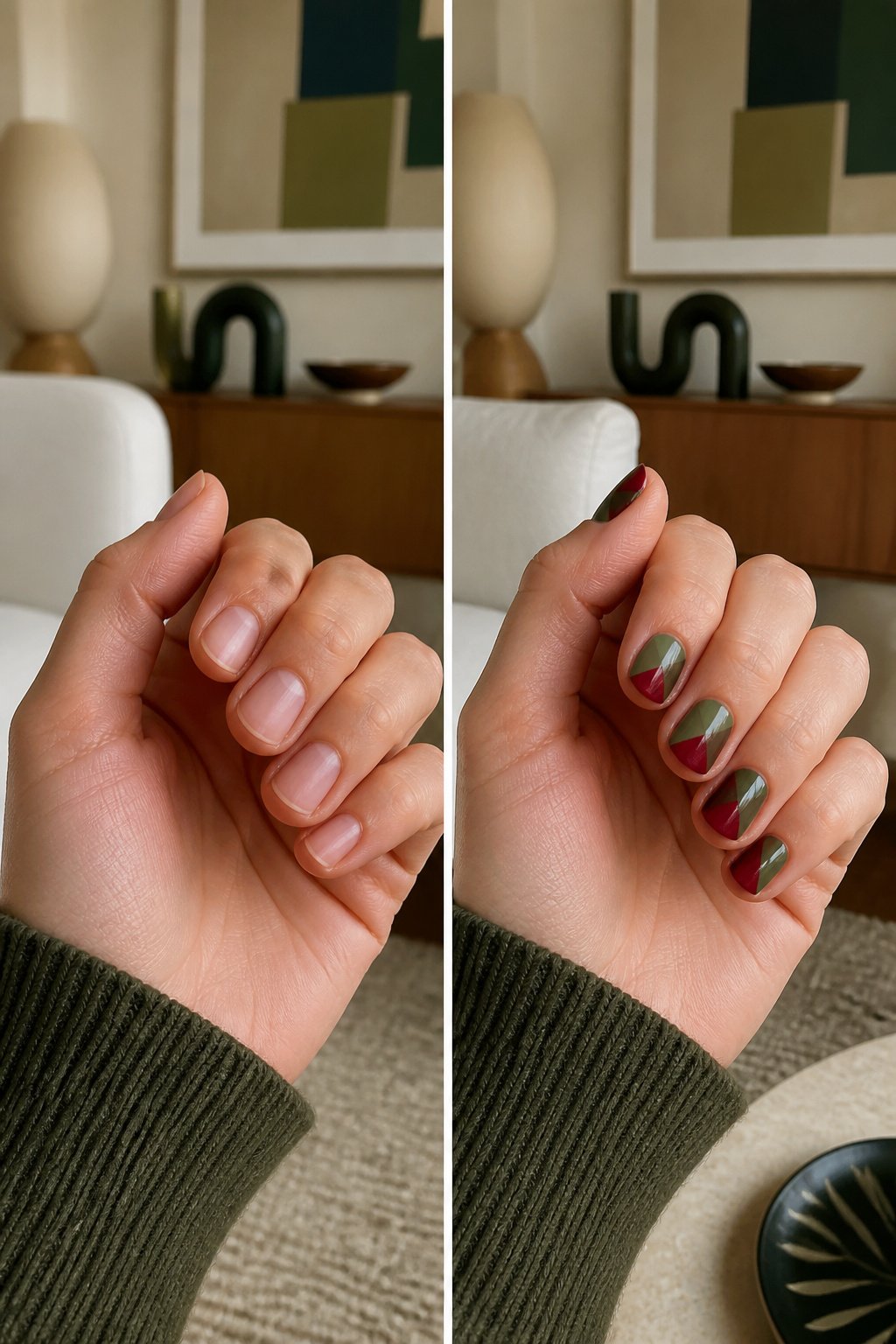
Color-blocking deep red against olive green reads as intentional geometry instead of a gradient that tries to marry the two. The first time I saw this done well, the split ran at an angle across each nail, maybe one-third crimson and two-thirds olive, enough that neither shade felt like an afterthought. Get closer to fifty-fifty and the eye starts reading two competing manicures; tilt too far and the minority color looks like a repair job. A 70/30 or 60/40 split keeps one tone dominant while letting the second register as design rather than mistake. The source that stuck with me used different hands entirely, one coated in each shade, which also works but demands more commitment to the pairing.
15. Multi-Spotted Designs
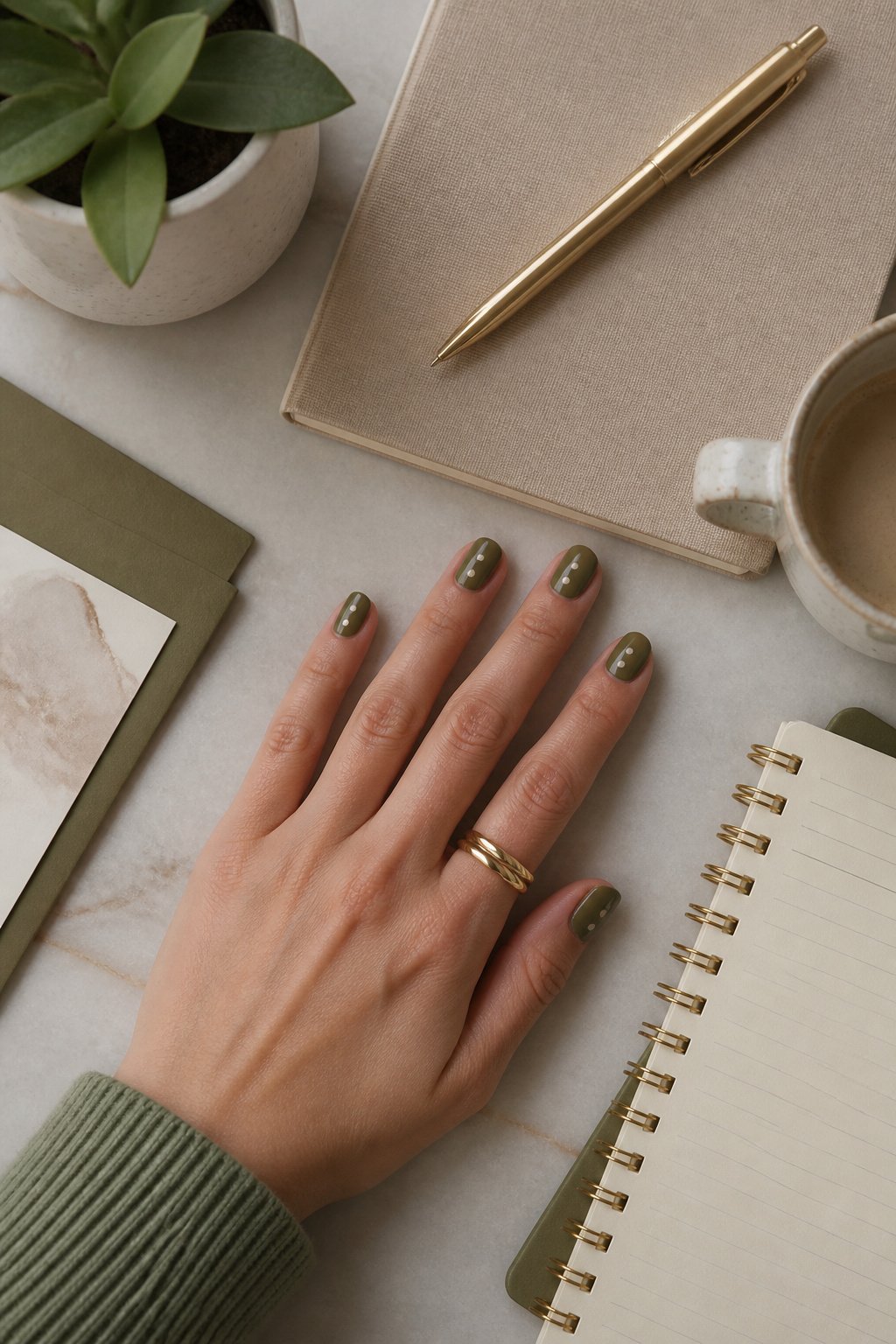
Two dots per nail lands in a sweet spot where the eye reads intention instead of error. Place the pair at the same height on every finger, and the hand becomes a single pattern rather than ten random marks. Offset them slightly toward the tip or the cuticle, but keep the direction consistent; mirror images from nail to nail break the rhythm and look like a slip of the tool.
The spacing matters as much as the placement. A gap roughly the width of one dot creates a visual breath between them; anything tighter and they merge into a short bar, anything wider and they start to compete. On shorter nails, two dots max out the real estate without crowding. On longer shapes, the same pair stays minimal and clean.
Color choice keeps the graphic edge sharp. Olive nails carry enough earth tone that a cream or warm beige dot reads as contrast without shouting. I have seen this done with a near-black olive base and bone-white accents, and the result felt like a print rather than nail art, the kind of thing that works with a stacked ring or a bare hand equally well.
Why Olive Nails Took Over
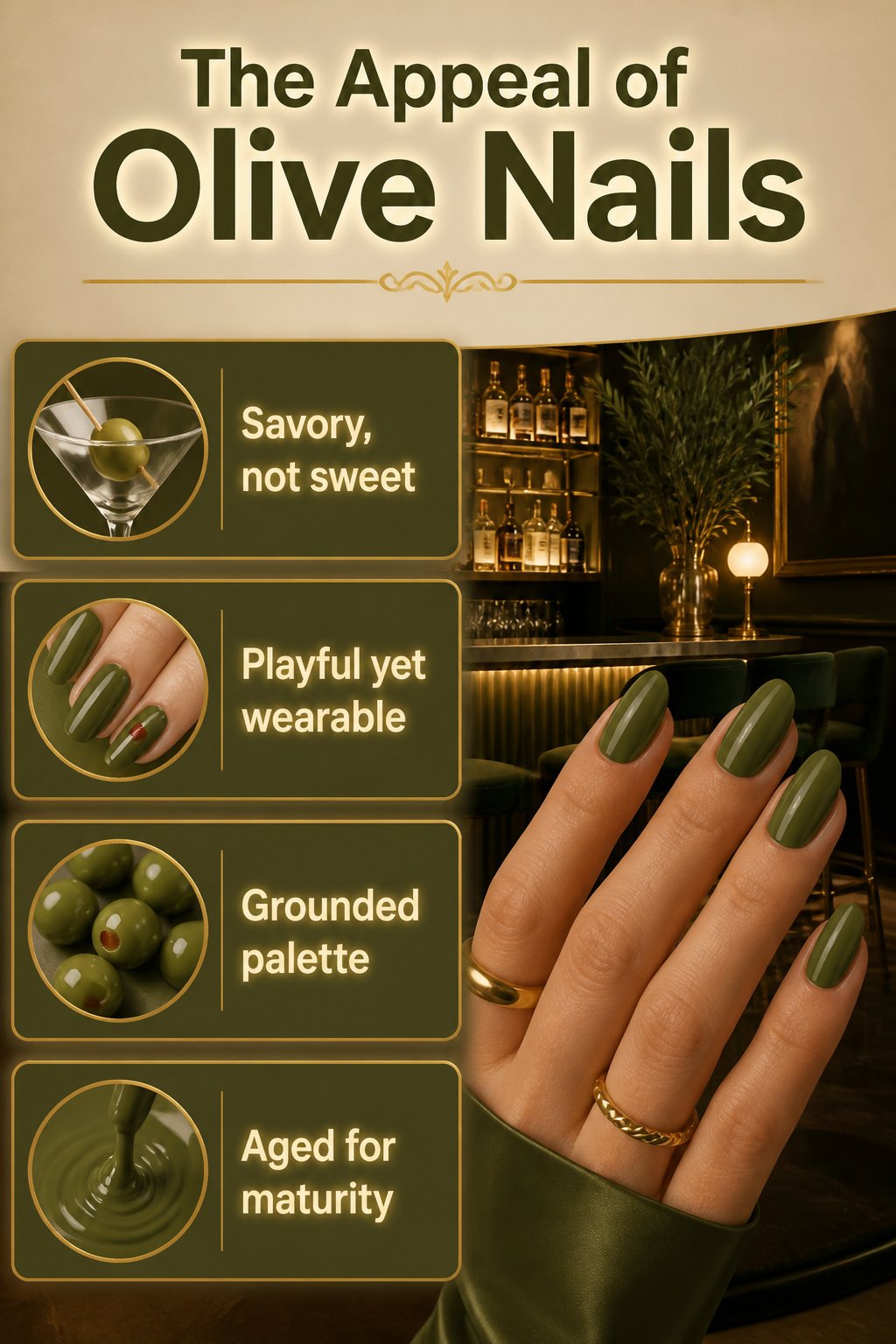
Sweet nail cravings have had a long run. Strawberry milk, blueberry milk, glazed donut finishes, back-to-back seasons of them, and by the end the whole register started feeling like a dessert menu aimed at someone half your age. The shift to savory is what makes olive nails feel adult rather than childish. Olive green sits in the same food-inspired territory, but it reads as something you’d order at a bar, not a bakery. Dirty martini manis, Castelvetrano almond tips, brined 3D gel, even tiny red rhinestoned pimentos: the references are playful, but the palette is grounded enough to wear from a work call through happy hour to Valentine’s Day without the polish feeling like costume. That balance, whimsical yet wearable, is why the trend stuck. Pastels ask you to step into a mood; olive green meets the one you’re already in.
Color Pairings That Work
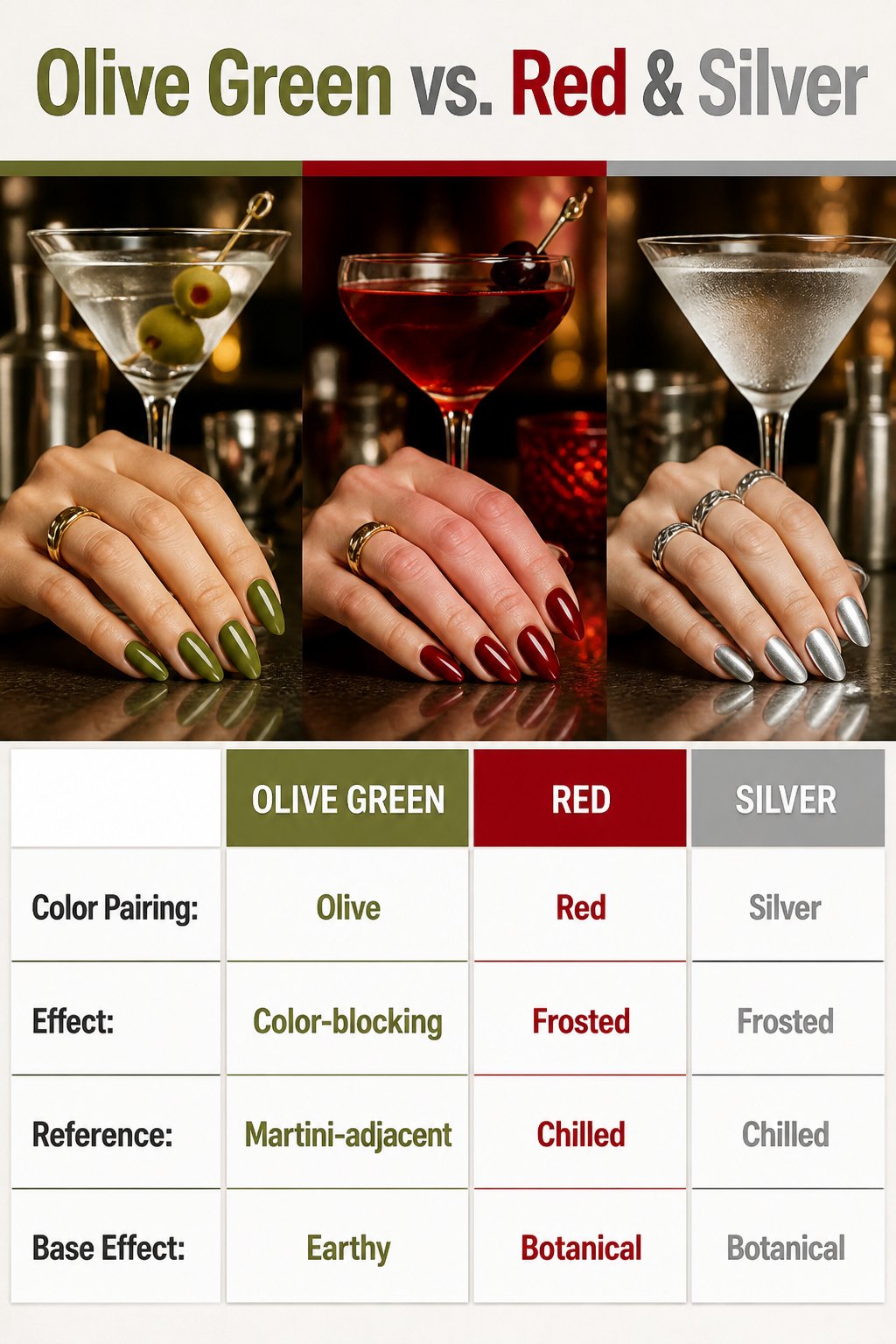
Olive green sits in an odd spot on the nail wheel: too yellow to read as forest, too muted to pass for neon. That middle position is exactly why red turns it into a cocktail reference while silver keeps it there and nude pulls it somewhere else entirely.
The pairing that keeps coming up is olive against deep red, split across two hands. The effect is deliberate color-blocking, not an accent nail but a full opposing set. It reads martini-adjacent because the two shades map onto the drink itself: the brine, the garnish. Silver or chrome on a second hand pushes that further into frosted-glass territory, the kind of manicure that looks chilled rather than warm.
Nude is where the reference breaks. A nude base with olive art or tips moves the set toward something earthier, more botanical. The shade of nude matters here: anything with peach or pink undertone fights the green, while a beige or taupe lets olive sit forward as the single accent. Chrome, by contrast, doubles down on the bar cart mood. Silver metallic catches light the way a chilled glass does; the eye reads temperature before it reads color.
Techniques for Texture and Dimension
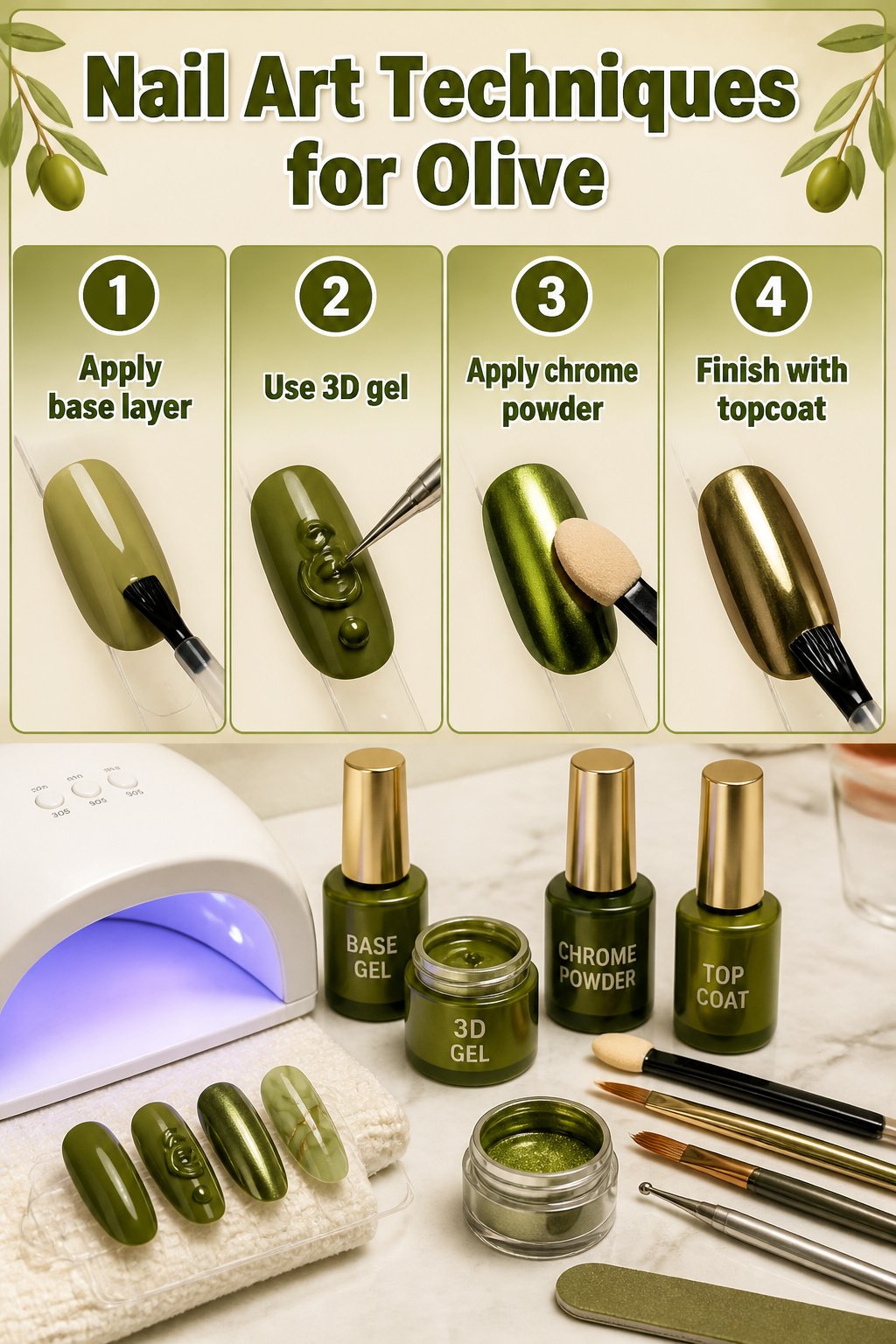
3D gel builds its shape in layers, and the olive base makes the shadow read as depth rather than decoration. A home kit with a small UV lamp can manage a single accent nail, maybe a thin coil or a dot that sits above the surface. Full sculptural coverage, the kind that catches light from three angles, needs a salon lamp with real wattage and a steady hand that has filed off a hundred previous attempts.
Chrome powder is the opposite problem: the tool is cheap, a little sponge applicator, but the surface underneath has to be glass. Any bump telegraphs through that metallic skin like a wrinkle under satin. Jelly and glazed finishes sit in between. Jelly wants a translucent gel polish, two or three sheer coats, and patience while each one self-levels. Glazed is more forgiving; it is essentially a milky topcoat over a solid color, and a decent drugstore version will get you most of the way there. The chrome look, though, still belongs in a salon if you want it to last past the first dishwashing.
Frequently Asked Questions
What are olive nails?
Olive nails are a manicure trend built around olive green polish, inspired by the dirty martini drink and actual olives as a savory alternative to years of sweet, dessert-themed nail art. The look ranges from a single coat of olive polish to literal designs with tiny red pimentos, 3D gel accents, or martini glass art. The palette reads as playful but adult, wearable from work through happy hour without feeling like costume.
How do you achieve the olive nail look?
Start with an olive green polish that carries enough brown in its base to avoid lime or forest territory, then add a glossy top coat to keep it from looking like hardware-store green. For literal designs, use small red accents placed asymmetrically, no wider than a pimento, or build 3D shapes with gel builder kept under two millimeters at the center so they do not catch on daily objects. A quality polish plus dedicated top coat typically lasts a week without chips.
What designs can I try with olive nails?
Options include a single glossy coat of olive polish, glassy cat-eye finishes with a red dab, jelly builds with maroon micro-dots, silver chrome for a frosted cocktail effect, French tips with a red dot at the smile line, color-blocked splits of olive and deep red, 3D sculpted olives, studded chrome pits, kiss prints with rhinestones, or full martini glass art on one or two accent nails. Each design keeps the olive green dominant and the red accent small and off-center to avoid reading as Christmas.