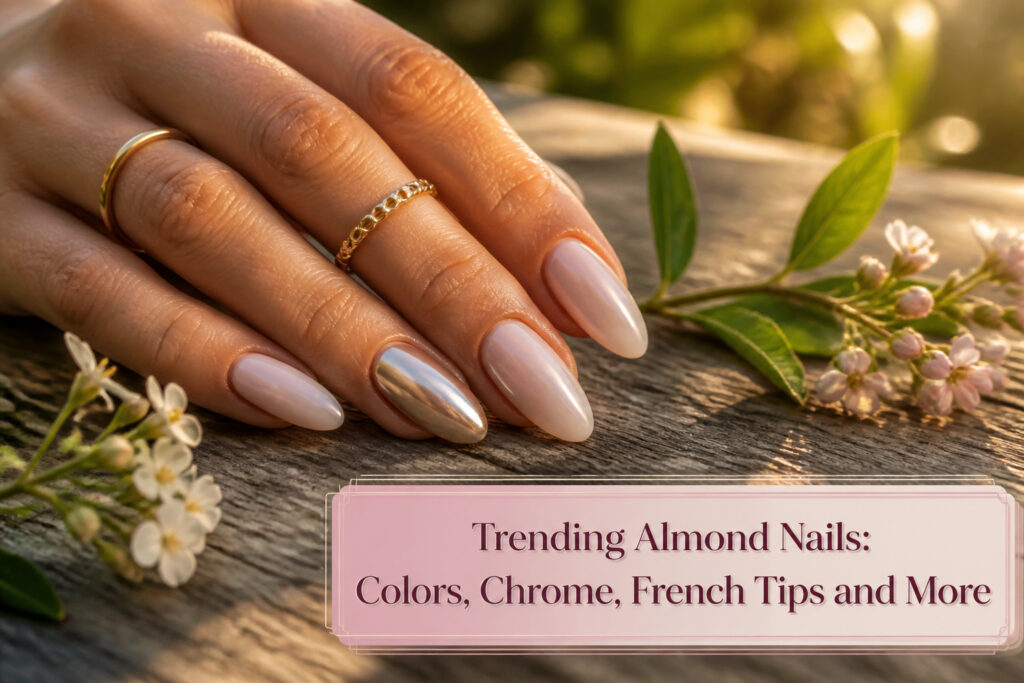
Trending almond nails are the elongated, tapered shape that dominated 2026 runway and salon requests alike. The catch is the filing angle: hit 25 degrees wrong and the elegant point collapses into a blunt oval or a sharp stiletto wobble. Georgia Rae, the celebrity manicurist who shaped the look for early adopters, notes that the true payoff comes when a sheer or milky shade follows the taper uninterrupted, letting the silhouette do the lengthening work that color alone never could.
Milky White Almond Nails
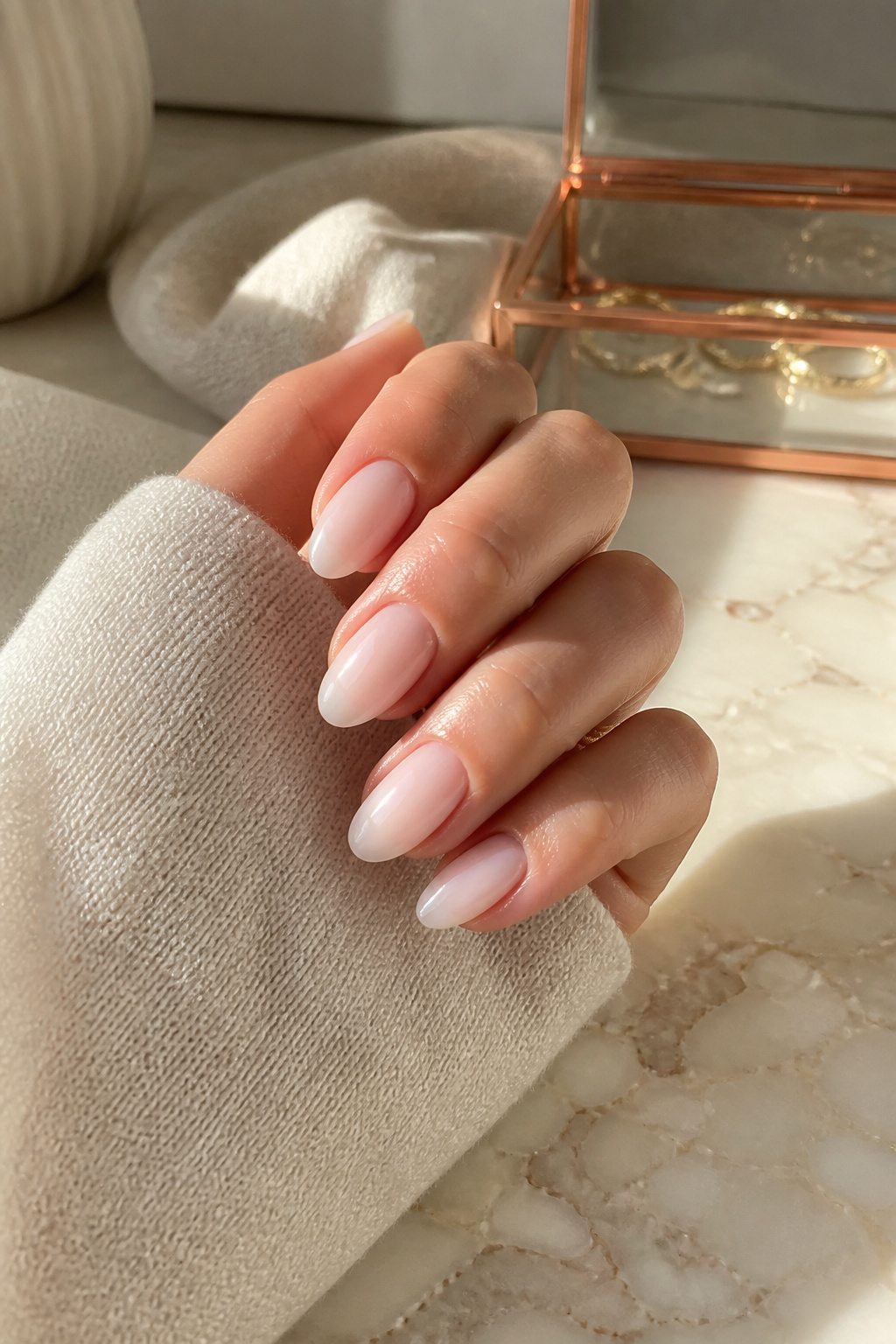
Milky white polish on an almond shape does something no other pairing quite manages: it turns the nail into a clean, uninterrupted line that pulls the eye straight to the tapered tip. The slight sheer of the color keeps the look from reading as harsh white-out, so the lengthening effect feels believable rather than theatrical. One coat of OPI Funny Bunny gives that translucent, creamy finish; two deepens it without losing the glow.
The almond form matters here more than it would with a bold color. A square edge would break the soft wash of milky white into a hard stop, but the gradual narrowing of the almond lets the shade flow to a point. Celebrity manicurist Georgia Rae notes that a true milky shade can carry a hint of pink, beige, or peach beneath the white depending on skin tone, which keeps the elongation from looking artificial against your hand.
For at-home wear, press-ons solve the shaping problem entirely. Glamnetic makes a set that arrives already tapered to the almond form, so the milky color sits exactly where it should without a steady filing hand. The finish reads as expensive and clean, the kind of manicure that works for a Tuesday meeting or a Saturday wedding without changing a thing.
Glazed Nude Almond Nails
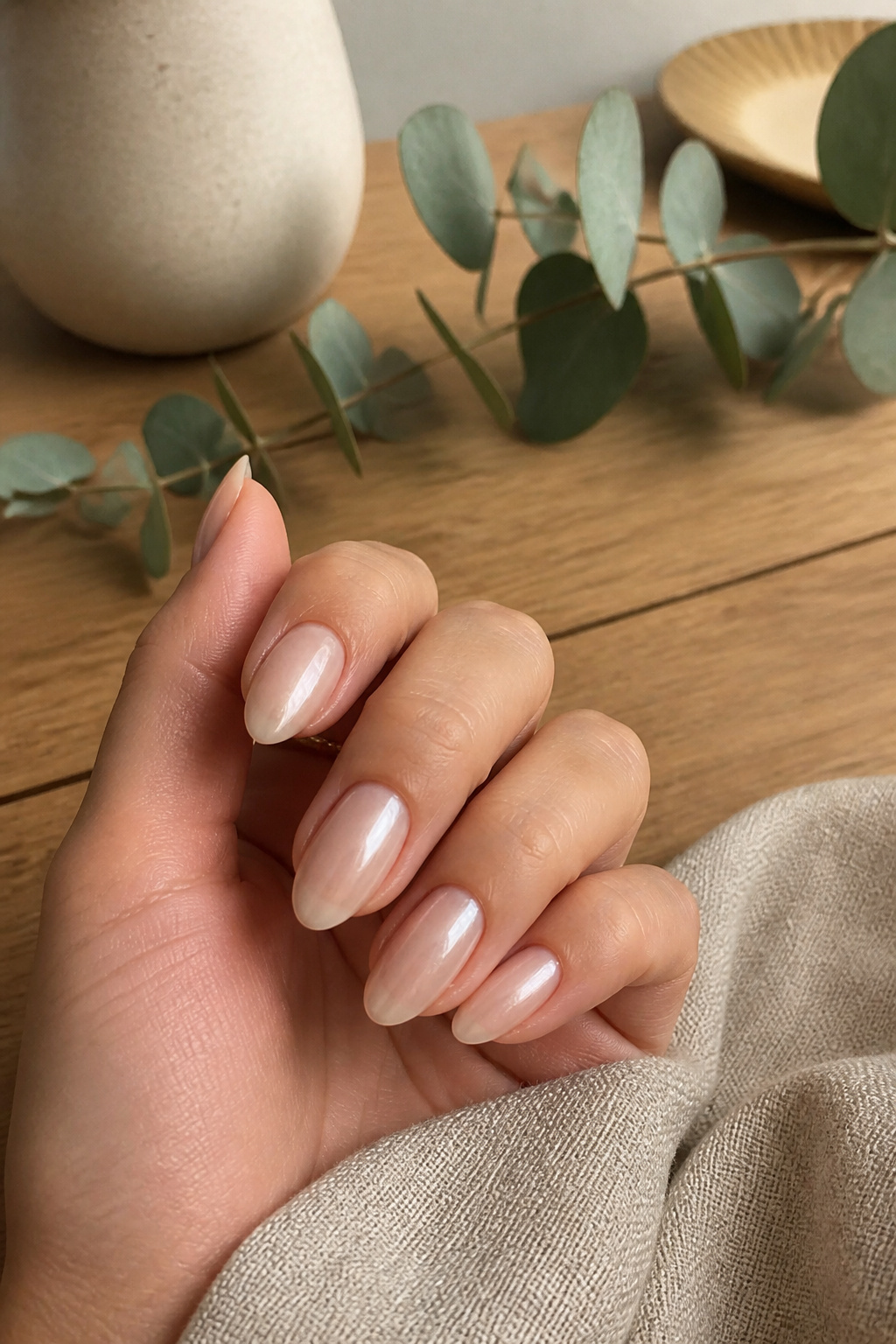
The glazed nude look on almond nails reads as skin-tone-matching quiet luxury rather than bare minimalism. A sheer polish base catches light like healthy nail plate, and a pearlescent powder brushed over the top gives that glazed donut finish without the frostiness of a full chrome. The effect is your own nails, only longer, slimmer, and more deliberate.
File at a 25-degree angle to keep the almond taper from going too round or too sharp. That angle preserves the slim point that makes this delicate color work, because a blunt tip turns nude polish into a missed manicure rather than an enhancement. The shape does the lifting here: the glaze just follows where the filing already went.
Simple Dotted Almond Nail Designs
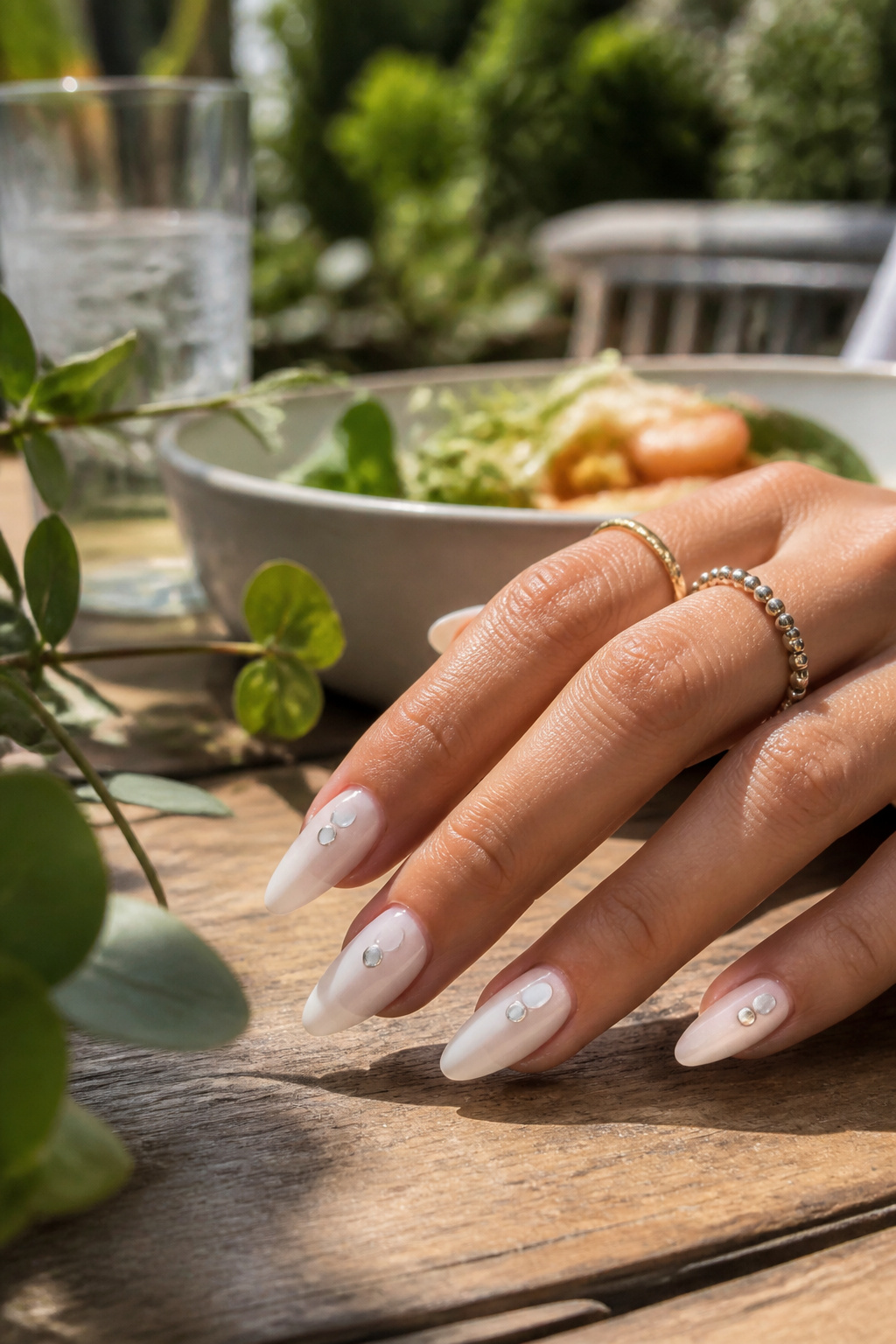
The almond shape does something useful with dots that squarer shapes do not. The taper toward the tip creates a natural frame, so a single dot placed near the free edge reads as intentional rather than accidental. I have seen this work with a milky white base and a single silver glitter dot, or with the dot clustered slightly off-center for asymmetry.
For beginners, the tool matters less than the pause. A toothpick, a bobby pin, or the round end of a dotting tool all work; the common mistake is rushing the second dot before the first sets and dragging it into a smear. Let each dot dry to the touch before adding another, which takes roughly a minute in normal room temperature.
Scattered placement reads differently than regimented rows. One or two dots per nail, positioned where the almond taper narrows, keeps the look minimal without tipping into childish. A pink cat-eye base with small white dots shows how the contrast in finish, matte against shimmer, does more work than size or number.
Clean Girl Almond Manicure
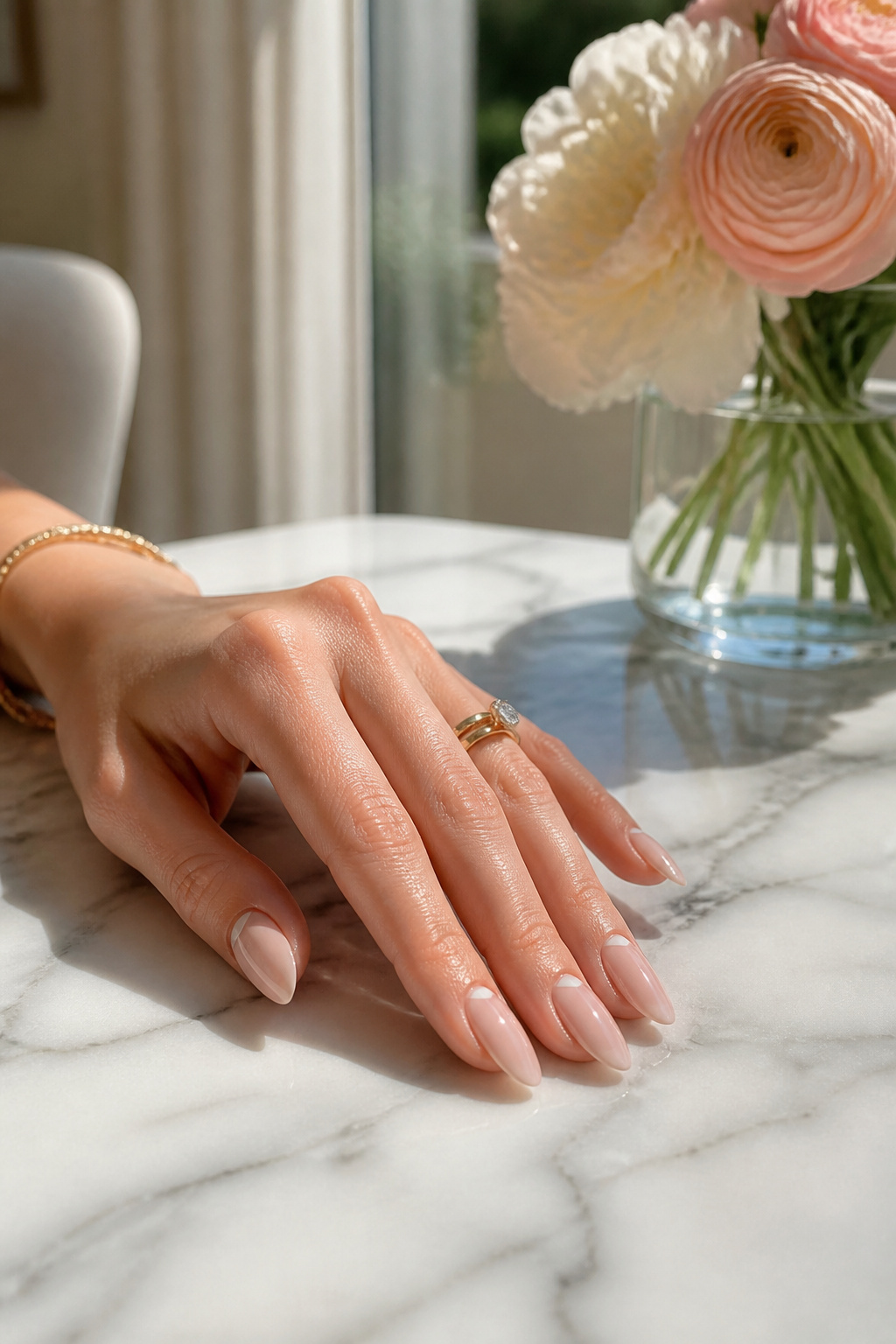
The clean girl aesthetic lives or dies on whether the nail looks like it grew that way. Almond shapes win here because the tapered tip follows the actual curve of a finger, where a square edge always reads as a decision someone made at a salon.
A sheer nude polish with a natural gloss does most of the work. The half moon at the base, kept in a soft white, mimics the look of healthy cuticles that have never seen a cuticle nipper. Almond nails carry this better than coffin or stiletto shapes because the line stays soft all the way to the tip; nothing about it asks for attention.
The filing angle matters more than the color. A 25-degree taper at each side creates that elongated oval without sharpening into a point. Tom Bachik, who manicures for the celebrities who started this look, calls almond his default shape for exactly this reason: it lengthens the finger without looking like it tried to.
Cuticle care is the actual product here, not the polish. The almond shape just gives that care somewhere honest to live.
Simple Celestial Almond Nail Art
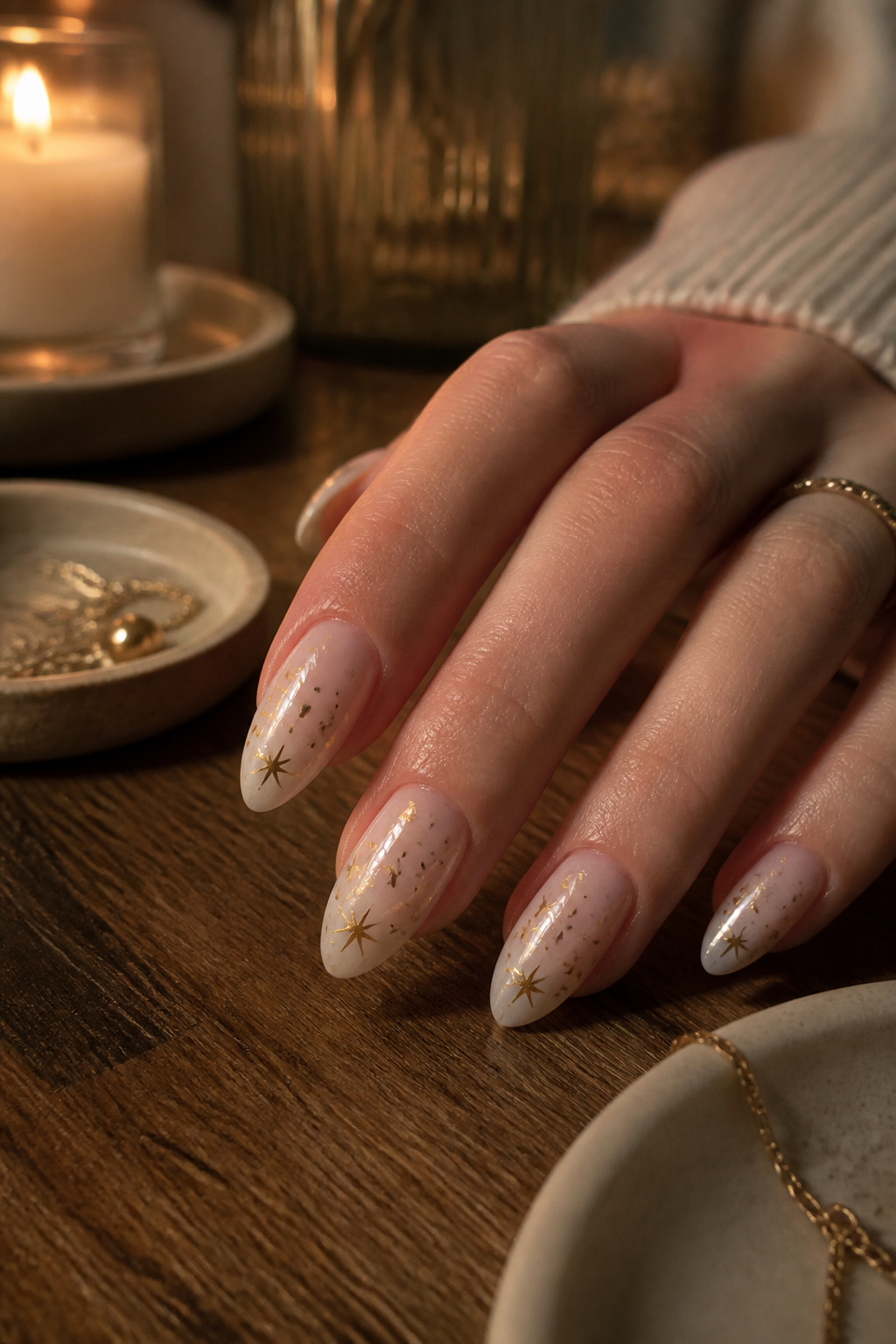
The almond’s rounded point sits naturally under a vertical trail of stars, almost like the shape was designed for it. That taper gives you a clear runway for a thin line of metallic silver or gold dots that read as a constellation without crowding the cuticle. Scatter a few smaller accents near the sidewalls and the eye travels the whole length of the nail instead of parking at the tip.
Nail art stickers make this genuinely accessible. A milky white base, a set of gold star decals pressed on before the top coat, and the whole thing looks intentional enough for a concert or a Monday morning. The stickers handle the precision that freehand usually botches, and they lie flat enough that you won’t catch an edge on your keys by Wednesday.
Cute Pink Almond Nails
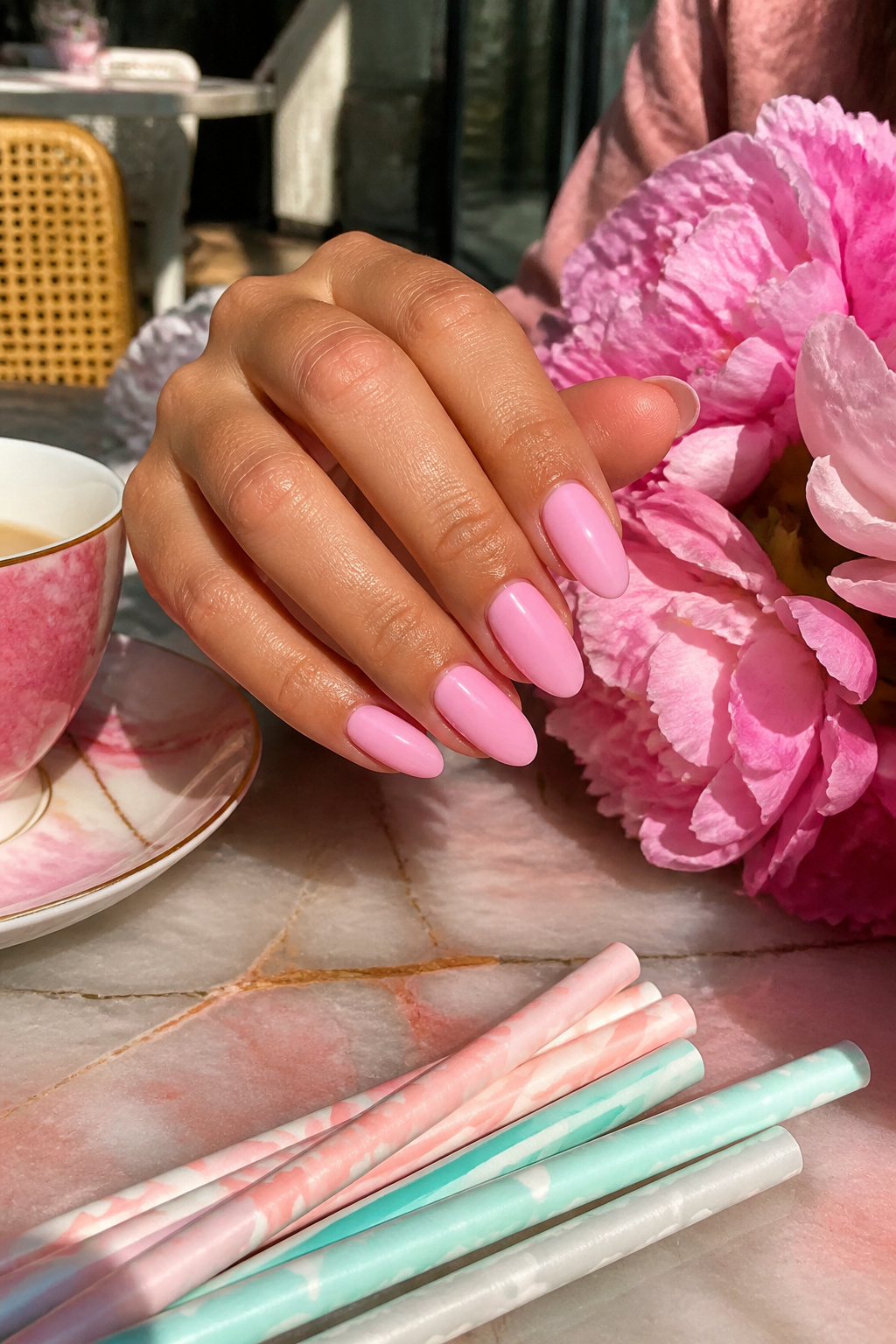
Bubblegum pink on an almond shape reads softer than the same bottle on a square tip. The taper narrows the visual weight, so the color floats instead of shouting. Dusty rose does the opposite trick: on squarer nails it can look like a neutral you settled for, but the almond point gives it enough edge to feel chosen, even deliberate.
Pastel pinks especially need that taper to escape the junior-high associations they pick up on blunt shapes. The elongated silhouette stretches the color out until it reads as adult. Hot pink, meanwhile, gets wearable rather than wild. Celebrity nail artist Queenie Nguyen uses a blushing pink at the center of a milky backdrop for an ethereal effect that still photographs well, and the technique works because the almond shape keeps the whole thing from tipping into costume.
What convinced me, looking through the summer collections, is how the same pink family covers almost every occasion once the shape is right. Bubblegum for weekend errands, dusty rose for meetings, a saturated hot pink on the tips for nights out. The almond form does the filtering so you do not have to think as hard about where a color belongs.
Pink Aura Almond Manicure
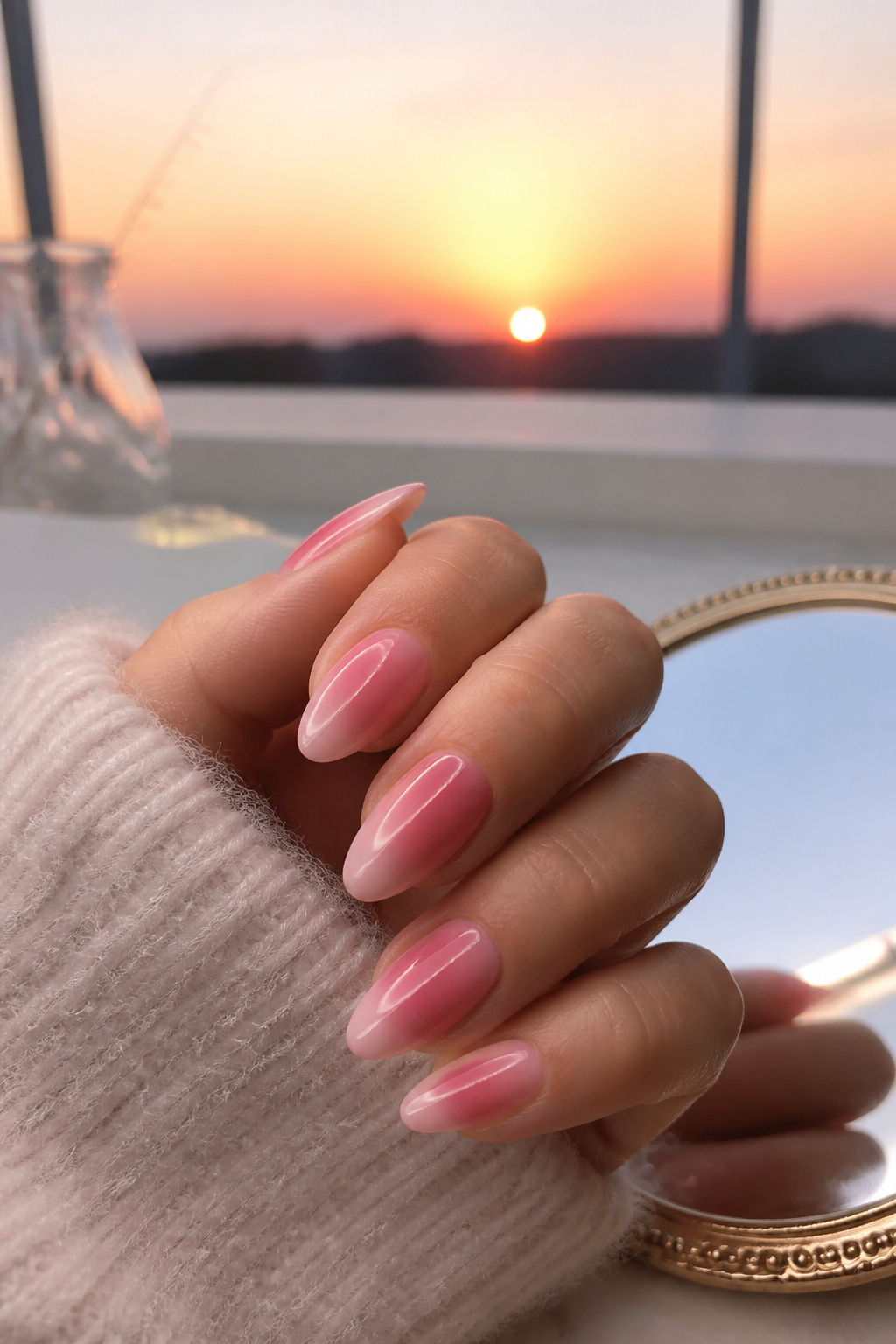
The pink aura almond manicure gets its glow from a diffused ombre center, airbrushed so the color looks like it sits inside the nail rather than on top. Blush tones work best for this, and the almond shape carries the gradient better than a shorter square or round would. The length gives the color room to fade from a soft halo at the center out to barely-there edges at the tip.
I noticed the same design on shorter nails tends to read as a smudge instead of a spotlight effect. The rounded tip of an almond shape catches light right where the pink is densest, so the whole nail looks lit from within. For 2026, the shade to ask for is that barely-pink flush, like the color your fingers turn after a warm shower.
Press-on sets have caught up to salon gel for this particular look. The airbrushing is already baked into the design, and the almond length in those kits is long enough to show the gradient without crossing into impractical territory.
Pink Rose Almond Nail Art
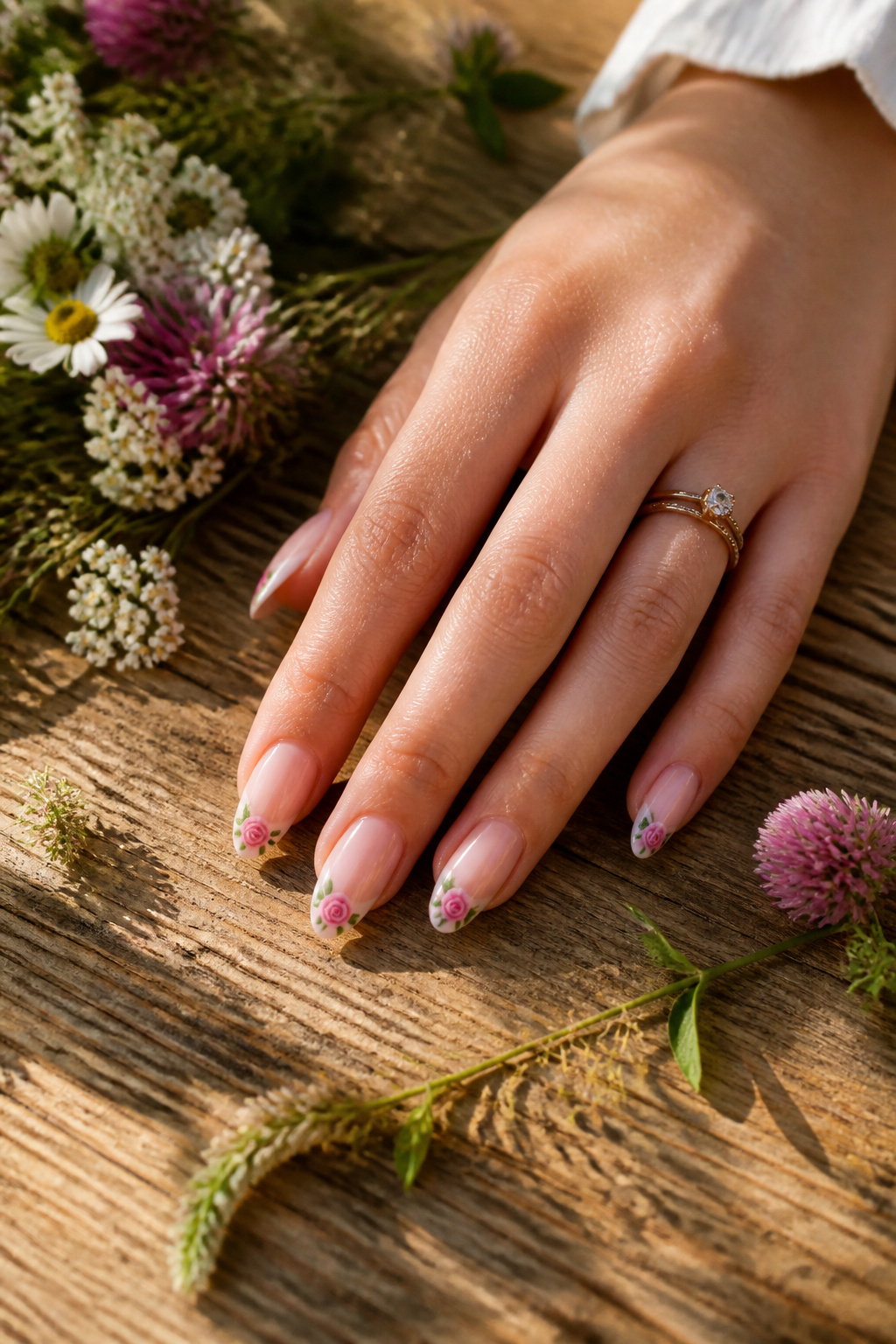
A single rose painted at the stress point, where the almond shape narrows, draws the eye to the slimmest part of the nail rather than fighting the taper. That placement took me a while to appreciate. I used to center florals on the nail bed the way you would on a square tip, and the design always looked off-balance, heavier toward the free edge than the cuticle.
Climbing vines work better when they follow the length of the almond, not across it. A stem that starts near the cuticle and trails toward the tip echoes the natural line and makes the finger look longer. Hand-painted vines give you control over the curve; stickers tend to come straight, so you either warm the adhesive slightly to bend them or accept that they will read as a band across the nail rather than a path.
A pale pink base with a deeper rose at the stress point flatters most skin tones without the contrast getting theatrical. If you are doing this yourself, paint the base, let it dry to a dull finish, then lay the rose detail in a slightly more saturated shade so it sits forward visually. Top coat goes on last, and only after the art has set, or the colors bleed into each other and the rose turns muddy.
Pink Almond French Manicure
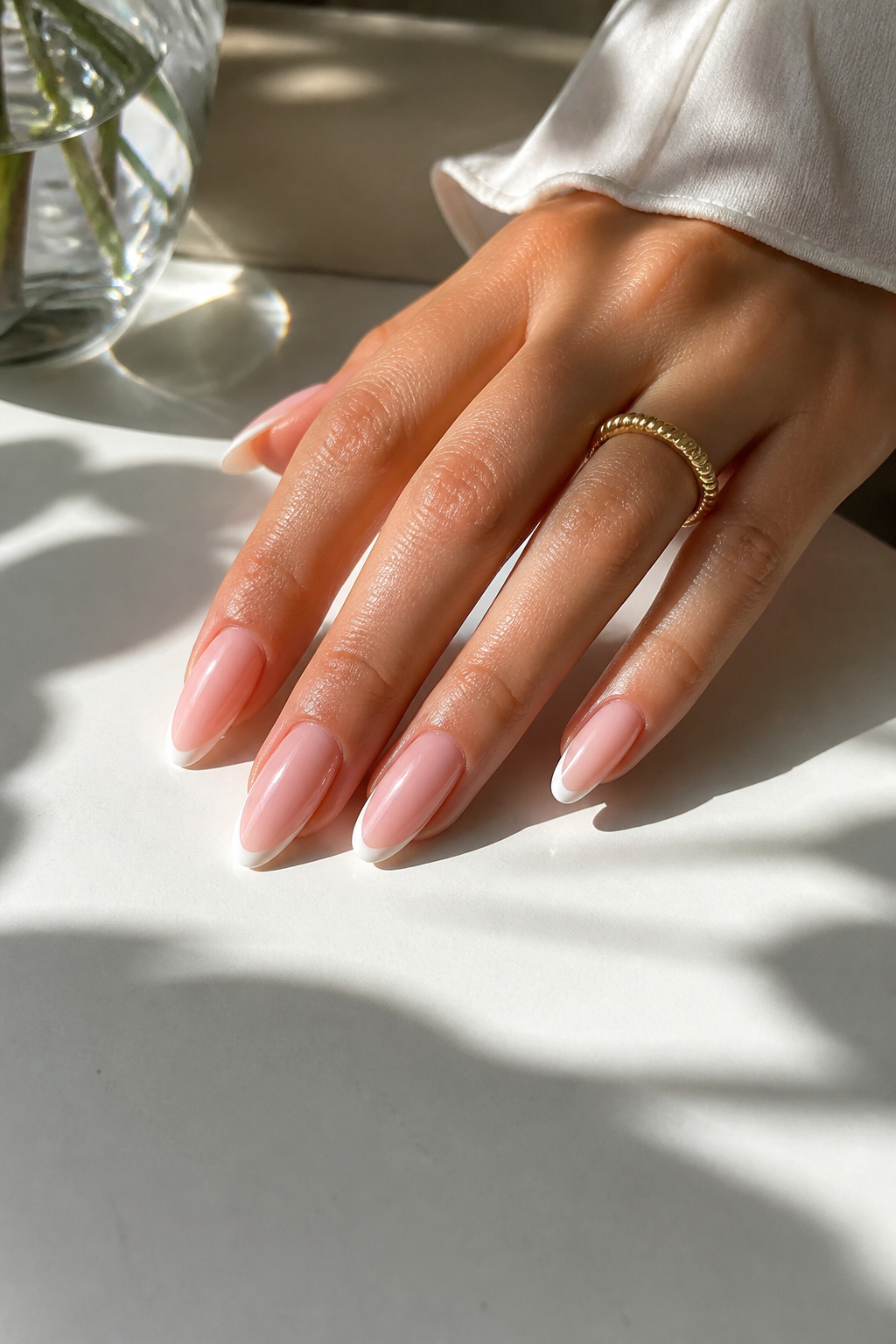
The pink base changes how the French manicure reads on an almond shape. A softer pink undercoat warms the whole hand, and the tapered tip lets the smile line arc higher and tighter than it would on a square nail. That curve matters: the almond’s natural point draws the eye upward, so a thick white band looks like a cap sitting too heavy on the end. A thinner line, closer to a micro French, keeps the proportion honest and the elongation the shape is there for.
The outline detail some nail artists are adding, a slightly deeper pink tracing the smile, gives the eye somewhere to land without turning the whole tip into a stripe. On my own almond nails, that thin contour has felt more modern than the classic white block I wore for years. The shape does the work; the line just follows it.
Pink Cat Eye Almond Nails
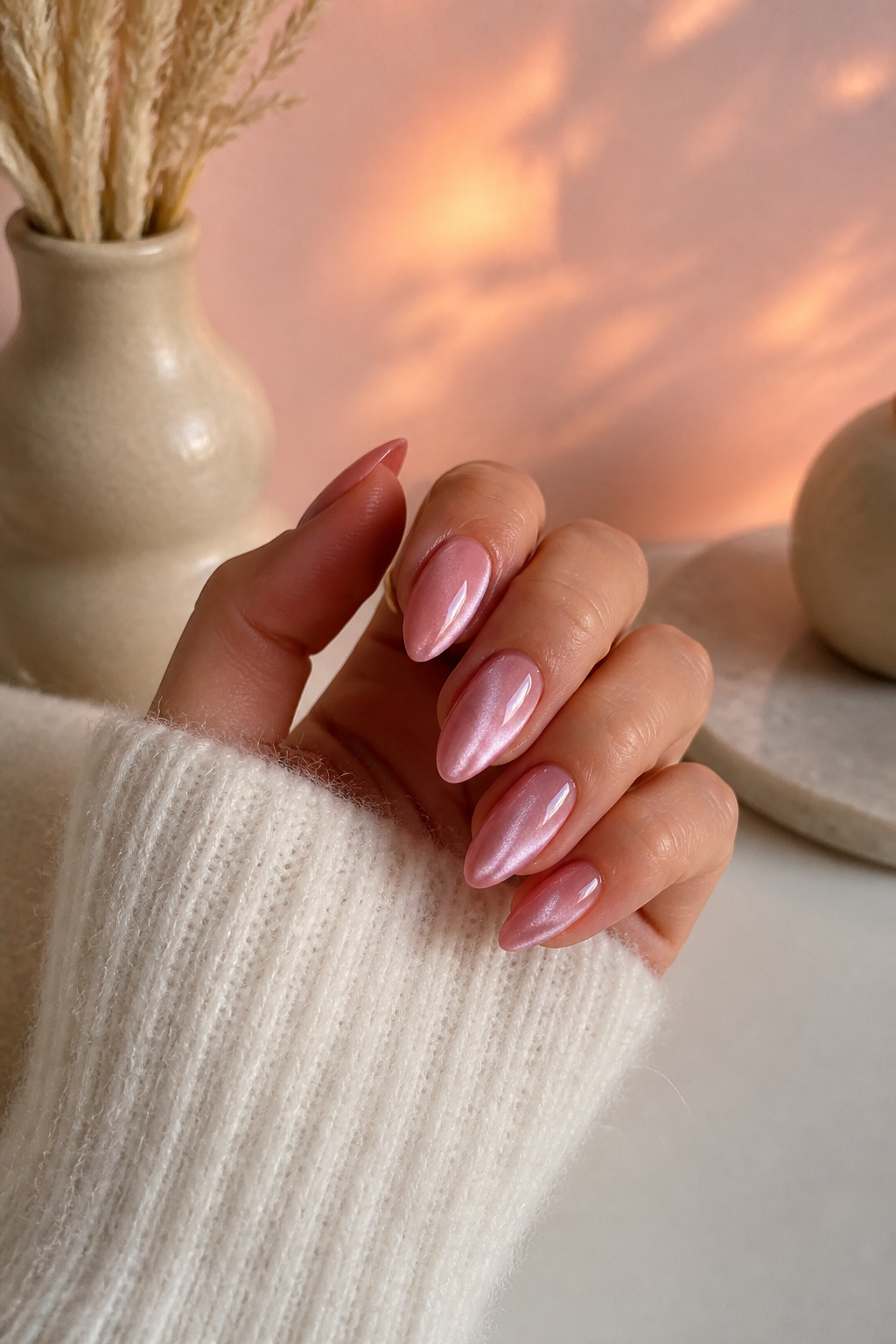
The magnetic cat eye gel effect looks especially sharp on an almond shape because the light streak runs straight down the nail’s length and lands right at that tapered point. Pink tones soften the drama just enough for everyday wear; the result reads as polished rather than theatrical.
For at-home attempts, the gel polish needs a steady hand with the magnet held close during the curing step. The streak shifts if you bump it, so work one nail at a time under the lamp. A pale pink base with a silvery cat eye layer on top gives the most forgiving finish, since any unevenness in the magnetic line blends into the lighter color rather than shouting across a dark one. The almond length helps here too: the narrower tip means less surface area to control, but also less room to hide a wobble.
Dimensional Red Almond Nails
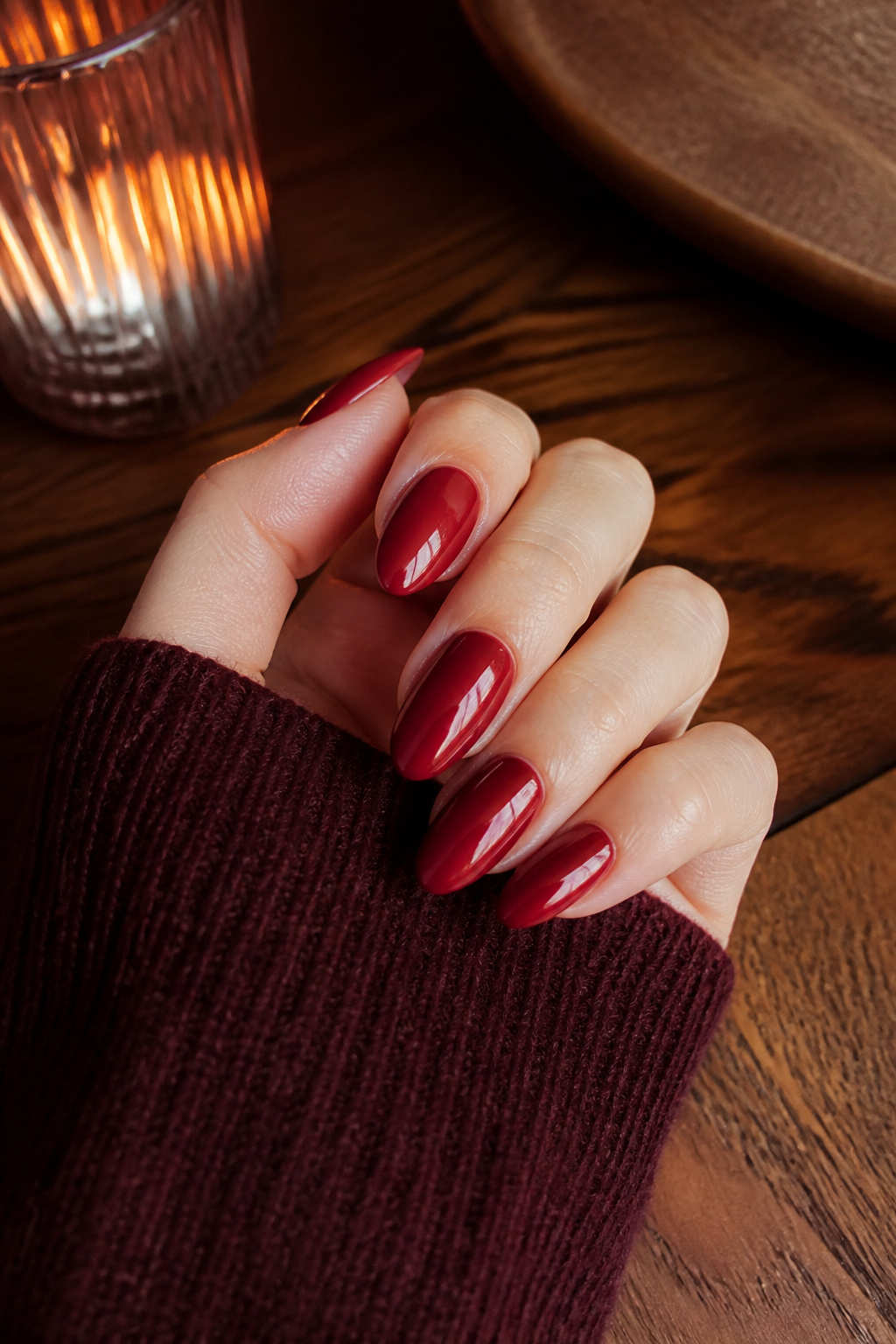
Layered red finishes on an almond shape do something flat reds never manage: they catch light at the free edge and sink it back toward the cuticle, so the nail looks almost wet from certain angles. Jelly reds stacked two or three coats deep create that depth without any glitter at all, though a single layer of encapsulated glitter, sealed under builder gel before the color goes on, turns the whole nail into a lamp-lit thing. The almond length matters here. Short squares cut the light off too early; the curve of an almond tip gives the layers enough real estate to shift and pool the way they’re supposed to. I tried a cat eye magnetic polish in this shape last season, and the shimmery streak it pulled across the nail only read because the almond length let it travel. For a simpler route, sponge a dark burgundy over bright red at the tip and fade it down. The technique is basic, but on a long almond nail the ombre reads as dimensional rather than just two colors meeting.
Red and White Almond Nail Designs
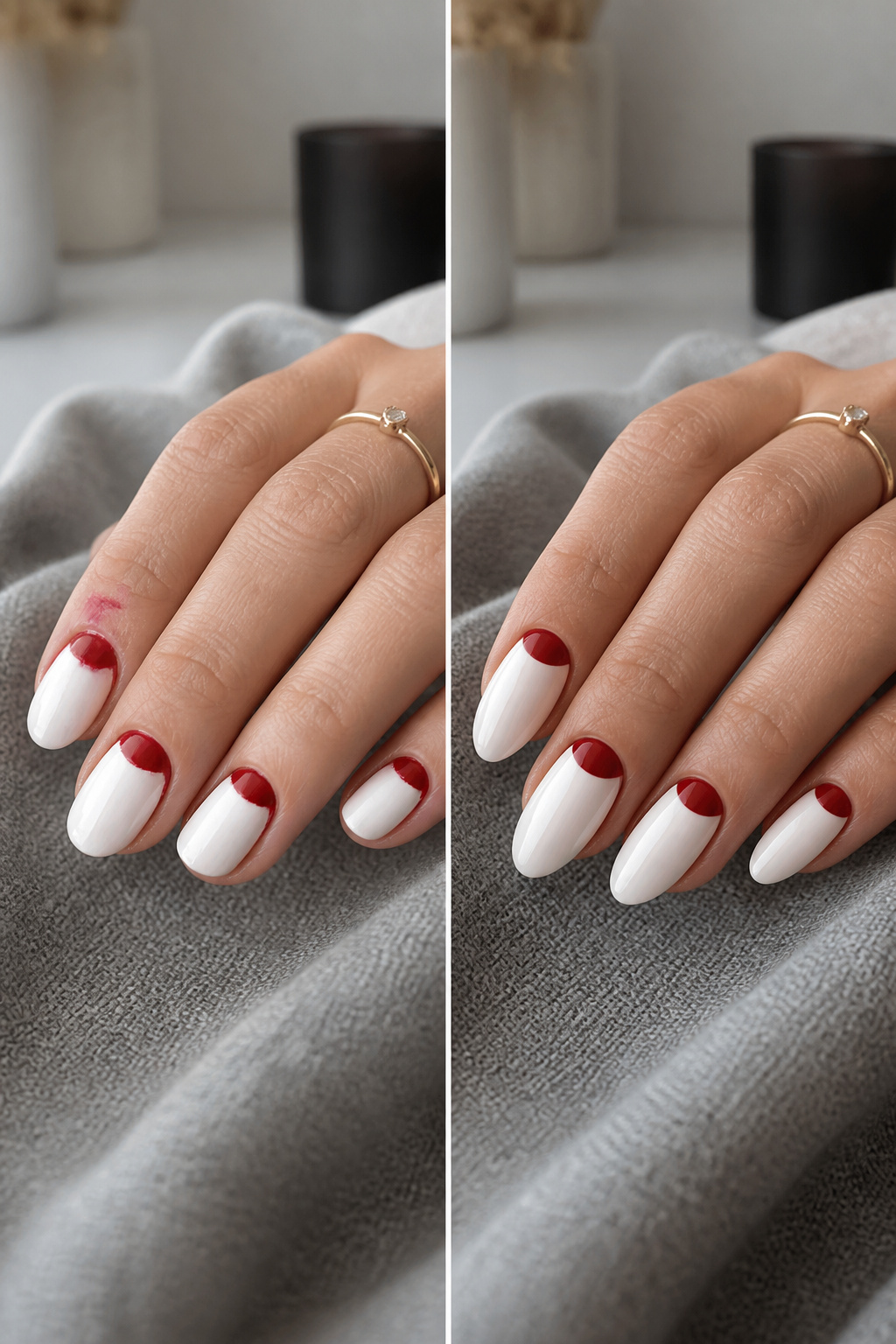
Red and white on an almond shape hits differently than it does on a square. The taper gives the eye a natural path to follow, so placing the point of contrast near the free edge keeps the look intentional rather than loud. A half-moon at the base in red, with the body in white, draws attention upward and makes fingers look longer. Flip it, and the red sits where the nail narrows, which reads as sharper.
Color blocking works best when the split follows the curve of the cuticle or runs diagonally across the nail. A straight horizontal line fights the almond’s slope and looks like a mistake. Geometric splits, thin triangles of red pointing toward the tip, use the shape the way it wants to be used. The point becomes the focal area without needing extra embellishment.
White as the dominant color keeps this wearable for everyday; red dominant reads evening. My own preference is a thin red chevron at the tip over a white base. It is clean enough for a Tuesday meeting and still looks deliberate. The almond length matters here. Too short, and the geometry collapses. Too long, and the red starts to look aggressive where the nail narrows.
Red Chrome Almond Manicure
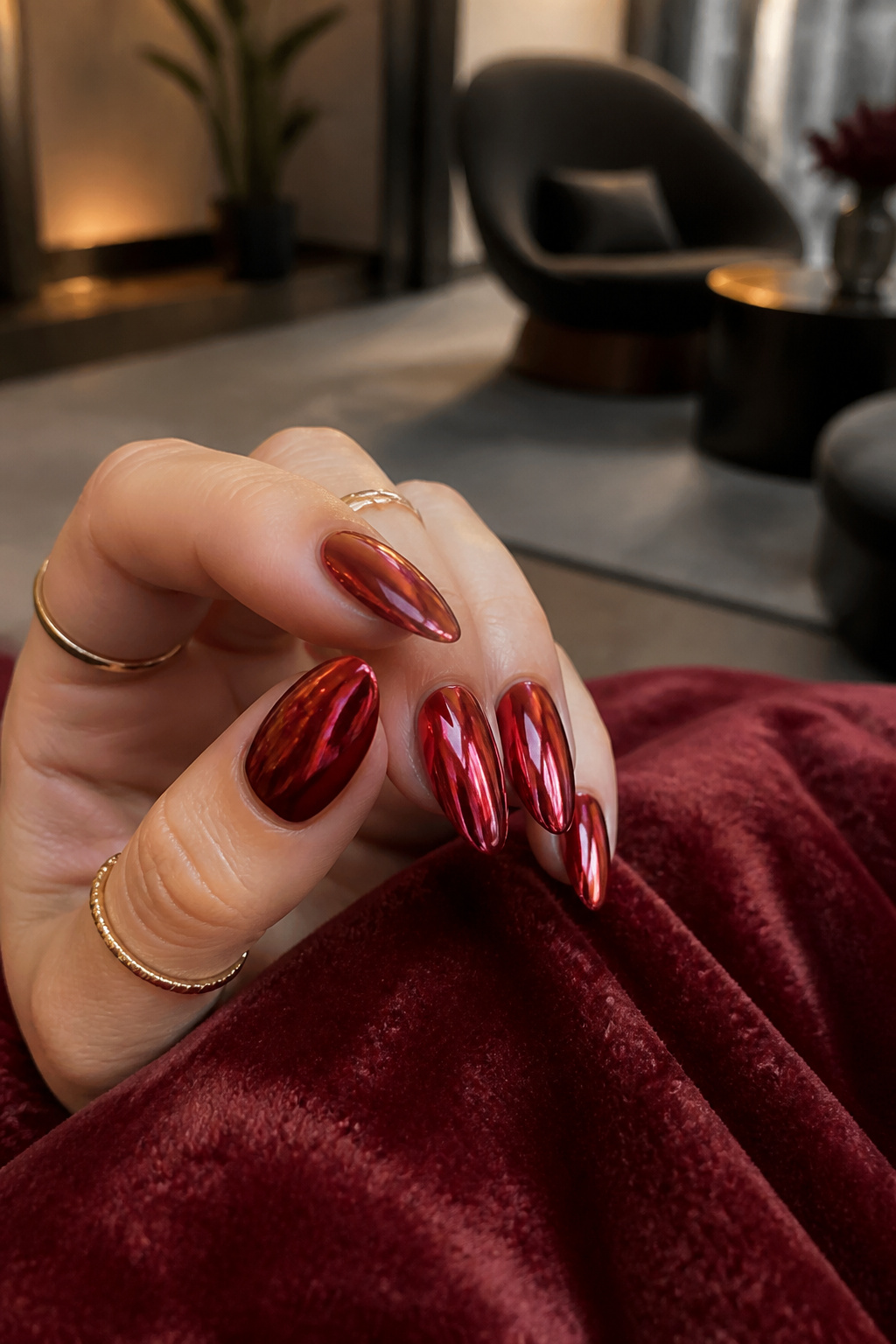
Red chrome over an almond base reads expensive from across a room. The mirror finish needs a true gel system, not regular polish, because the chrome powder buffs onto a no-wipe top coat that only cures under a lamp. The tapered sides of the almond shape catch light at two angles, so the reflection travels the full length instead of sitting flat like it would on a square tip. A classic cherry red underneath keeps the look from veering into costume territory; the chrome layer transforms it into something that feels current rather than retro. Budget for the gear. A decent LED lamp runs about what two salon visits cost, and the powder itself is inexpensive once you own the setup. The real risk is skipping the curing step between layers, which leaves a grainy, half-mirror finish that no amount of top coat fixes. If your lamp is aging, replace the bulbs before you start. Weak curing is the mistake that turns this mirror-like finish into a dull smear, and the almond taper makes every flaw visible.
Ombre Red Almond Nail Ideas
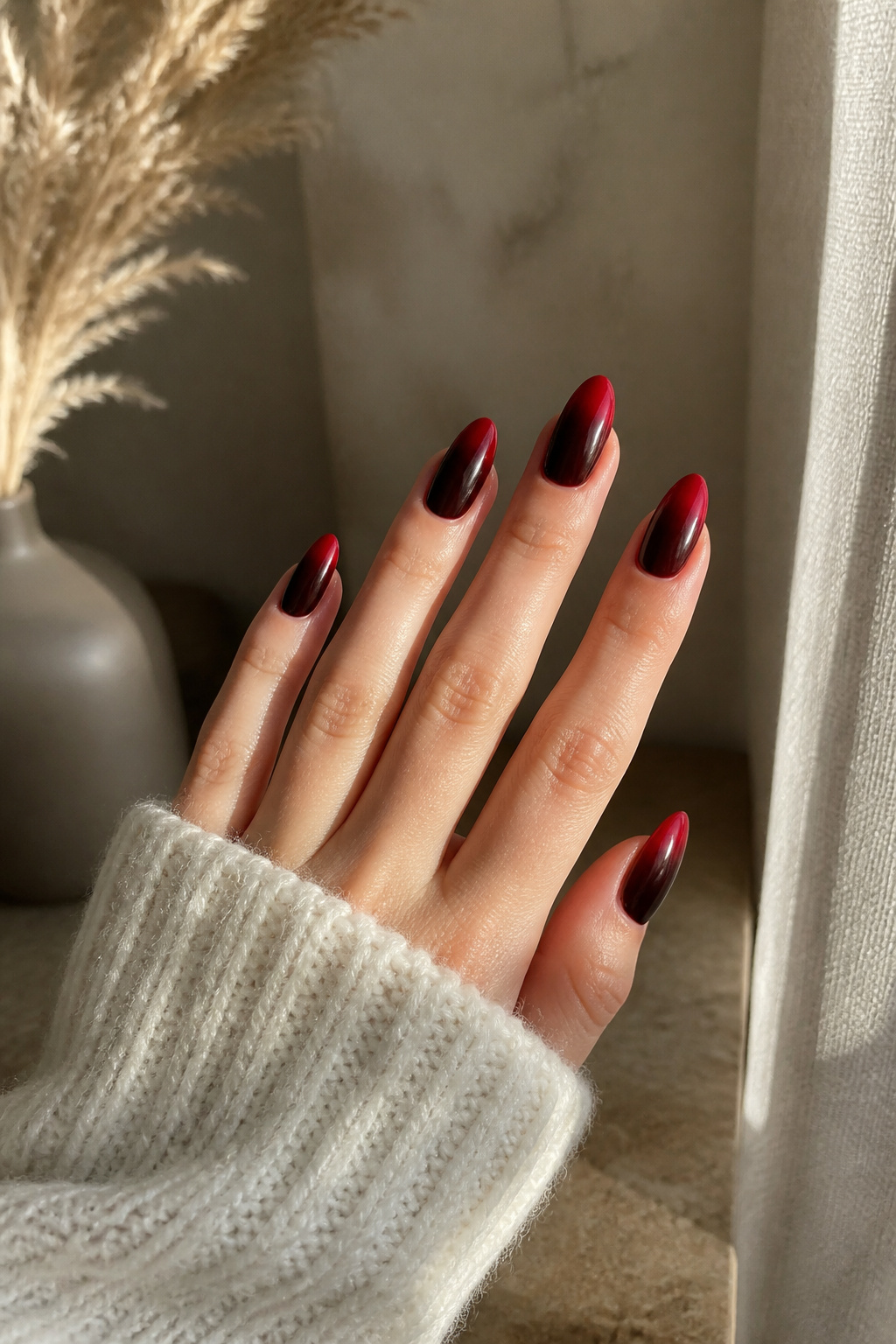
A dark burgundy polish fading into a bright red base gives almond nails a depth that shorter shapes rarely achieve. The longer taper creates the runway needed for a nail art sponge to lay down smooth, uninterrupted gradients without the color blocking you get on squarer tips. I have watched the same ombre technique look patchy on a short round nail and seamless on an almond shape, and the difference is entirely that extra millimeter of blending surface.
For a softer take, the red-to-pink transition follows the same logic: the extended free edge lets the two tones meet gradually rather than collide. The almond shape buys you enough room to correct a heavy hand mid-sponge, which is why this is the shape I’d pick for a first attempt at any gradient red. Mismatched French tips paired with subtle ombre accents also sit better on almond nails, since the tapered point gives each design element its own territory instead of crowding the same visual space.
Silver Chrome Almond Nails
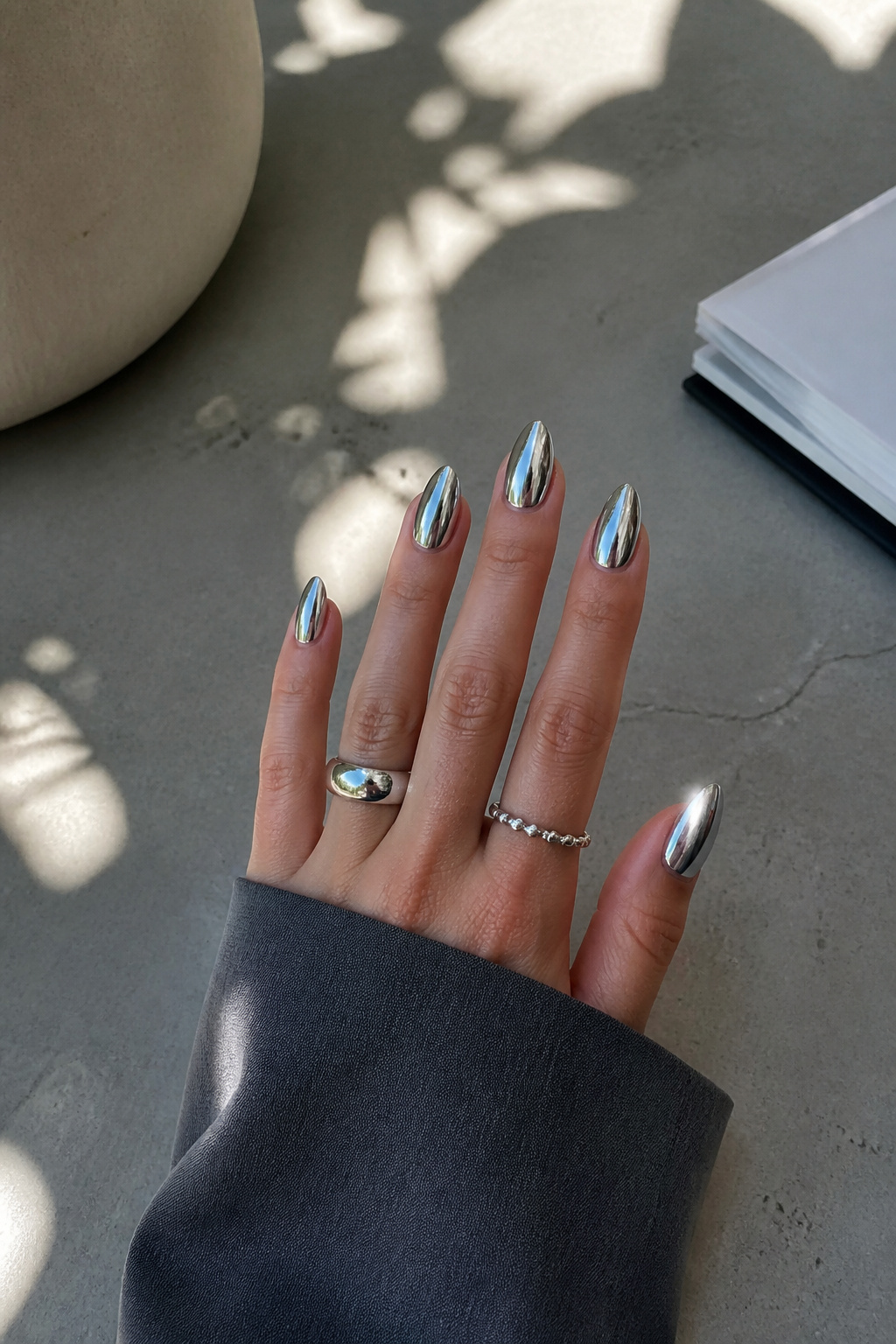
A full silver chrome finish on an almond shape reads differently than it does on a square nail. The elongated taper catches light along a continuous slope, so the mirror effect travels with your hand movement rather than flashing flat from a blunt edge. That slope is what makes this look feel futuristic rather than simply metallic.
The application starts with black gel polish as a base, with silver chrome powder buffed over it to create the true liquid-mirror surface. The result is closer to wearing a piece of high-shine jewelry than a traditional nail color, and the almond silhouette keeps it from looking industrial.
Visible regrowth is the main maintenance issue here. Because the chrome sits on a dark base, any new nail growth at the cuticle creates a stark line that breaks the seamless mirror effect. On an almond shape, that line follows the narrower taper and can appear more pronounced than it would on a wider square nail. Plan for fills every two weeks if you want to keep the finish intact, or treat this as a short-term look for a specific event rather than an everyday manicure.
Almond Nails with Metallic Star Designs
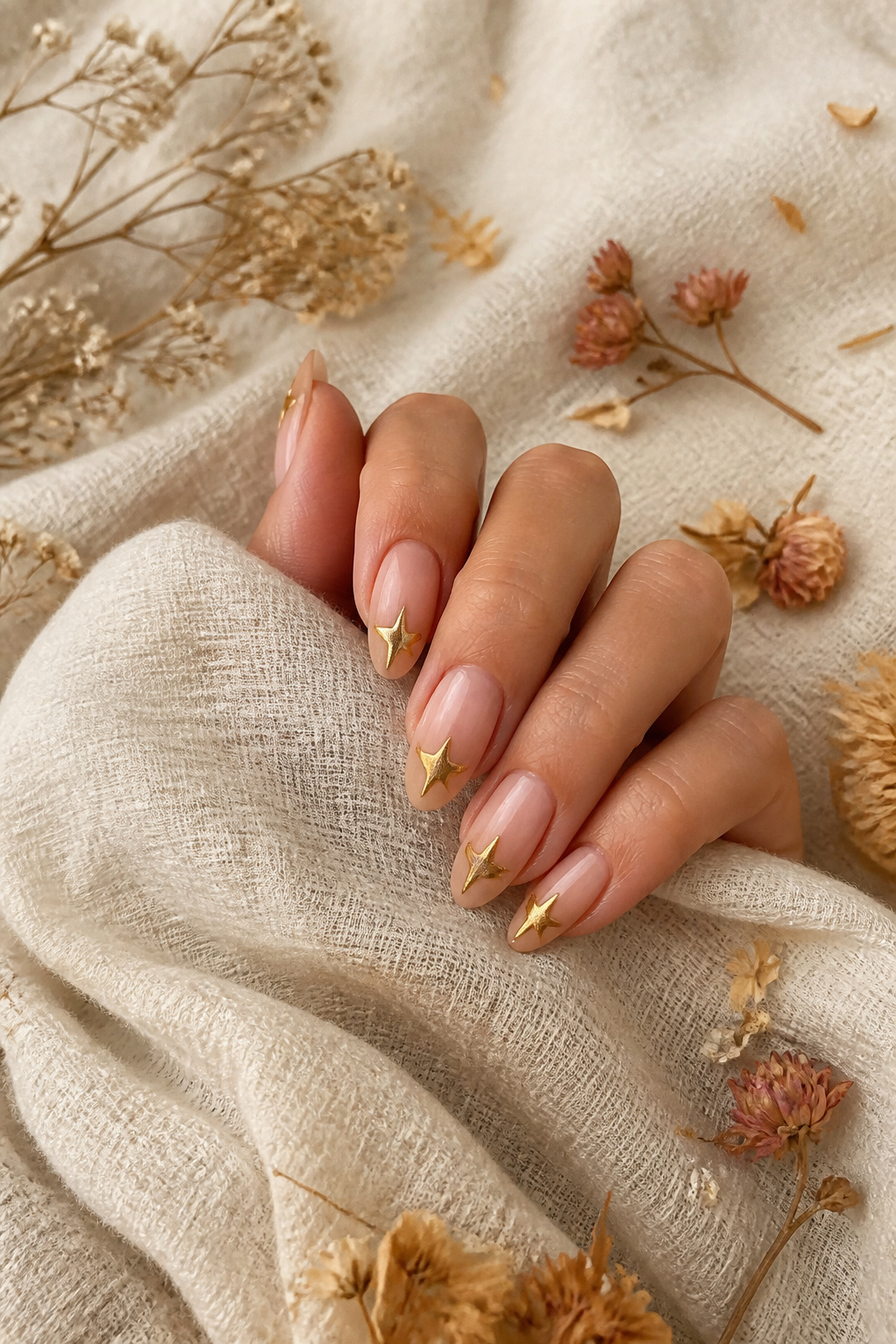
Metallic star accents read as playful on a square nail, but the almond taper gives them a direction. Silver or gold stars placed toward the point draw the eye along the length the shape already created, which flatters the finger rather than cluttering it. The geometry matters: three small stars clustered near the tip land better than a scattered field of larger ones that fight the narrowing line.
Application splits into two workable paths. Foil stars, pressed on with a silicone tool, give the cleanest edges and the truest mirror finish; they also sit flat, so they survive the taper without catching. Hand-painted stars with a fine liner brush and metallic gel offer more control over placement and scale, though the chrome pigment tends to streak if the coat is too thick. Thin to win, as they say in the shop.
A neutral base, something close to bare nail or soft pink, keeps the look from tipping into costume territory. The bold chrome needs the restraint. For an evening out, the contrast reads intentional; for daily wear, it can feel like one detail too many unless the stars stay small and the placement stays tight to that upper third.
Iridescent Almond Manicure
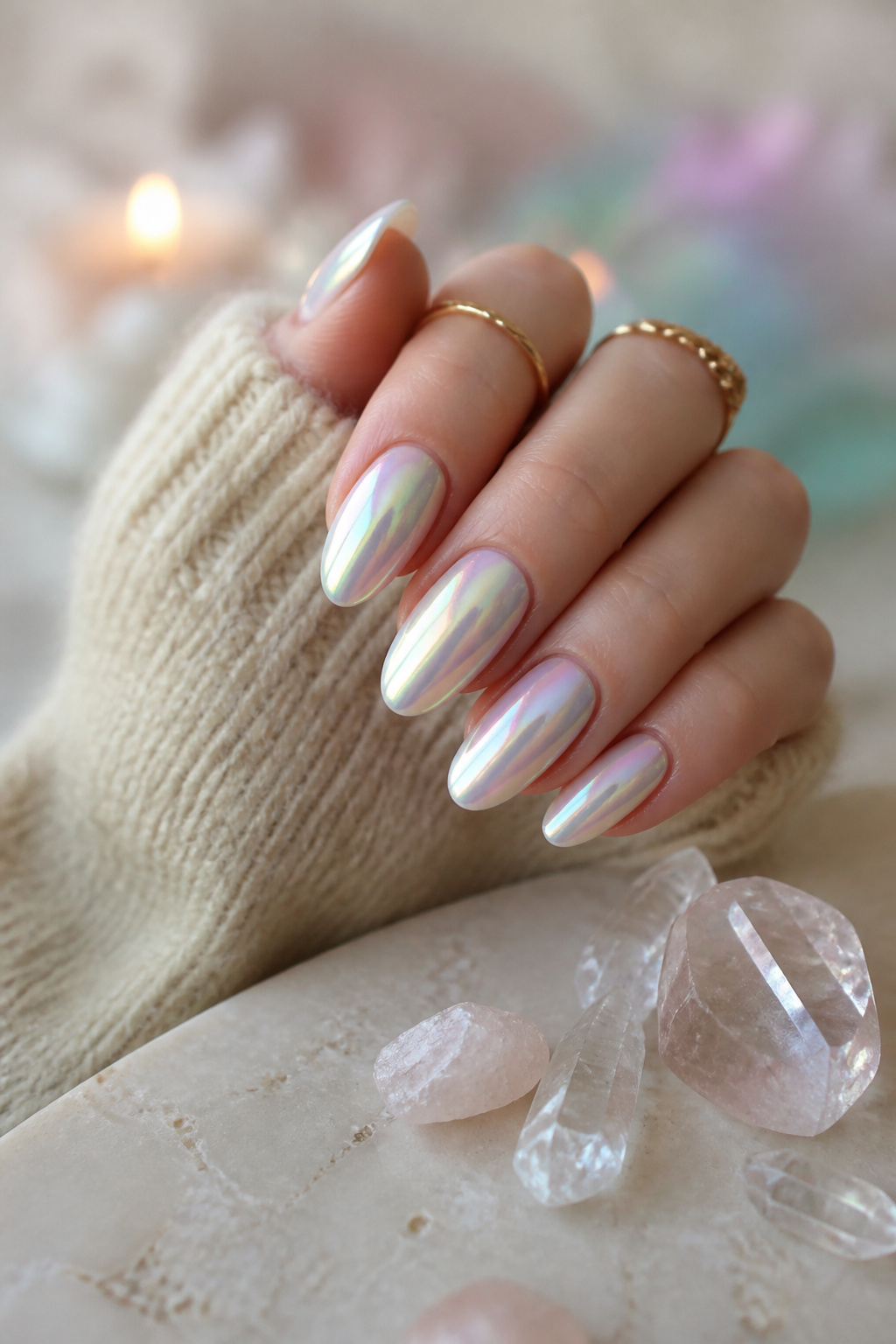
Oil-slick chrome, pearl glaze, and unicorn powder each do something different on an almond nail, and the shape itself is why they work at all. The curved surface catches light at angles a square edge would miss, while the tapered length gives the eye a runway to follow as the color travels from cuticle to tip.
An oil-slick finish reads darkest, shifting between petrol blue, burnt copper, and moss green depending on how you hold your hand. The effect needs a black or deep navy base; anything lighter and the interference pigments scatter too thin to read as dimensional. Pearl glaze is the softer option, a sheer luminous layer that catches light without shouting. It pairs with iridescent decals placed one or two per nail, enough to break up the surface without turning the whole hand into costume. Unicorn powder sits between the two, more concentrated than pearl but less theatrical than oil-slick. Lavender bases make it feel ethereal; soft silver keeps it closer to the glazed-donut neutrals that still dominate most office settings.
The common mistake is treating these finishes like topcoats over bright colors. A visible shift demands a muted foundation, either deep enough to create contrast or sheer enough to let the interference pigment do the work alone. On short almond shapes the effect compresses, so the tapered length matters; without enough nail to travel across, the color shift lands as glitter rather than movement.
Gold Chrome Almond French Manicure
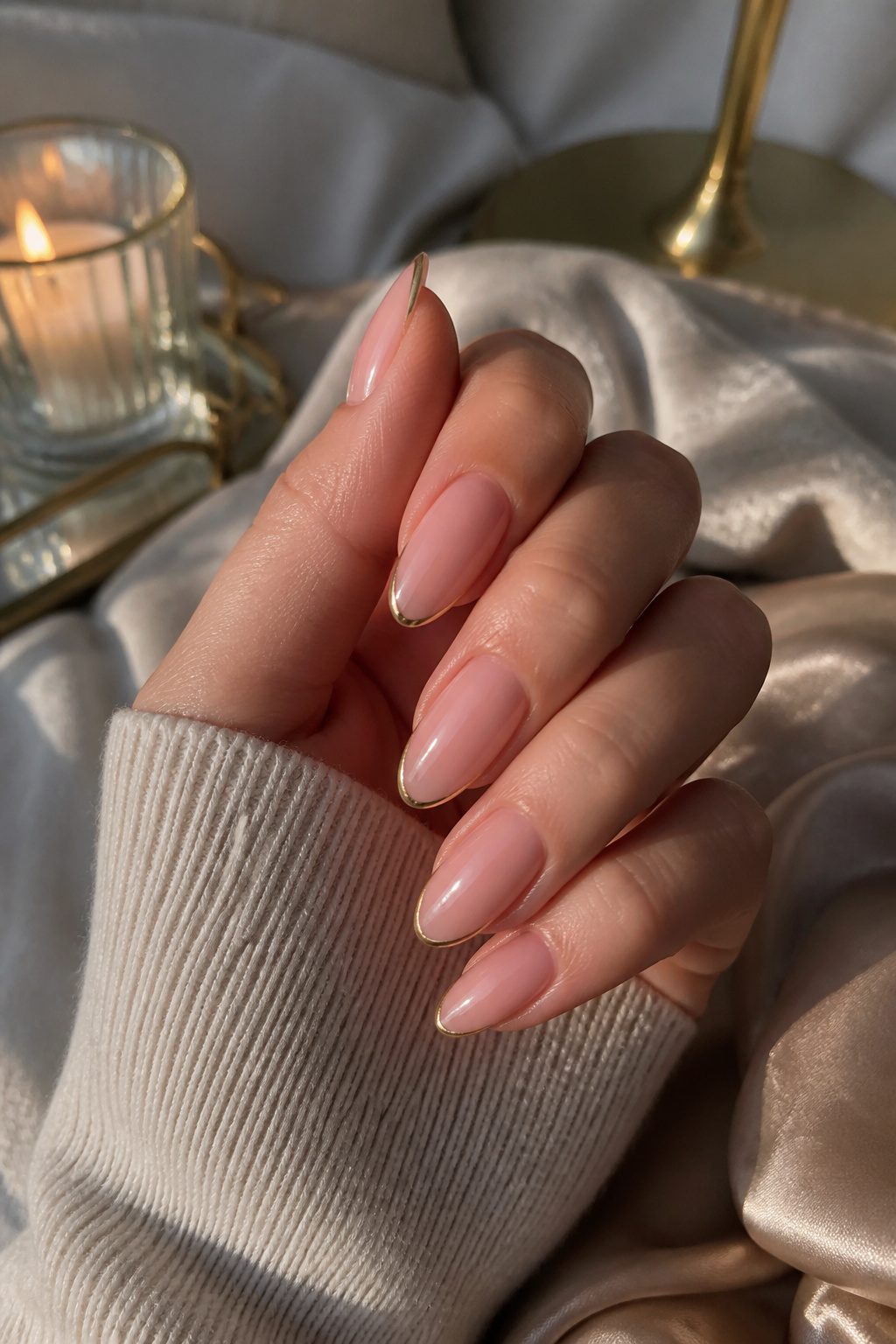
The gold micro-French on almond nails works because the taper does the visual work for you. A standard French tip width, about one-fifth of the free edge, looks heavy on an almond shape. The narrowing silhouette already draws the eye upward; a thick gold band fights that line instead of following it. What reads as elegant is a thin rim, almost a wire of metallic gold, sitting at the very tip.
A milky or sheer pink base keeps the look from tipping into costume territory. The gold itself should read as brushed or softly reflective rather than mirror-bright; the almond length gives you enough real estate that the metal catches light at the edges without needing to shout. Ask for the micro width specifically, or bring a photo that shows the line at roughly one-tenth of the nail end rather than the classic quarter.
The shape also changes how you wear it. Almond nails taper more dramatically than square or coffin, so the gold band appears to float rather than cap the nail. That is the effect you are paying for, and a thinner line preserves it.
Micro French Tip Almond Nails
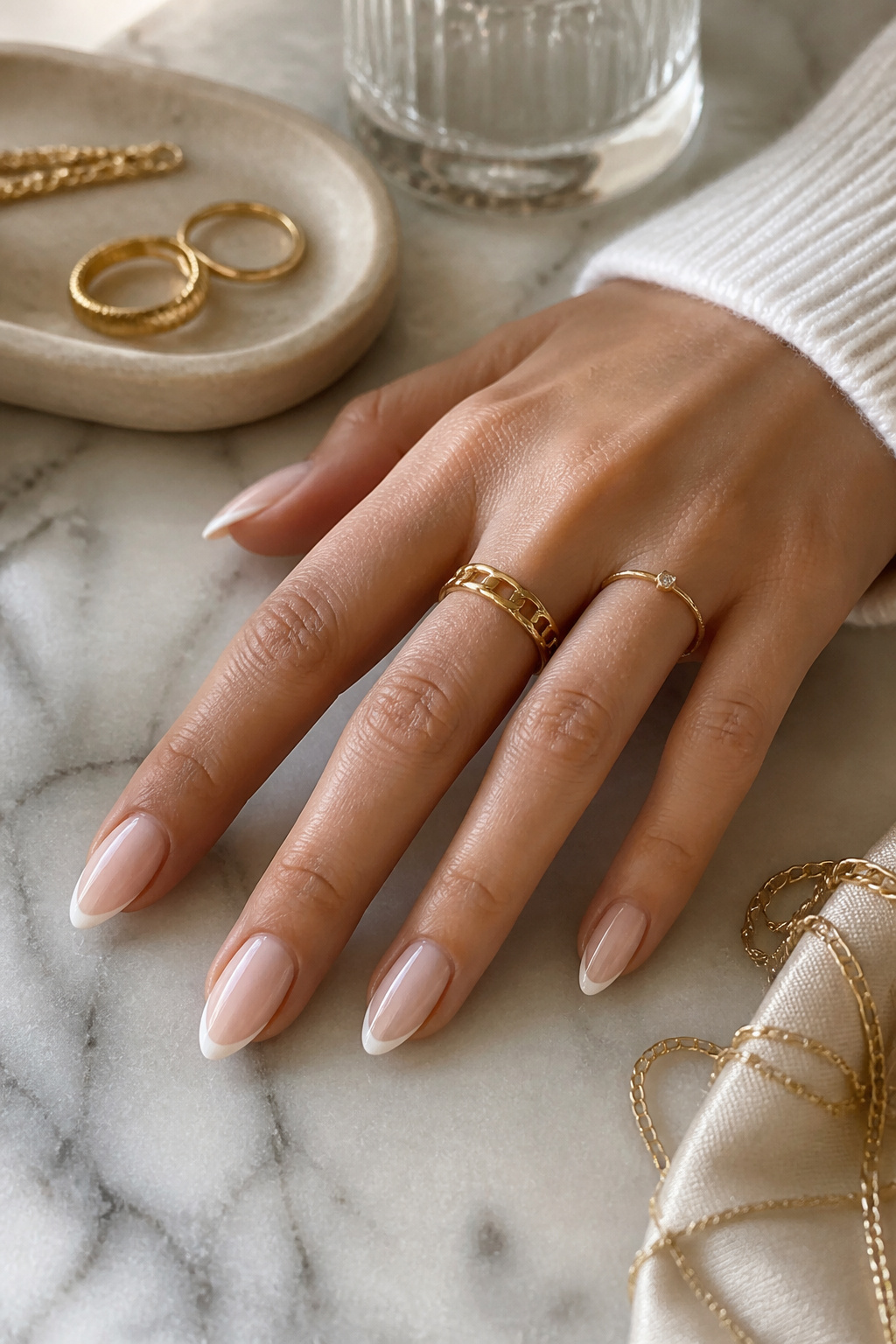
The ultra-thin line French manicure has become the default update for 2026, and on an almond shape it reads as intentional rather than apologetic. The natural taper of the nail gives that 1–2 millimeter tip a built-in curve; the line follows the silhouette instead of fighting it. A classic French band can look heavy here, like hardware bolted onto something delicate. The micro version lets the almond do the work.
What convinced me, looking through dozens of these, is the exaggeration effect. The tapered length stretches the thin line visually, so the smaller the tip, the longer the nail appears. It is the same logic that makes a slim belt lengthen a torso. For anyone loyal to the French manicure but bored by it, this is the single easiest pivot: same palette, different proportion.
Spotted French Tip Almond Nail Designs
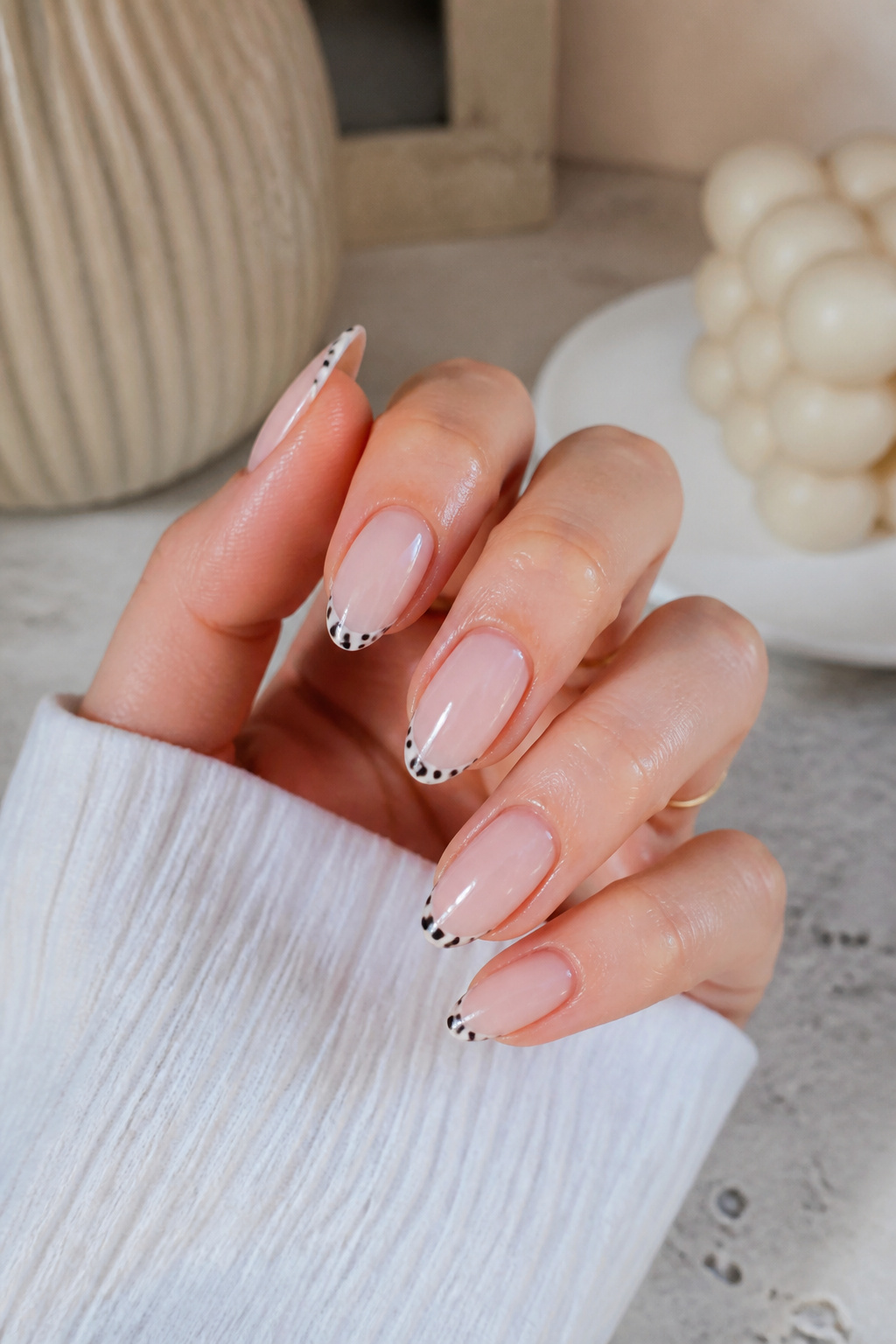
Dalmatian spots on a micro French line read as deliberate, not messy, because the almond shape gives the pattern room to breathe. The narrow tip keeps the spotted zone small; spots either track that thin curved border or scatter a millimeter below it into the sheer pink or nude base. A round nail would crowd the same dots toward the center and look spotted all over, but the almond point pulls the eye upward and contains the playfulness to one end.
I tried picturing this on a square nail and the spots immediately felt like a print job gone wrong. The almond taper does the editing for you. For placement, a dotting tool or the rounded end of a bobby pin works; press once, lift straight up, vary the spacing slightly so no two spots mirror each other. A matte top coat over the spots keeps them chalky and graphic, while gloss makes them read more like actual animal print. Either way, the base stays clean. That is the whole point of the micro French: the line is so thin that even five or six irregular dots do not overwhelm it.
Almond Nail Shape
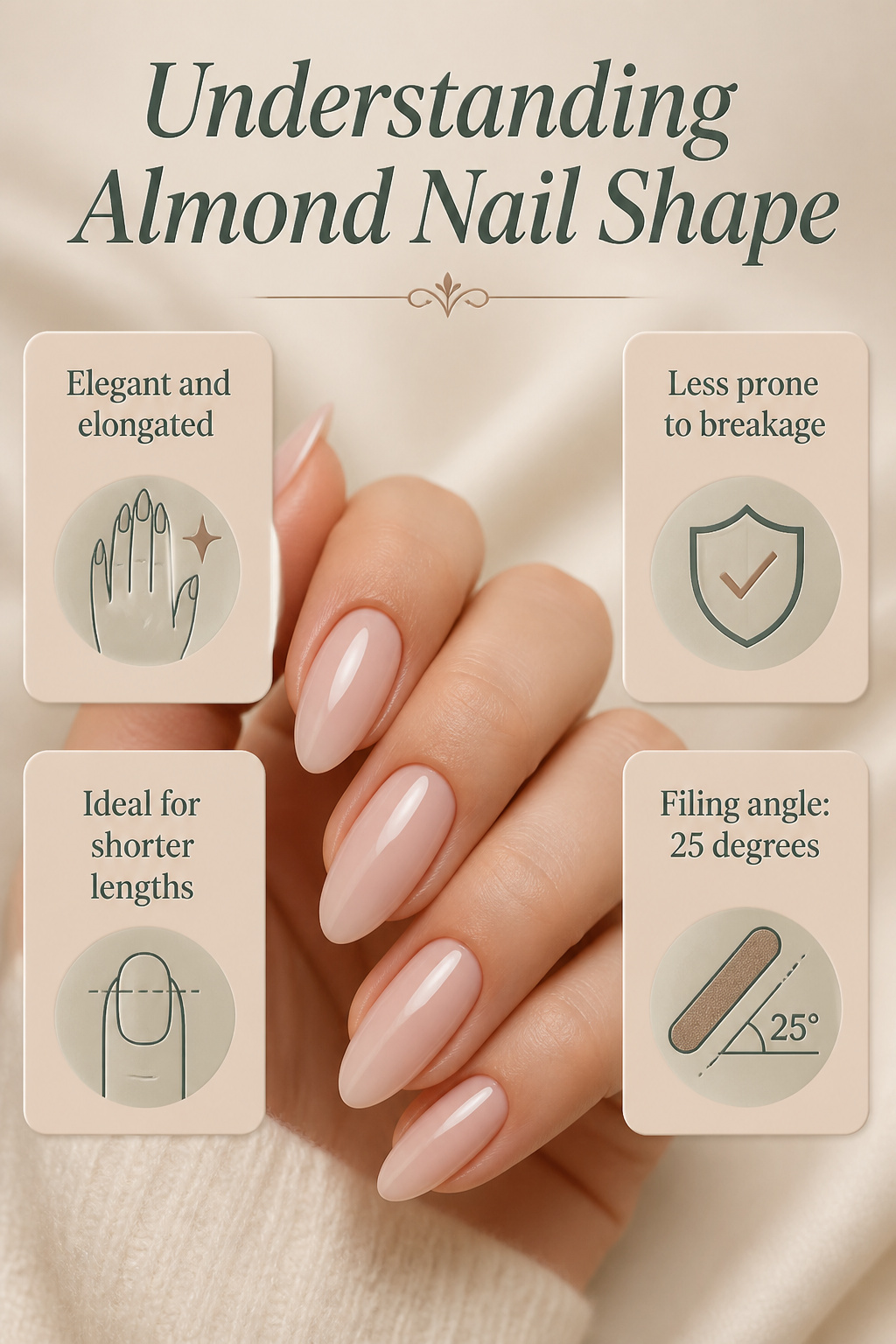
An almond nail tapers to a slim, rounded point, narrower than a square or coffin shape but softer than a stiletto. The resemblance to the nut itself is unmistakable once you look for it, and that gentle point is what gives the shape its elongating effect on the fingers.
Celebrity manicurists keep returning to this shape for the same reason clients do. Tom Bachik, who works with supermodels and red-carpet regulars, calls it his favorite overall because it creates an elegant, elongated feel without demanding impossible length. Georgia Rae, the artist behind Sofia Richie Grainge’s wedding set, notes that when shaped correctly, almond nails give the illusion of a longer nail bed. The corners also catch and break less often than a squared-off nail, which makes the shape more wearable day-to-day.
What distinguishes almond nails from a true trend is this practicality. A stiletto makes a statement but limits your typing; a square can snag on fabric. Almond splits the difference, and that balance lets it resurface every few seasons rather than disappearing. It works on natural nails at a shorter "baby almond" length or on gel extensions if you want more drama. Press-on brands stock it heavily for the same reason: you do not need to grow your own nails to test the look.
The filing angle matters. Sources suggest roughly 25 degrees at the tip to get the taper right without overshooting into stiletto territory. From there, the shape accepts almost any finish, which is why you will see it carrying French tips, chrome, ombré, and minimal art with equal success.
Trending Colors and Designs
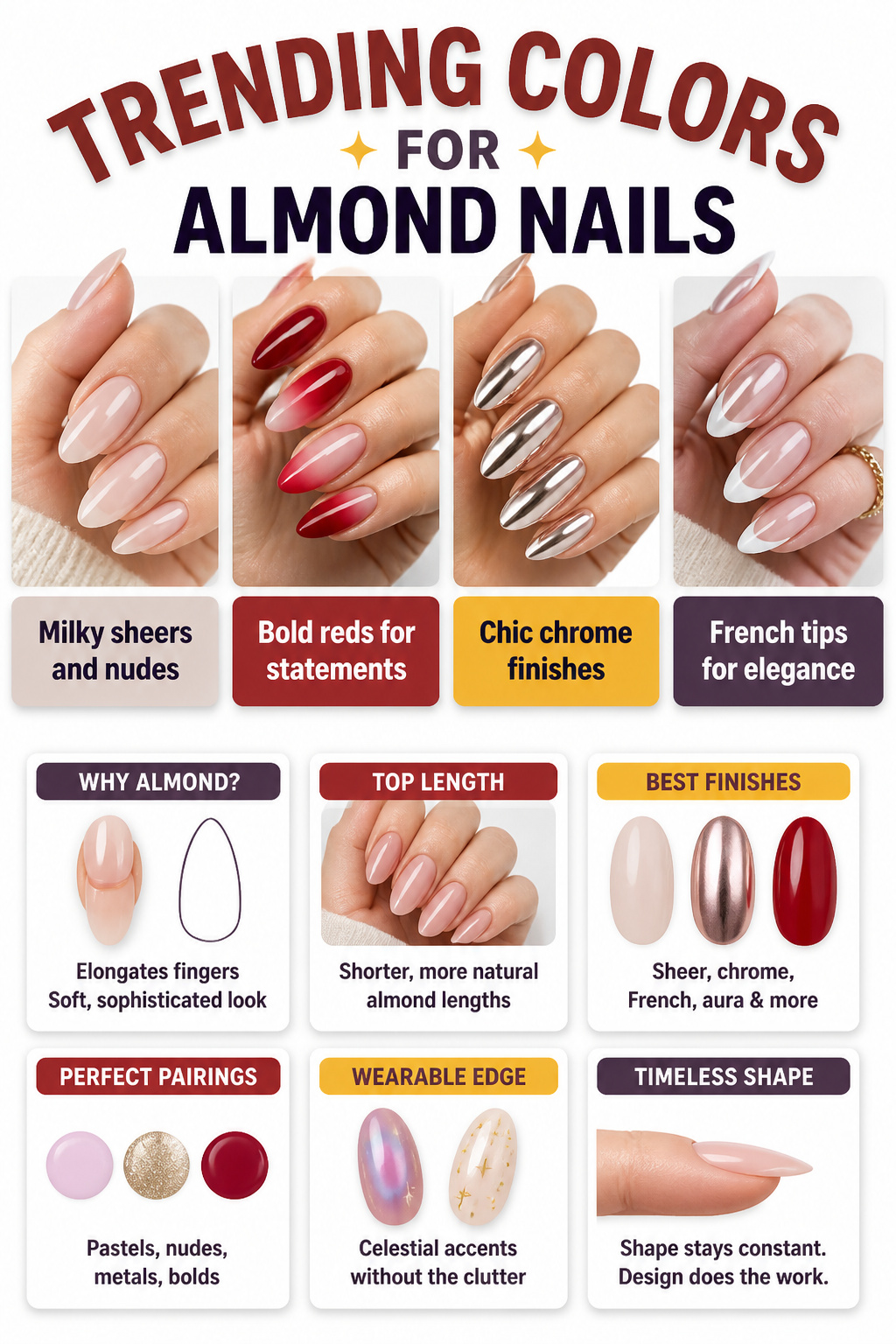
Milky sheers and nude bases are the quiet foundation most almond manicures start from now. The cloudlike, slip-for-your-nails quality of a sheer milky shade reads as polished without trying, and the elongated taper of the almond shape gives that neutrality somewhere to go. Pastels sit comfortably on the same base, though they read more deliberately; the shape softens them enough that they do not turn juvenile.
Bold reds have shifted from classic to statement, especially with dimensional or ombre work that uses the almond length as a runway for the color transition. Chrome and metallic finishes are the defining look of 2026, and this is where the almond shape earns its keep: the taper catches light along the entire edge, turning a simple chrome powder application into something that moves when your hands do. French tips pair best with the elongated almond design, lending a naturally elegant finish, and the current versions run from traditional to micro-thin lines that read as architecture more than accent. Aura effects and celestial accents, dots or swirls topped with chrome, are the playful end of the spectrum, and the almond canvas keeps them from looking cluttered. The shorter, more natural almond lengths coming in this year keep all of these wearable; the shape stays constant, but the design does the work of making it fresh.
Application Techniques
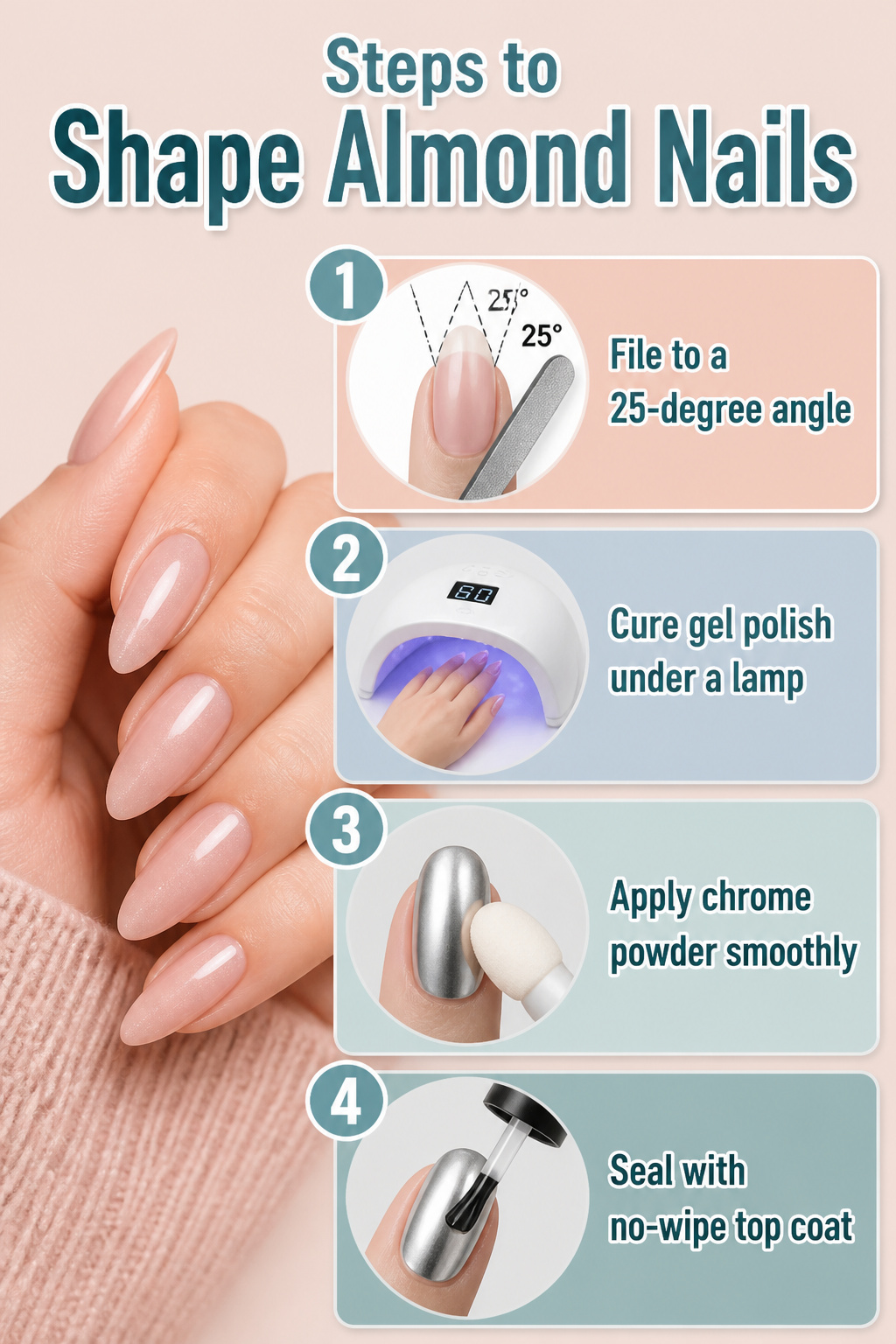
Shaping natural nails to almond takes a 25-degree angle at the tip, filing inward from each side until the free edge tapers without going sharp. My own nails split when I take them too narrow, so I stop while the center still has a little width; press-on sets skip that gamble entirely, and several of the chrome looks I liked came that way.
Gel polish needs curing under a lamp, usually 30 to 60 seconds per coat depending on the brand’s instructions. Chrome powder goes on after that base is fully set: rub it over the tacky inhibition layer with a silicone tool or a gloved finger until the surface turns mirror-smooth. A no-wipe top coat seals it. For home attempts, a fine liner brush and a dotting tool cover most of the art you see trending; French tips, in particular, are just a steady hand and a guide sticker.
Salon work earns its cost once you want red chrome or silver chrome over black gel, because the powder shows every bump in the base coat. I have watched my own DIY chrome turn streaky where the lamp did not cure evenly, and fixing that means starting over. If the design needs built-up gel or hand-painted detail, the appointment price stops feeling optional.
Short Almond Nails
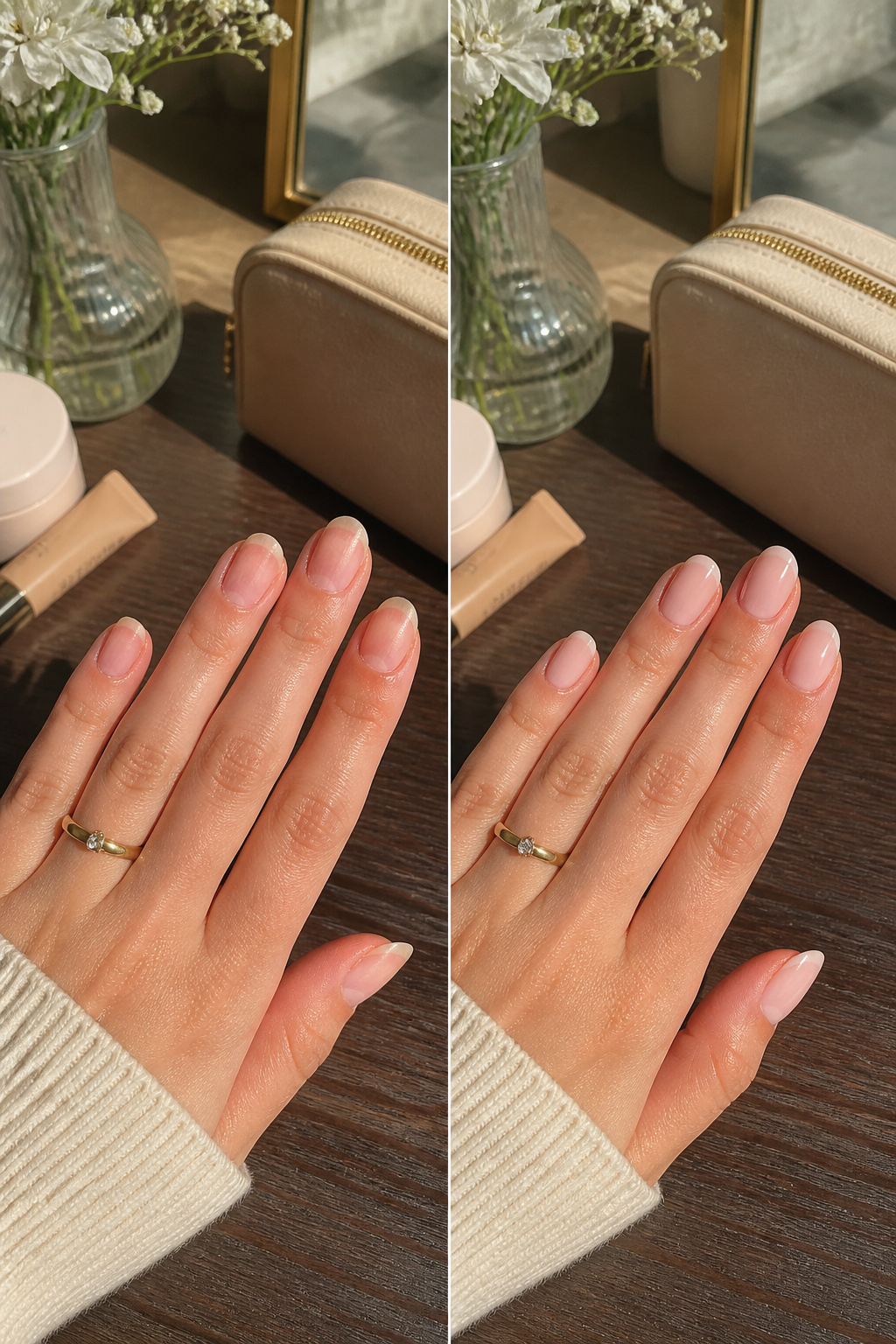
Short almond nails keep the taper close to the fingertip, usually ending just past the free edge with a rounded point that elongates the finger without catching on keyboards or pockets. Celebrity nail artist Elle Gerstein calls this shape the "quiet luxury of nail shapes" because it forces intention: you cannot hide behind length, so proportion and finish carry the whole look. Precision matters more than drama here.
The 2026 trends that translate best to short almond are milky sheers, neutral chrome, and classic reds. A short almond in deep burgundy or bright cherry reads confident rather than flashy because the shape itself supplies the elegance. Fine-tipped French designs and subtle metallic accents also work, since they draw the eye to the nail’s architecture rather than its span. Jelly nails with cloud decals fit this canvas too, though the translucent effect needs a clean natural base to look deliberate rather than accidental.
What short almond cannot sell is anything that requires vertical real estate to read correctly. Elaborate 3D appliqués, heavy gradient fades, or large-scale nail art tend to crowd the surface and look busy instead of expensive. The same goes for bold color-blocking that depends on length to create negative space between hues. On short almond, one well-placed detail beats several competing ones.
Nail Art for Beginners
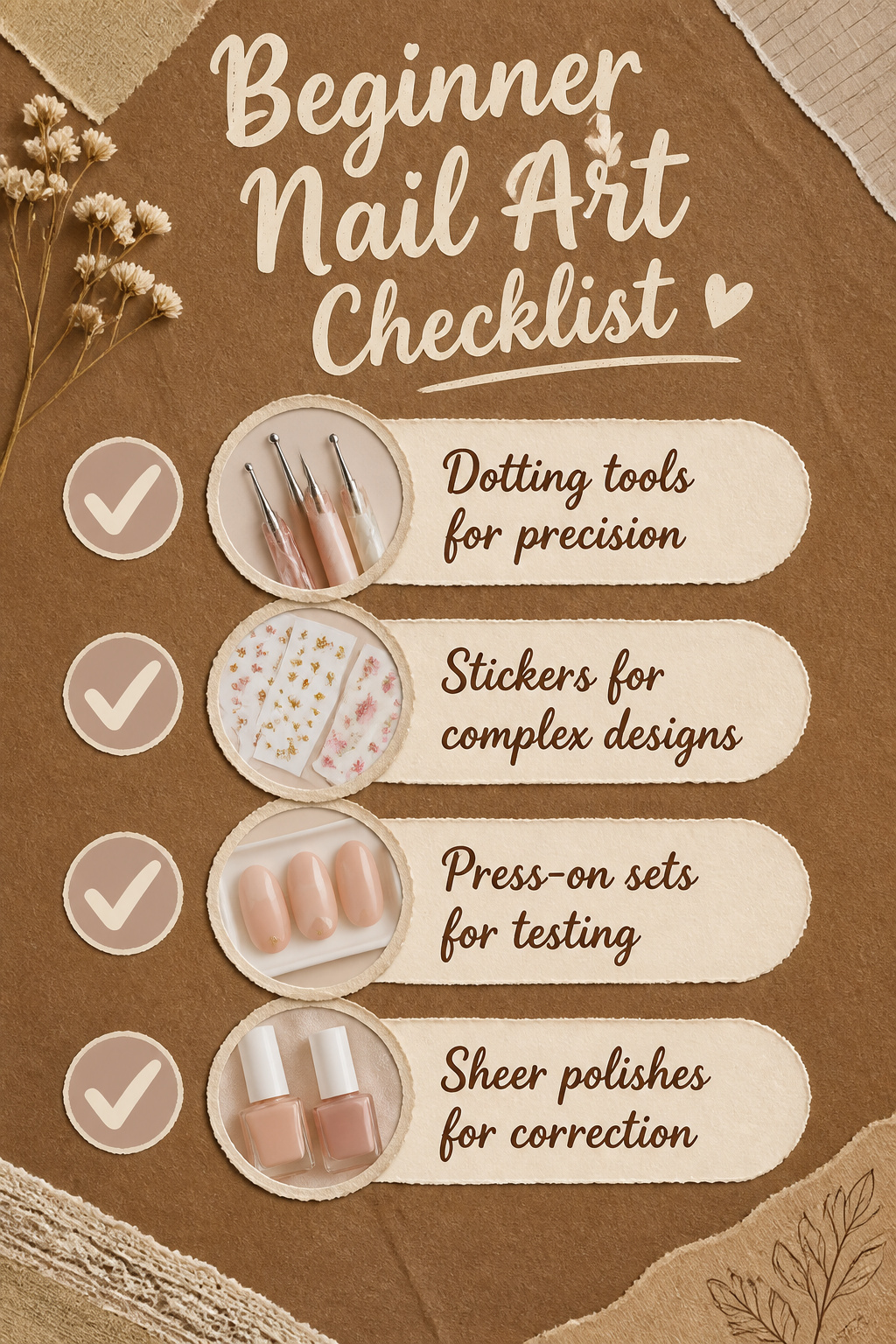
Dotting tools turn out to be the safest first purchase for anyone nervous about freehand work on an almond shape. The rounded tip follows the curve of the nail bed, and a single dot of contrasting color near the cuticle line reads as intentional rather than messy. Stickers and water decals fill the gap when you want something complex, like a half-moon or a thin stripe, without the steady hand that hand-painting demands. Press-on sets in almond shapes let you test the look for a full week before you commit to filing your natural nails into that tapered silhouette, which matters because the almond grows out awkwardly if your nail beds are naturally wide. Sheer polishes with forgiving formulas, the kind that streak less on uneven application, cover beginner mistakes that opaque colors announce immediately. Starting with artificial tips also teaches you what length actually works for your typing and your pockets before the shape is permanent.
Frequently Asked Questions
Are almond nails still trending?
Yes, almond nails have moved from a passing trend to a permanent mainstay. In 2026 they are paired with shorter, more natural lengths and designs like milky sheers, neutral chrome, and statement French tips. The shape stays constant while the design keeps the look current.
What colors look best on almond-shaped nails?
Timeless classics like neutrals, sheer pinks, and wine tones work universally, and bold shades like red or dark chocolate brown also suit the shape well. Milky shades with a hint of pink, beige, or peach beneath the white flatter most skin tones and create a lengthening effect.
How do I achieve almond nails at home?
File natural nails at about a 25-degree angle on each side to create the tapered tip, or use press-on nails that arrive already shaped. Press-ons solve the shaping problem entirely and let the color sit exactly where it should without a steady filing hand.